Answer first
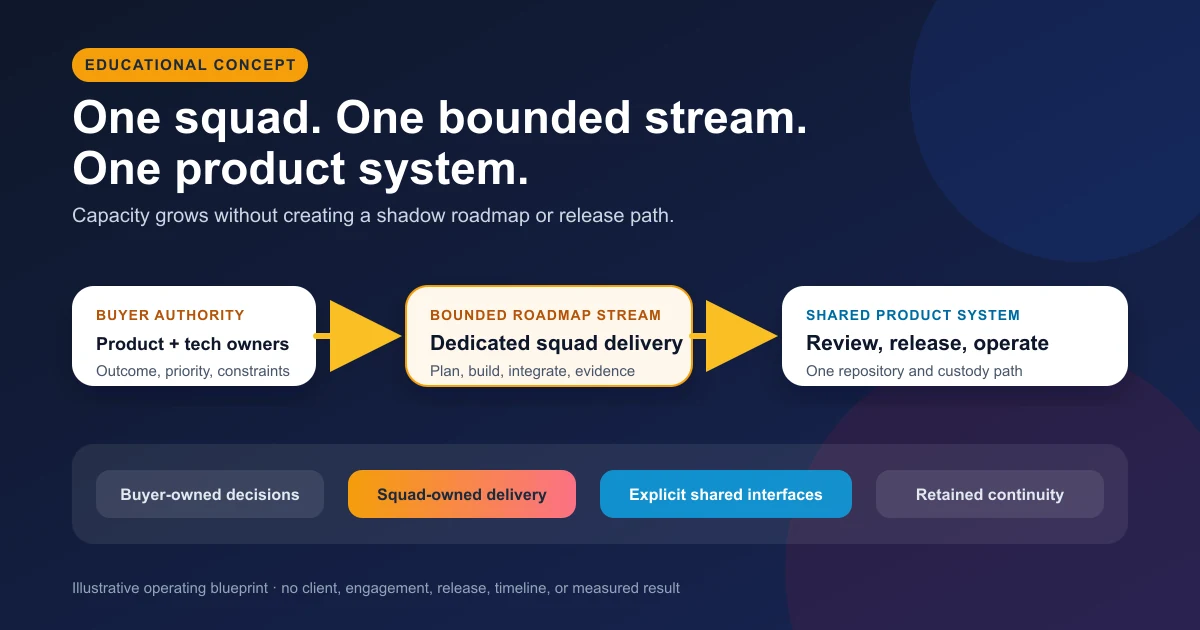
A dedicated squad works best as one bounded roadmap stream inside the buyer's product system—not as a second company with its own priorities, architecture, and release rules.
Start with one product outcome, one accountable product owner, a clear technical boundary, and a thin end-to-end slice that can be integrated and released through the existing delivery path. Give the squad room to plan and execute inside that boundary while keeping business priority, platform constraints, and production custody explicit.
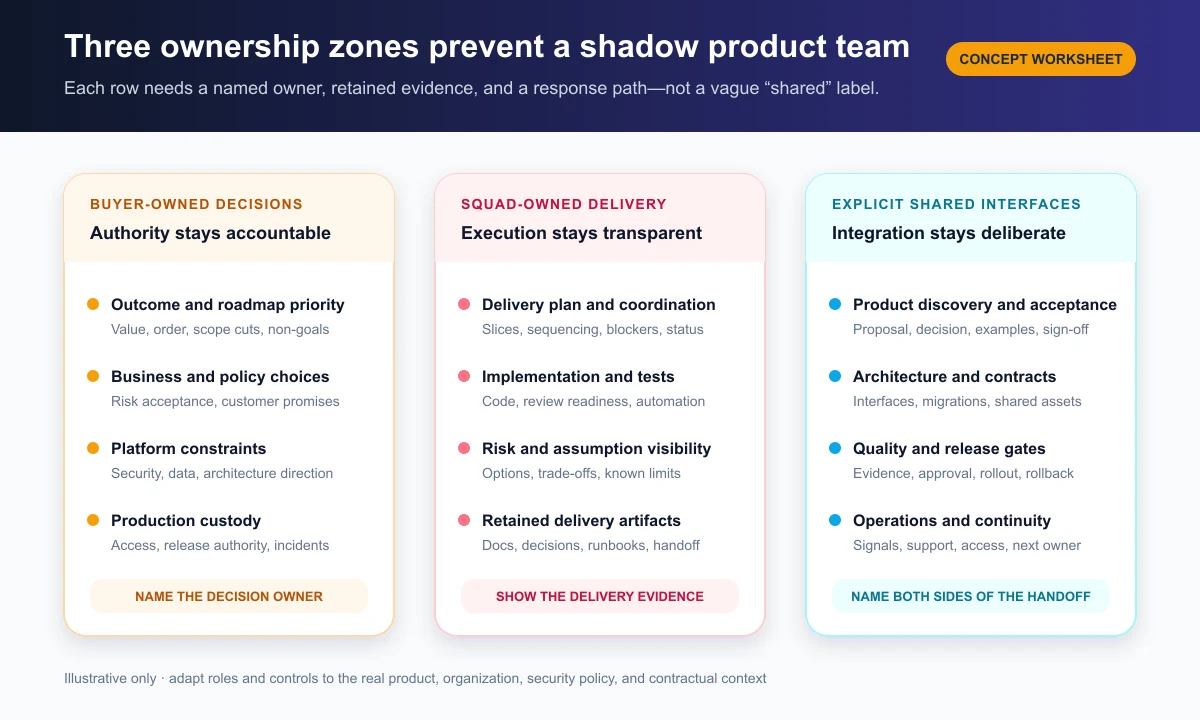
The smallest useful operating model has three ownership zones: buyer-owned decisions, squad-owned delivery, and shared interfaces with a named proposal owner, decision owner, evidence, and response time. That boundary matters more than the number of developers or a promise of additional velocity.
Illustrative discovery conversation — not a client quotation
“Take a feature area and move independently” becomes workable only after product authority, technical interfaces, release custody, and continuity are named.
Product leader
“Our roadmap is growing faster than the internal team. Can a dedicated squad take a feature area and move independently?”
Leeonex
“Which outcome can be bounded, who still decides priority, and where will that stream touch shared data, architecture, design, release, and support?”
Product leader
“We can keep one product owner and technical owner, but we cannot coordinate every ticket or absorb a separate release process.”
Leeonex
“Then the first scope is one vertical roadmap stream inside your delivery system: explicit interfaces, a small integration slice, shared quality gates, and continuity evidence from the start.”
This is Leeonex-authored teaching material. It represents no real buyer, product, team, supplier, quotation, repository, delivery engagement, release, handoff, or result.
Starting situation and buyer
This concept is for leaders who need durable capacity, not a larger coordination problem.
The intended buyer is a product leader, engineering leader, founder, or agency delivery owner with an active product and a roadmap stream that repeatedly loses priority. The internal team may be protecting the platform, supporting customers, handling incidents, and delivering the core roadmap while an adjacent product area waits.
The constraint is rarely engineering headcount alone. Product decisions still need a business owner. Shared services, data, security, design, environments, and release processes cross team boundaries. Internal reviewers have limited time. A supplier may not know why an old constraint exists, and the internal team may not know which assumptions the new squad is making.
Adding a team without defining those interfaces creates two backlogs, two definitions of done, delayed reviews, duplicated platform work, and a handoff problem. The design task is to create enough autonomy for delivery without pretending the stream is independent of the product around it.
Product owner
Owns the outcome, priority, scope cuts, stakeholder decisions, acceptance, and the response time the squad can plan around.
Buyer technical owner
Owns platform constraints, architecture authority, security expectations, shared interfaces, and cross-team technical decisions.
Squad lead
Turns the goal into a delivery plan, coordinates design and engineering, exposes risk, and keeps evidence and unfinished work visible.
Release or operations owner
Owns environment access, release approval, observability, rollback, support routing, and production custody after a change ships.
Core flow
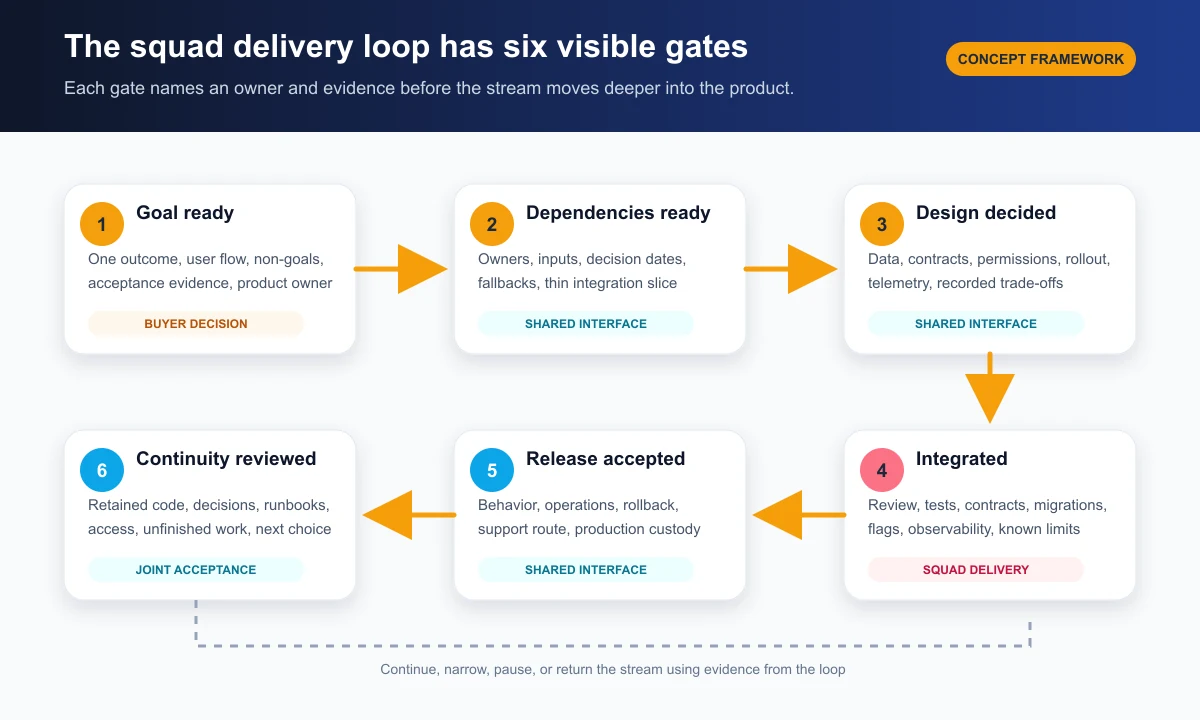
The delivery loop starts with a product goal and ends with releasable work plus retained knowledge.
First, the product owner frames one outcome, the users and workflow affected, the constraint, the non-goals, and the evidence that will support acceptance. The squad and technical owner then map dependencies and choose a thin vertical slice that crosses the real product path without taking on the whole feature area.
Before implementation grows, the relevant interface decisions are recorded: module and data ownership, API or event contracts, permissions, shared UI, migration rules, observability, rollout, and support. The squad builds and tests inside the shared standards, integrates early, and presents decision and quality evidence—not only a visual demo.
Release remains a controlled product event. Acceptance covers behavior, integration, operations, documentation, and rollback. After release or a releasable checkpoint, the team reviews what was learned, what remains risky, and whether the stream should continue, narrow, pause, or return to the core team.
Smallest useful scope
Prove one operating slice before assigning an entire product area.
V1 is not “give the squad the backlog.” It is one outcome-shaped slice with a real user path, a bounded set of interfaces, named decision owners, and the same route to production used by the wider product. The slice should be valuable enough to expose product and technical reality while small enough to review and recover if an assumption is wrong.
Include onboarding to the buyer-controlled repository and tools, a working agreement, architecture and security constraints, dependency owners, a definition of ready, a definition of done, review expectations, integration evidence, release or release-readiness evidence, operational notes, and a continuity check. These are part of the deliverable, not administrative work outside it.
The learning goal is to test the boundary: can decisions arrive in time, can the squad integrate safely, can the internal team review without becoming a ticket dispatcher, and can another qualified team understand and continue the work from retained artifacts?
Architecture and implementation decisions
Optimize for clear interfaces and one delivery system, not supplier-shaped architecture.
The squad should work in the product's agreed source-control, review, build, artifact, environment, and documentation systems. A separate repository or pipeline can be justified by a real security or deployment boundary, but supplier convenience alone is weak architecture. Whatever the repository shape, ownership, versioning, interface tests, dependency updates, and release custody must remain visible.
Define a bounded module or vertical capability with explicit data ownership and contracts. Prefer stable APIs or events over direct access to another team's tables. Record architecture decisions when the squad introduces a dependency, changes a shared schema, creates a migration, or chooses a pattern other teams will need to support.
Integrate continuously where the product allows it. Contract tests, representative integration environments, feature flags, migration rehearsal, compatible rollout steps, telemetry, and a rollback path reduce the cost of discovering interface problems at the end. The squad should see the production signals needed to operate its changes without receiving broader access than its responsibilities require.
Keep design decisions, acceptance examples, code review, automated checks, known limitations, runbooks, release evidence, and unfinished work in durable systems. A recurring continuity review should confirm that access can be removed, another team can build and understand the work, and production ownership is not trapped in private messages or one person's memory.
Risks and guardrails
More capacity amplifies the operating model already in place.
- Keep one prioritized product roadmap and one named buyer-side decision owner. The squad may shape options and scope, but it should not invent business priority in a vacuum.
- Give the squad a bounded outcome and interfaces, not a disconnected ticket queue or an entire platform described only as “move faster.”
- Use buyer-controlled repositories, issue tracking, documentation, environments, artifact storage, and access policies so continuity does not depend on a supplier account.
- Name architecture decisions that the squad may make, decisions that need review, and non-negotiable security, data, design, accessibility, and operations constraints.
- Start with a thin end-to-end integration slice that exercises code review, tests, shared interfaces, environments, release evidence, monitoring, rollback, and support handoff.
- Make dependencies visible before a commitment. Each dependency needs an owner, required input, decision date, fallback, and effect on scope or release.
- Review work where it joins the product: API contracts, shared components, data migrations, feature flags, telemetry, documentation, and operational ownership—not only at a sprint demo.
- Inspect knowledge concentration, access, unfinished work, decision records, runbooks, and a releasable state at regular boundaries so handoff remains an operating property.
Build now, validate later
Ownership, integration, release, and continuity belong in the first slice; squad expansion does not.
Establish the four accountable roles, three ownership zones, one outcome brief, thin vertical slice, dependency map, architecture boundaries, buyer-controlled tools, review and quality standards, six delivery gates, release or release-readiness evidence, observability, support routing, and a continuity check now. These make the engagement operable.
Validate a broader roadmap stream, additional disciplines, multiple workstreams, expanded environment access, direct release authority, platform ownership, on-call participation, and a longer engagement only after the first slice exposes real review, integration, and decision behavior.
Deliberately exclude a supplier-owned shadow roadmap, private source or documentation, independent business prioritization, unreviewed shared-schema changes, production access without a responsibility, and staffing growth used to compensate for missing product or architecture decisions.
Limitations and evidence boundary
This concept proves no delivery speed, release frequency, quality, continuity, cost efficiency, team fit, or business outcome.
No client, product, roadmap, team, contract, repository, architecture, environment, release process, incident history, or delivery baseline was inspected. No squad was staffed or operated. The four roles, six gates, three zones, workflow, architecture choices, guardrails, and diagrams are proposed planning choices, not engagement evidence or contractual advice.
Stronger delivery claims would require an approved engagement record, named responsibilities, scope and change history, access and repository evidence, architecture decisions, review and test records, release evidence, production or release-readiness checks, continuity exercises, known exceptions, and client permission for public wording and visuals.
Any performance claim would also need a pre-agreed baseline and measurement window. Useful definitions might cover time from ready work to release, blocked time by dependency, review delay, escaped defects, change failure, recovery, predictable completion, or handoff readiness. Sources, exclusions, confounding changes, attribution limits, verifier, and approved language would need to be recorded before publication.
Lessons and first consultation
Bring the delivery boundary and decision capacity—not a target headcount alone.
A useful squad brief describes the product outcome, ownership, interfaces, constraints, evidence, and stopping conditions. These inputs make a first consultation concrete:
- The roadmap pressure, desired product outcome, affected users, current team shape, internal leadership time, and why another squad is being considered now
- The product owner, technical owner, release owner, stakeholder decision path, expected response times, and decisions the buyer cannot delegate
- Repository and environment model, architecture boundaries, shared services, data and security constraints, design system, quality gates, release cadence, and support process
- Known dependencies, representative backlog items, current delivery baseline definitions, acceptable evidence, access constraints, continuity needs, and the conditions for expanding, pausing, or ending the stream
Leeonex's dedicated development squad service fits ongoing product streams that need a stable team and explicit shared governance. The staff augmentation versus project outsourcing guide helps decide whether a squad is the right operating model, while the fixed-price versus time-and-materials guide separates delivery ownership from billing mechanics.
Explore the Leeonex case-study hub to compare other evidence types and product decisions. None of these pages guarantees delivery speed, quality, leads, rankings, AI citations, or commercial results.
A problem-aligned next step
Map one roadmap stream before you add another team.
Bring the outcome, owners, interfaces, and release path. Leeonex can help define a squad boundary that fits the product you already operate.