Answer first
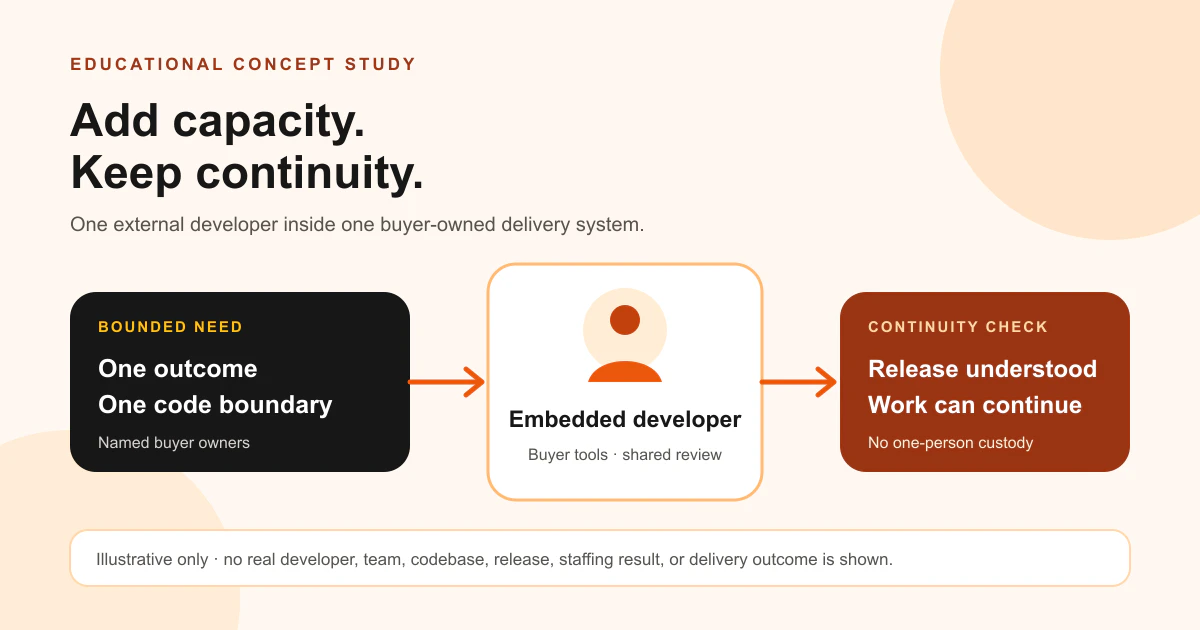
Add an external developer through one buyer-owned contribution lane, then prove both delivery and continuity before widening the backlog.
Staff augmentation is useful when the buyer already owns product direction and delivery, but lacks enough capacity or a needed skill inside that system. The external developer should join the existing tools, standards, review path, and production controls—not create a parallel backlog or supplier-owned island.
The smallest useful start is one bounded production-shaped slice with a product owner, an internal engineering owner, clear access, observable acceptance, and retained artifacts. Readiness is not “accounts created” or “first ticket closed.” It is the ability to make, verify, release or rehearse, diagnose, explain, and hand on a safe change.
Continuity runs in two directions: the developer can navigate the buyer's system without constant translation, and the buyer can understand and continue the work without depending on that one person. If either direction fails, adding more tickets deepens the dependency rather than solving the capacity problem.
Illustrative discovery conversation — not a client quotation
“Take tickets next week” becomes a viable staff augmentation brief only after outcome, ownership, delivery path, and continuity are explicit.
Engineering lead
“We have more ready work than the team can absorb. Can one senior external developer start taking tickets next week?”
Leeonex
“Which outcome is waiting, who owns its product and technical decisions, and what must a developer understand to release and support a change safely?”
Engineering lead
“The internal team owns priority and production. We need contribution inside our stack, but nobody can spend every day translating tickets or reviewing a separate codebase.”
Leeonex
“Then start with one bounded contribution lane, a paired internal owner, and a production-shaped slice that proves context, review, release, and continuity before the backlog widens.”
This is Leeonex-authored teaching material. It represents no real buyer, developer, client, team, role request, repository, ticket, engagement, production change, quotation, or outcome.
Starting situation and buyer
The buyer needs capacity inside a functioning delivery system—not outsourced product ownership.
This concept is for a product or engineering leader, startup founder, or agency delivery owner whose team has more approved work than it can absorb, a temporary coverage gap, or a specialist need that does not justify a permanent hire yet. The roadmap and priorities exist. The constraint is completing good work without overloading the people who already own the product.
The common mistake is to describe the need as a technology list and a number of hours. That omits the code boundary, product context, decision owners, review capacity, production access, evidence of done, and the knowledge that must remain after the engagement changes. A technically capable developer can still be blocked—or create fragile work—inside an undefined lane.
Staff augmentation is a poor fit when nobody can set priority, explain the product, review important decisions, or own production. In that situation, a focused discovery, bounded project, dedicated squad, rescue review, or internal leadership decision may fit better. The goal is not to force every capacity problem into the same commercial model.
Product decision owner
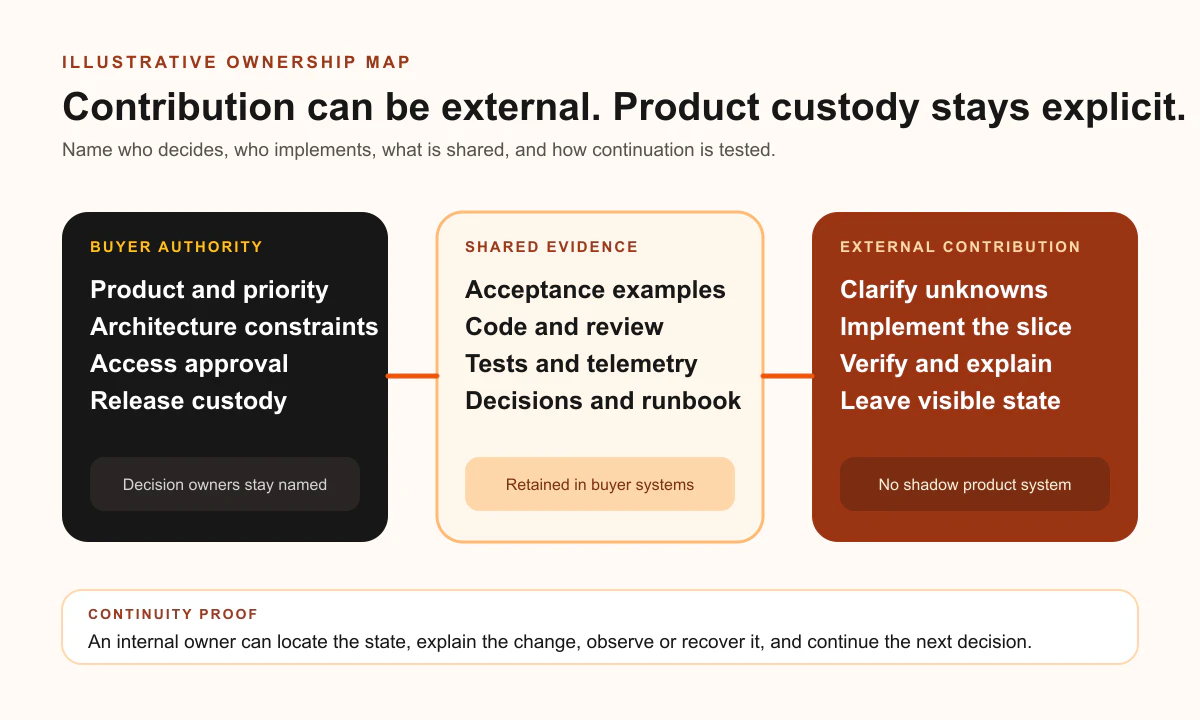
Defines the user or business outcome, sets priority, answers scope questions, accepts the result, and decides what should not enter the lane.
Internal engineering owner
Owns architecture constraints, access approvals, review expectations, production custody, and the ability to continue the work internally.
Embedded developer
Implements inside the buyer's workflow, raises missing context, records decisions, participates in review, and leaves the slice understandable and operable.
Release or operations owner
Confirms environment, observability, rollout, rollback, incident routing, and the evidence needed before a change reaches production.
Core contribution flow
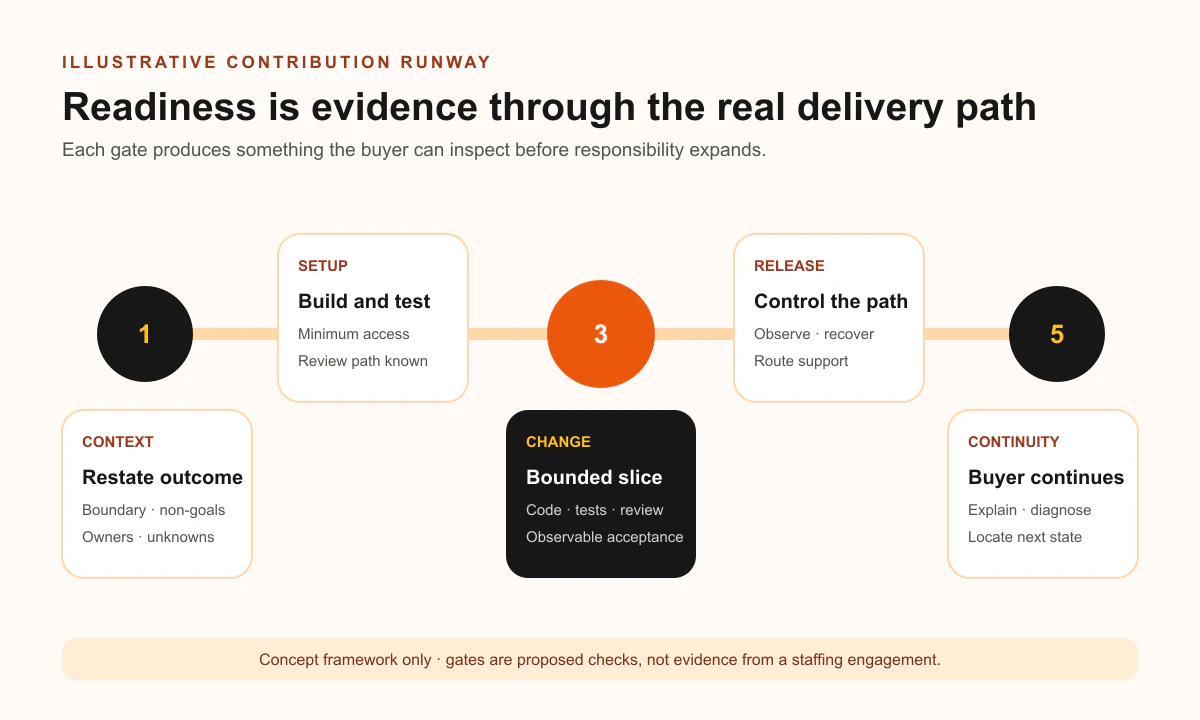
Move from context to a bounded change, controlled release, and buyer-side continuation.
First, frame the capacity gap as one outcome: the user or operational problem, why it matters now, which code or workflow is in scope, what stays outside it, and who can answer product and engineering questions. The developer should be able to restate the boundary and identify unknowns before implementation begins.
Next, establish the minimum access and working environment needed for that lane. Use organization-owned identities, repositories, issue tracking, documentation, test data, environments, and communication. Verify local build, relevant tests, review rules, secrets handling, architecture constraints, and escalation paths through evidence rather than a list of links.
The first change should be real enough to cross product context, implementation, tests, review, staging or an equivalent environment, acceptance, telemetry, and release or release rehearsal. It should be small enough to inspect and reverse. A cosmetic chore teaches little; a critical migration creates too much blast radius for an unproven path.
Finally, capture the decision, behavior, tests, operating notes, known limitations, and follow-up state where the buyer keeps its engineering knowledge. An internal owner then explains how the slice works, how to observe and recover it, and how the next change would proceed. That continuity check is part of delivery, not an exit-week documentation sprint.
Smallest useful scope
Scope the first production-shaped slice and its operating path, not a probationary pile of disconnected tickets.
A useful first scope contains enough product, technical, and operational reality to expose whether the role fits. It does not need a large feature. It does need a real boundary, decision path, acceptance evidence, and continuity result:
- One outcome and representative user path, with explicit non-goals and acceptance examples
- The relevant repository, module, data, integration, environment, and access boundary
- A buyer-owned ticket, branch, review, test, release, observation, and support path
- Named product, engineering, implementation, and production responsibilities
- A decision log, code and test evidence, operating note, known limitations, and follow-up owner
- A continuity check in which an internal owner can explain, run, diagnose, and continue the slice
The slice should answer practical questions. Can the developer find context without repeated private explanations? Can the internal owner review important decisions within an agreed time? Does the change use the existing standards and release path? Can the team observe it? Are the artifacts sufficient for someone else to continue?
Architecture and implementation decisions
Preserve one product system even when the contributor is external.
The default should be the buyer's source control, branching, review, continuous integration, artifact storage, environment, observability, ticketing, and documentation model. Separate supplier systems may be required by a genuine security or legal boundary, but convenience alone is a weak reason to split product history and operational custody.
Define the module and data boundary before access expands. Prefer the minimum permissions and test data required for current work. Record who approves access, how it is reviewed, which production signals the developer needs, and how credentials are removed. Least privilege should still let the developer perform the responsibilities being assigned; unusably narrow access simply moves work back to the internal team.
Important implementation decisions belong in durable records: behavior and edge cases, interfaces, migrations, dependencies, security and privacy constraints, accessibility expectations, test strategy, rollout, telemetry, rollback, and support routing. Code review should evaluate those consequences, not act only as a syntax gate.
Design for substitution without pretending every person is interchangeable. The aim is not to erase individual expertise. It is to ensure that repository state, decisions, environments, operating knowledge, and unfinished work are discoverable enough for a qualified person to continue without reconstructing the engagement from chat history.
Risks and guardrails
A single added developer makes ownership quality easier to see—and easier to neglect.
- Match the developer to the actual constraint: stack, seniority, domain, ambiguity, review load, communication, and production responsibility—not a generic role label.
- Keep source, tickets, documentation, artifacts, environments, identities, and decisions in buyer-controlled systems with access tied to current responsibility.
- Give the contribution lane a named outcome and boundary. A random ticket queue produces local activity but hides whether the intended capacity gap is closing.
- Pair on context and decisions, not every keystroke. The internal owner should remain able to reason about the work without becoming a permanent translator.
- Choose a first slice that crosses the real delivery path but has limited blast radius, observable acceptance, a rollback option, and no irreversible data gamble.
- Review architecture, security, accessibility, data, tests, observability, documentation, and support implications where relevant—not only whether the happy path runs.
- Record open assumptions and decision latency. Adding a developer cannot compensate for absent product authority or an unavailable technical reviewer.
- Test substitution and exit while the engagement is healthy: another qualified person should be able to locate the state, build it, explain it, and continue it.
Build now versus later
Build the safe contribution path now; expand capacity only after the path produces credible evidence.
Establish the named outcome, role fit, four accountable roles, buyer-owned tools, minimum access, working agreement, code and data boundary, five evidence gates, first slice, review response expectations, test and release path, observability, retained artifacts, and continuity check now. These make the contribution lane operable.
Validate a broader backlog, additional repositories or environments, production permissions, independent release authority, on-call responsibilities, multiple external developers, a longer commitment, or a dedicated squad after the first slice exposes real context, review, quality, and ownership behavior.
Deliberately exclude supplier-owned source or documentation, vague “work on anything” access, product prioritization by the developer, unreviewed architecture changes, production access without responsibility, hidden subcontracting, and output targets that reward ticket volume over usable product evidence.
Limitations and evidence boundary
This concept proves no ramp speed, output, quality, continuity, cost advantage, team fit, release improvement, or business outcome.
No client, developer, product, team, contract, repository, architecture, environment, access policy, ticket history, release process, incident record, or delivery baseline was inspected. No developer was matched, onboarded, embedded, reviewed, released, substituted, or offboarded. The lane, roles, five gates, two-way continuity test, controls, and diagrams are proposed planning choices—not engagement evidence, security advice, or a staffing guarantee.
Stronger delivery claims would require an approved role and engagement record, responsibilities, working agreement, access evidence, repository activity, decision and review records, tests, release or rehearsal evidence, production observations, support records, retained documentation, a demonstrated continuity or substitution check, exceptions, and permission for public wording and visuals.
Any performance claim would also need a pre-agreed baseline, definition, and measurement window. Possible measures could include time to a reviewable or releasable change, blocked time, review delay, change failure, escaped defects, recovery, documentation completeness, or handoff readiness. Sources, exclusions, confounding changes, attribution limits, verifier, and approved wording would be required before publication.
Lessons and first consultation
Bring the capacity gap and delivery system—not a résumé checklist alone.
Augmentation should add contribution without exporting ownership. Role fit matters, but the surrounding path determines whether skill becomes safe delivery. These inputs make a first consultation concrete:
- The capacity or specialist gap, why it matters now, the desired outcome, affected users, representative backlog, and the work that should remain outside augmentation
- Current team shape, product and engineering decision owners, review availability, release ownership, communication cadence, and expected engagement flexibility
- Stack, repositories, system boundary, architecture constraints, environments, data sensitivity, access process, testing, deployment, monitoring, support, and security requirements
- A candidate first slice, acceptance evidence, known dependencies, documentation state, baseline definitions if performance will later be discussed, and pause, expand, substitution, and exit conditions
For the broader readiness sequence, use the external development team onboarding checklist. It covers access, product context, architecture, delivery, quality, and exit controls across more than this one-developer concept. You can also compare staff augmentation with project outsourcing before choosing who should own day-to-day product and delivery decisions.
Explore Leeonex staff augmentation, review other educational case studies, or bring the lane to a first conversation.
Problem-aligned next step
Map one contribution lane before adding one external developer.
Bring the capacity gap, stack, current team, code boundary, decision owners, access constraints, release path, and a candidate first slice. Leeonex can help determine whether embedded augmentation is the right shape and what evidence should unlock expansion.