Answer first
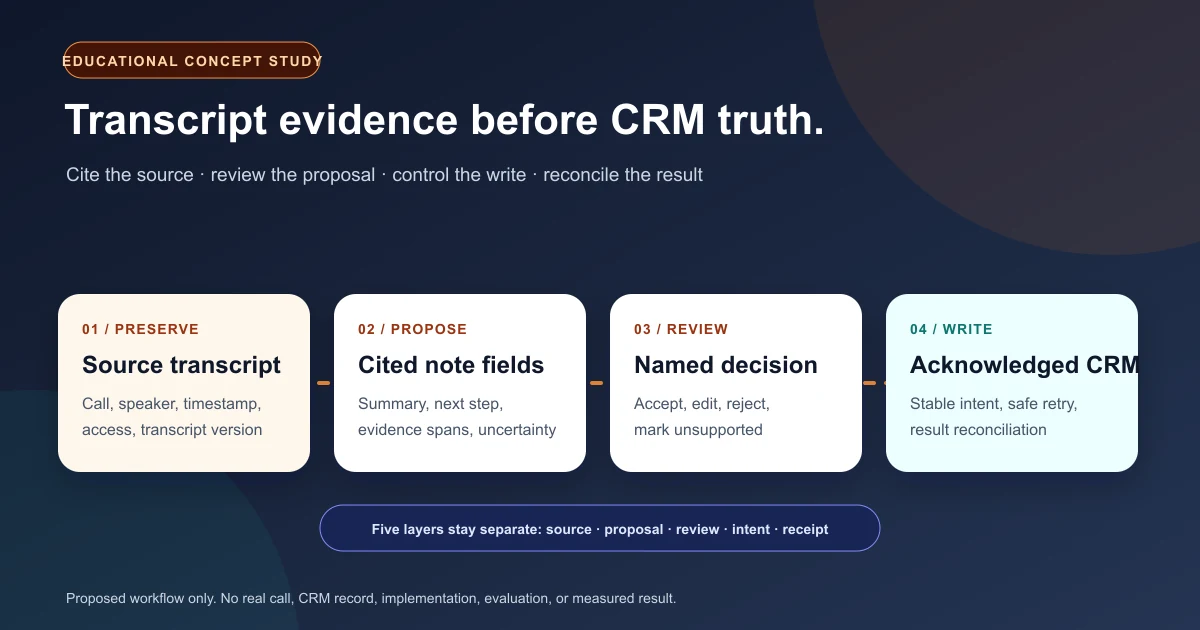
Treat AI call notes as cited proposals until a person approves the exact CRM update.
The smallest useful feature takes one permitted call transcript, matches it to one known CRM activity, and proposes a concise summary plus a few defined fields. Every factual proposal links to the supporting transcript span. A named reviewer accepts, edits, rejects, or marks it unsupported before a controlled integration writes the approved version and records the CRM acknowledgement.
This is an educational concept study, not a client story, product demonstration, or delivered system. No call, transcript, participant, CRM record, model evaluation, adoption, time saving, pipeline change, or commercial outcome here is real. The counts above describe the proposed design, not observed performance.
Illustrative discovery conversation — not a client quotation
“Can the call recorder update the CRM automatically?”
Illustrative revenue operations lead: “Reps have recordings and transcripts, but the CRM still has thin notes. We want the AI to fill next step, decision date, pain points, and deal risk after every call.”
Illustrative Leeonex response: “Which statements are direct customer facts, which are rep interpretations, which fields can change forecasts, and who must confirm that the note is attached to the right account and call?”
Both voices are invented teaching examples. They are not a client conversation, customer quotation, sales transcript, or description of delivered work.
Starting situation and intended buyer
Imagine a B2B sales team where calls are recorded in one system, transcripts arrive in another, and the CRM expects structured fields plus a readable activity note. Reps write notes late or copy a generic summary. Revenue operations cannot tell whether a missing field means “not discussed,” “not heard,” “not required,” or “forgotten.” Managers may then treat a generated sentence as a customer commitment even when it was only a seller's proposal.
The intended buyer is a revenue operations leader, sales product owner, CRM owner, or AI product team responsible for call capture and post-call work. Useful collaborators include sales managers, privacy and legal owners, security, data governance, and the people who administer the recording, identity, and CRM systems.
The important constraints are not just model quality. Recording and transcription must be permitted; speakers and meetings must be matched correctly; CRM fields carry different consequences; transcripts can mishear names and numbers; multiple calls may discuss the same opportunity; and a participant may later require correction or deletion under the organization's policy.
Separate the user roles and their authority
- Conversation participant:speaks on the call under the organization's notice, consent, and recording rules; the feature does not invent permission from participation.
- Sales representative: verifies call identity, reviews the note, distinguishes customer statements from seller statements, and owns follow-up promises under team policy.
- Manager or field approver: reviews fields with forecasting, pricing, legal, or other material consequences when the operating model requires a second decision.
- Revenue operations owner: defines the CRM schema, source priority, field rules, correction process, reporting meaning, and release acceptance evidence.
- Product and platform owners: own transcript access, model configuration, integration credentials, observability, retention, incidents, and the ability to pause the feature.
One person may hold several roles in a small team, but the system should keep the decisions distinct. Reviewing a summary is not automatically permission to change forecast stage, and an accepted CRM request is not proof that the expected record version is visible to downstream reporting.
Core flow: preserve, propose, review, write, and reconcile
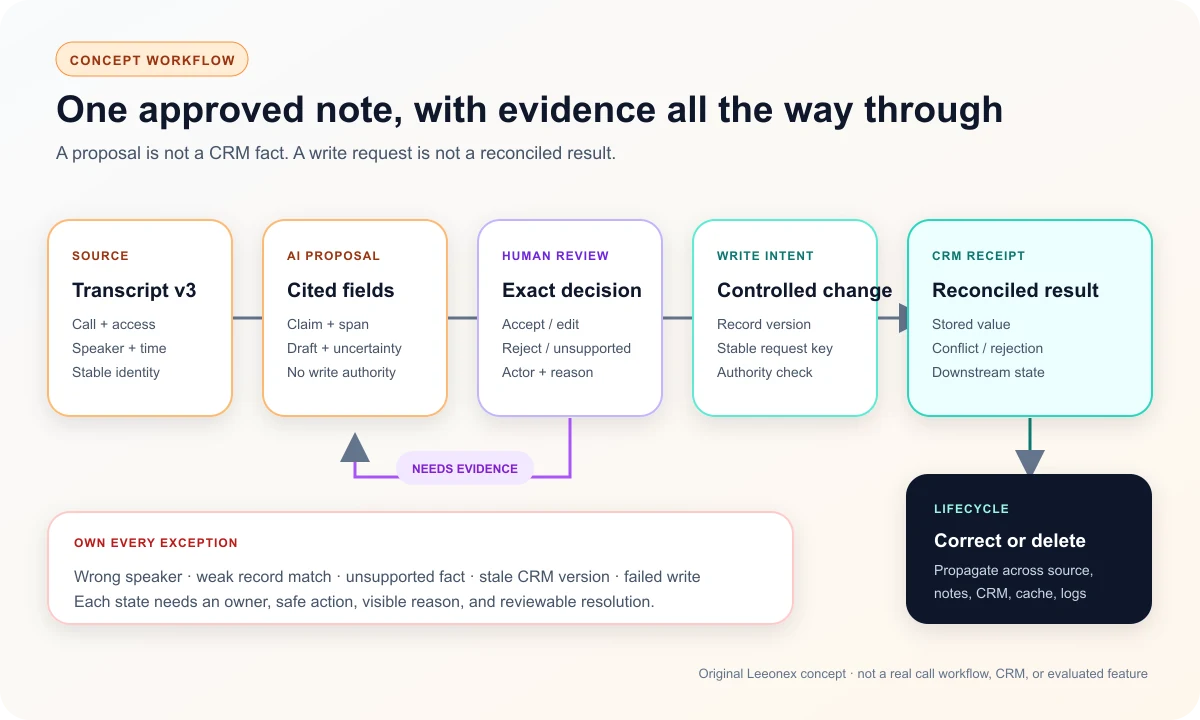
Begin with a stable call identity, participant and access context, recording policy status, transcript version, timestamps, and speaker labels. Preserve the source transcript used for the note or a governed reference to it. Do not silently replace the source after a transcript correction; create a new version so the old proposal can still be explained.
Match the call to a candidate account, contact, opportunity, and CRM activity using deterministic identifiers where possible. If the match is ambiguous, make that visible work. The model may then propose a summary and bounded fields such as stated problem, requested follow-up, named stakeholder, or explicitly discussed timing. Each proposal carries the supporting transcript span, speaker, timestamp, source version, prompt or configuration version, and a review state.
The reviewer compares the proposal with the cited words, corrects transcription or interpretation, and chooses the exact fields to approve. The application creates a versioned write intent with a stable idempotency key and checks current CRM state before writing. It records success, rejection, conflict, or uncertainty, then reconciles the intended values with the values actually stored.
Build the smallest useful scope now
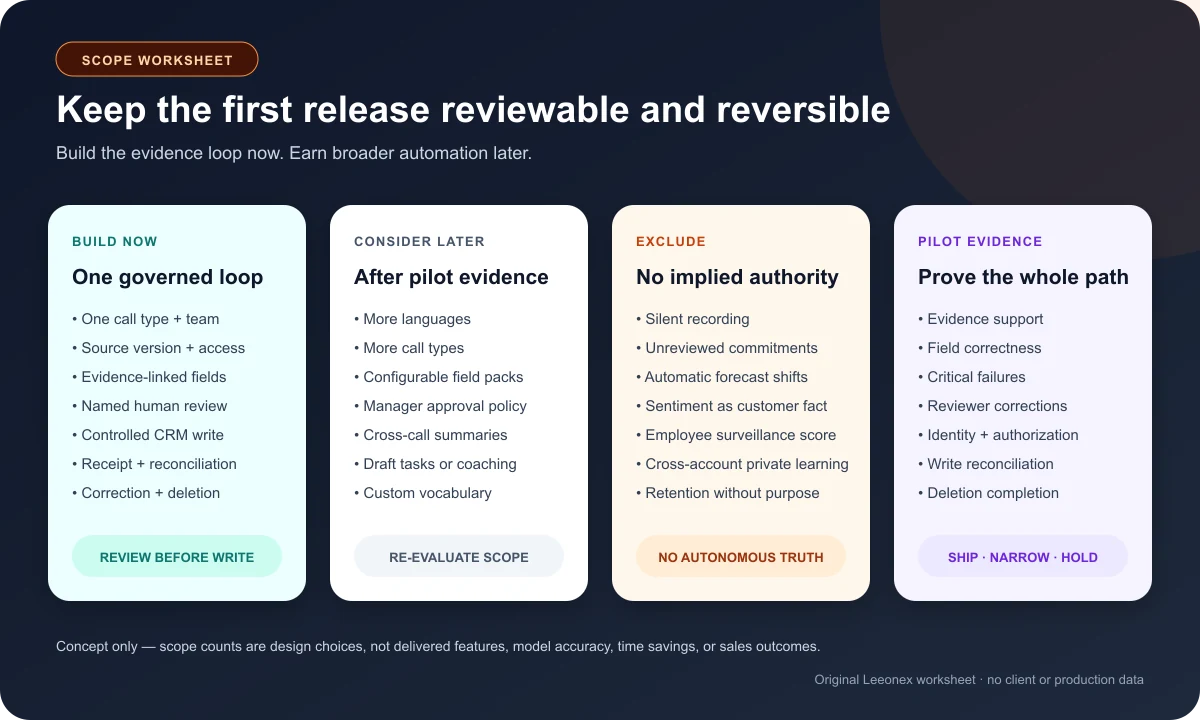
Start with one call type, one sales team, one language, one recording and transcript source, one CRM activity type, one reviewer, and three to five low-ambiguity fields. Build source versioning, record matching, evidence-linked proposals, a review interface, server-side authority checks, versioned write intents, acknowledgement, reconciliation, correction, and deletion handling.
The first release can write a reviewed activity note and a tightly controlled set of fields. Keep forecast stage, probability, pricing, contractual commitments, legal conclusions, and external follow-up behind existing owners unless a later pilot proves a specific and reviewable rule. Preserve the current manual route when the transcript is unavailable, access is denied, the record match is weak, or the reviewer disagrees.
Use the AI feature production readiness checklist to define evaluation, permissions, fallbacks, monitoring, cost, and operating ownership. If the roadmap includes a live voice agent rather than post-call notes, the AI voice agent requirements guide addresses turn-taking, tool calls, confirmation, transfer, and telephony states that this concept deliberately excludes.
Defer expansion until the review evidence is credible
Later options may include multiple languages, more call types, manager approval policies, cross-call account summaries, task-draft suggestions, coaching cues, custom vocabulary, and configurable field packs. Each addition changes the evaluation set, permissions, retention, user experience, and incident surface. A feature that works for discovery calls has not thereby proved it can summarize negotiations, support incidents, or regulated conversations.
Deliberately exclude autonomous opportunity-stage changes, automatic forecast adjustments, unreviewed commitments, sentiment scores treated as fact, employee surveillance scores, external emails, silent recording, and cross-account learning from private conversations. Do not retain audio or full transcripts merely because the model provider accepts them; retention needs a purpose, owner, access rule, and deletion path.
Architecture decisions and product guardrails
- Store the source transcript, AI proposals, human edits, approval decisions, write intent, and CRM acknowledgement as separate layers linked by stable identifiers and versions.
- Keep facts, interpretations, and actions distinct. “Customer said procurement review starts in November” differs from “deal closes in November” and from changing a forecast date.
- Require evidence spans for factual proposals. A fluent sentence without a permitted source should be marked unsupported, not repaired by adding another invented detail.
- Validate call-to-record identity, field type, allowed value, current record version, reviewer authority, and write preconditions with deterministic code outside the model.
- Treat transcripts as untrusted input. Spoken instructions cannot change system policy, expose another account, or grant tools and permissions.
- Use stable write keys and state lookups so retries do not create duplicate activities or repeat a consequential field change.
- Propagate correction and deletion across source references, proposals, review artifacts, indexes, caches, logs, and CRM data according to the approved policy.
- Version the transcript engine, prompt, model, schema, evidence rules, and evaluation set. Name the owner who can narrow, disable, roll back, or investigate the feature.
Leeonex's AI product feature development service is the closest fit when the user experience, evaluation boundary, evidence model, and product integration need to be designed as one maintained feature rather than a disconnected automation script.
What a responsible pilot would need to prove
Freeze a privacy-approved evaluation set with clear audio, weak audio, overlapping speech, incorrect speaker labels, names, amounts, dates, negation, tentative language, seller statements, customer statements, corrections, unsupported inferences, duplicate calls, ambiguous CRM matches, stale records, rejected writes, partial failures, and deletion requests. Define a reference decision for every proposed field and critical failure.
Evaluate transcript dependence, evidence-span support, field correctness, unsupported additions, reviewer agreement, correction types, identity matching, authorization, duplicate prevention, write reconciliation, deletion completion, latency, queue age, and cost per approved note. Track consequential failures separately from average quality; one unsupported commitment or cross-account write can matter more than many acceptable summaries.
These are proposed measures, not results. A future claim about note completeness, reviewer time, CRM adoption, forecast quality, sales productivity, conversion, or revenue would require a dated baseline, defined unit and calculation, comparison method, observation window, exclusions, source systems, attribution limits, verifier, and publication permission.
Risks, limitations, and what this concept cannot decide
Obvious failures include a fabricated fact, wrong speaker, misheard amount, incorrect date, or update to the wrong account. Quieter risks include biased summaries, surveillance pressure, overconfident sentiment labels, privilege or confidentiality leakage, recordings kept beyond their purpose, reviewer fatigue, corrections that do not reach downstream reports, and managers treating a machine-generated note as stronger evidence than the conversation supports.
This concept does not determine whether calls may be recorded or processed, what notice or consent is required, whether employee monitoring is appropriate, which data may enter a model, how long material should be retained, which CRM fields should exist, or what legal, privacy, security, employment, sector, or contractual obligations apply. Accountable specialists must decide those questions for the real organization and jurisdictions.
It also does not select a recorder, transcript provider, model, CRM, hosting pattern, security certification, service level, or universal accuracy threshold. If a structured rep template and better CRM defaults solve the actual problem, an AI feature may add cost and risk without enough value.
Lessons for product and revenue teams
The main lesson is that post-call intelligence is an evidence, authority, and system-state problem before it is a summarization prompt. A useful summary can remain a draft. A CRM fact needs support, identity, ownership, approval, and a correction path. Separating those layers makes uncertainty visible and gives the team somewhere safe to stop.
Scope by consequence rather than by impressive output. A cited activity note is easier to review and reverse than an automatic forecast change. Start where a human can inspect the evidence, where the downstream action is bounded, and where failure can be detected without reconstructing the meeting from memory.
What to bring to a first consultation
Bring one call type, a privacy-approved sample transcript, the current rep note, candidate CRM fields, field definitions, an example of a harmful or misleading note, call and record identity rules, reviewer and manager roles, notice and retention policies, transcript and CRM API constraints, correction and deletion paths, recent integration failures, expected volume, and the evidence needed before a pilot may expand.
Leeonex can use those inputs to separate deterministic controls from model proposals, identify missing ownership, define the smallest reviewable product slice, and state what a pilot would need to prove. Browse the case-study hub for more clearly labeled educational studies, or discuss your call-notes feature with Leeonex.