Answer first
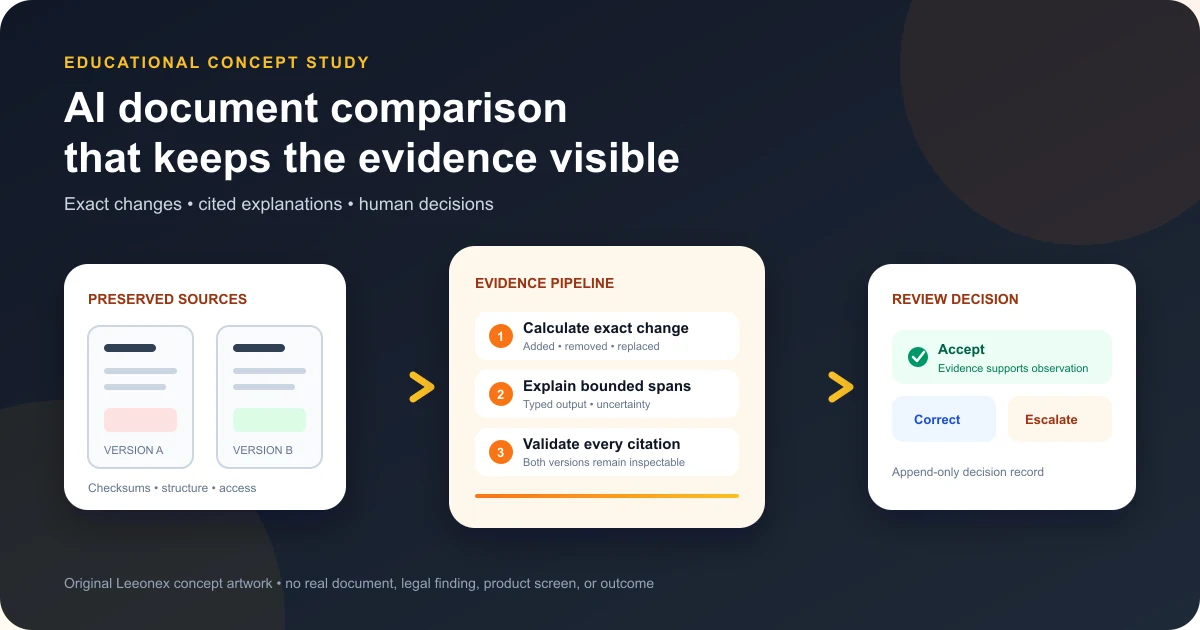
A useful AI document-comparison V1 preserves the exact change and helps a reviewer inspect it. It does not replace the reviewer.
Start with one document family and one decision. Keep both source versions immutable, extract their structure, calculate exact additions and removals, and align comparable sections. Then let a model explain only those bounded source spans, with citations back to each original.
A reviewer should be able to accept, correct, or escalate every material observation. If extraction, alignment, or evidence is weak, the product should say so and preserve the manual comparison path. Automatic approval, legal judgment, broad document support, and unsupported confidence can wait—or remain permanently outside the feature.
Illustrative discovery conversation — not a client quotation
“Tell us what changed” becomes an evidence and decision problem, not merely a prompting problem.
Product lead
“Reviewers compare long versions line by line. Can AI just tell them what changed and whether it matters?”
Leeonex
“Which changes are objectively detectable, which require domain judgment, and what evidence must stay visible before a reviewer acts?”
Product lead
“A missed clause is serious, formatting changes are noisy, and different reviewers sometimes interpret the same wording differently.”
Leeonex
“Then preserve exact changes as the base layer. Let AI explain bounded source spans, show uncertainty, and record the human decision without rewriting the originals.”
This is Leeonex-authored teaching material. It represents no real buyer, client, document, contract, policy, product, model output, quotation, implementation, legal conclusion, launch, accuracy, adoption, time saving, or business outcome.
Starting situation and buyer
This concept is for teams that compare recurring document versions and cannot afford a plausible but untraceable summary.
The intended buyer is a product leader, procurement operations owner, policy team, or compliance operations lead planning a comparison feature inside an existing product or internal system. Reviewers may inspect supplier terms, policy revisions, operating procedures, specifications, or other controlled documents.
The current workflow often combines side-by-side reading, tracked changes, comments, spreadsheets, and domain memory. Formatting noise hides meaningful edits; reordered sections create false matches; scanned pages parse badly; and a clean-looking summary can disconnect the decision from the words that support it.
The buyer does not need a universal document intelligence platform first. They need one reliable loop for a recognizable document family, with evidence, uncertainty, ownership, and a fallback strong enough for the consequences of the decision.
Product owner
Owns the supported document family, reviewer job, release boundary, non-goals, acceptance evidence, and expansion decision.
Document-domain owner
Defines meaningful sections, approved terminology, material-change rules, ambiguous cases, and where qualified judgment is mandatory.
Technical owner
Owns ingestion, file integrity, parsing, alignment, model calls, access control, observability, deletion, rollback, and vendor custody.
Reviewer
Inspects cited changes, accepts or corrects explanations, escalates uncertainty, and remains accountable for the downstream decision.
User roles and core flow
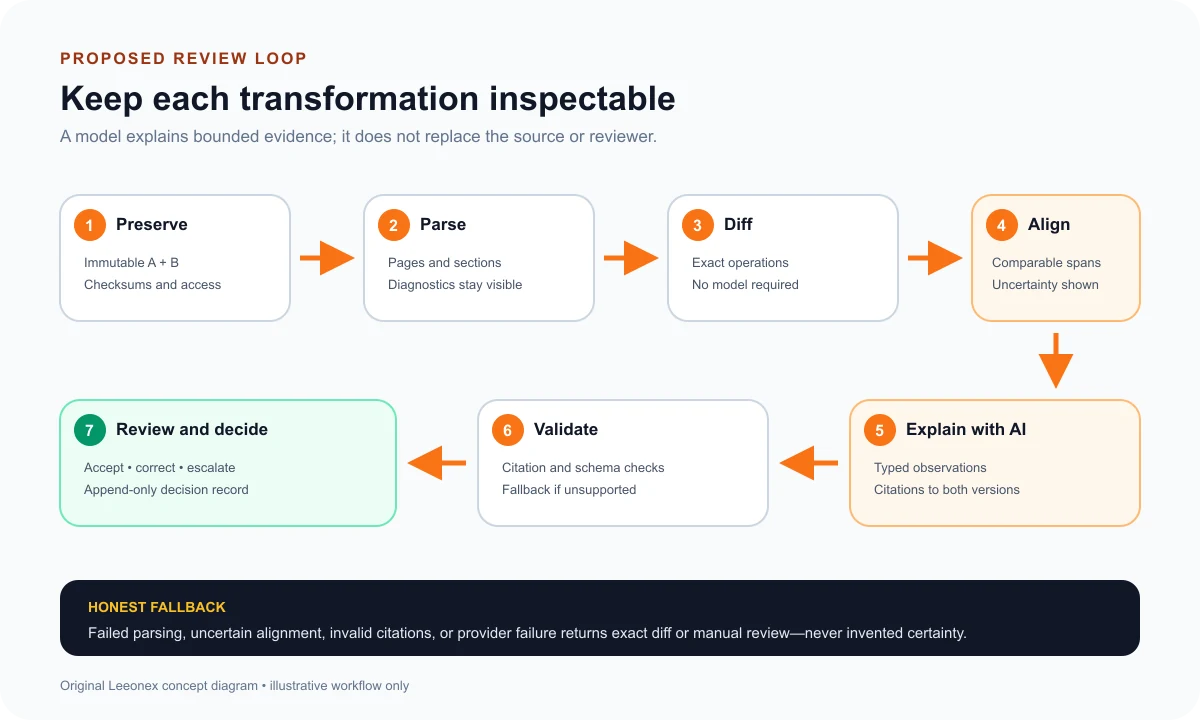
The workflow moves from preserved sources to exact changes, bounded explanations, and a recorded human decision.
An authorized contributor selects a baseline and candidate version. The system validates file type and size, scans the upload according to the product's security policy, records identity and checksums, and preserves the originals. It must never silently replace one source after a comparison has begun.
Parsing produces pages, headings, paragraphs, lists, tables, and stable span identifiers where the format permits. A deterministic layer calculates unchanged, added, removed, and replaced content. Alignment then proposes which sections should be compared while exposing low-confidence or structurally incompatible matches.
The model receives only authorized, bounded source spans plus the approved taxonomy. It proposes a plain-language explanation, materiality class, and uncertainty note. Validation confirms that every cited span exists and that structured output matches the contract before the interface shows it.
The reviewer sees the exact change beside the explanation, can open both originals, and records accept, correct, or escalate. Their decision is append-only and linked to the comparison, policy, model, prompt, and parser versions used at that moment.
Smallest useful scope
Prove one repeatable comparison job before promising every file, language, and judgment.
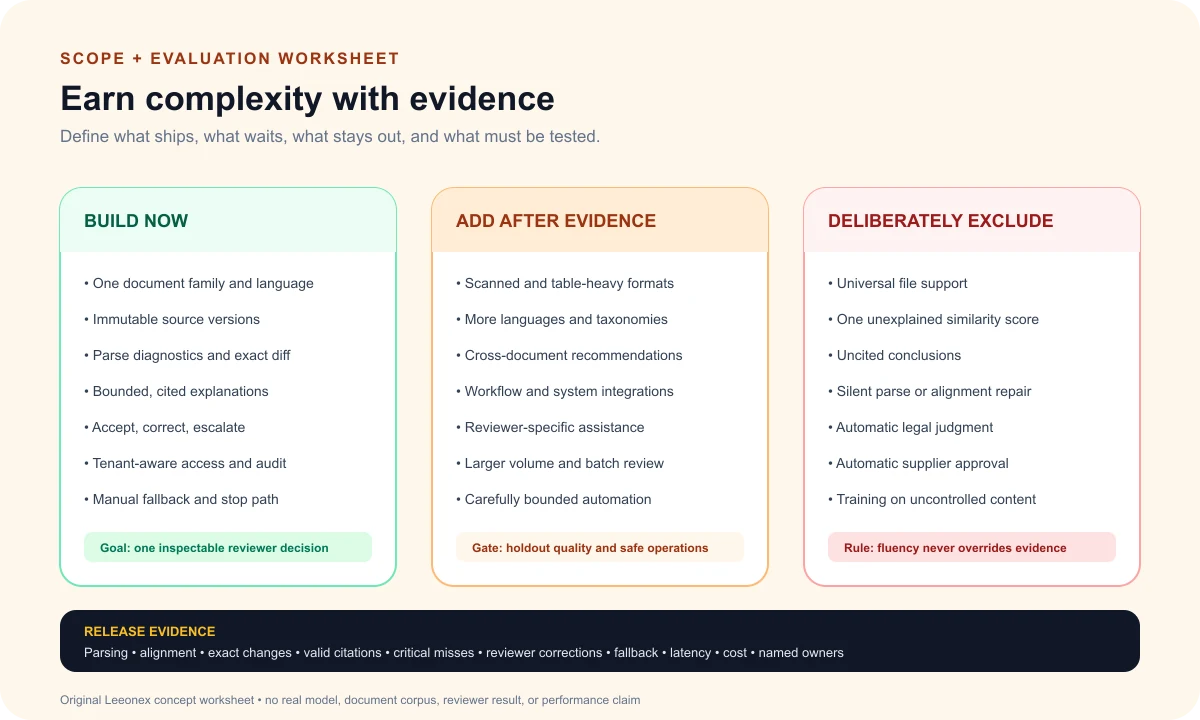
A credible V1 supports one document family with reasonably stable structure, one language, one reviewer role, and one downstream decision. For example, the feature may help a procurement reviewer identify changed supplier terms; it does not approve a supplier or provide legal advice.
Build source preservation, parsing diagnostics, section alignment, deterministic diff, cited explanations, reviewer decisions, search and filtering, export, access control, audit events, observability, and a manual fallback. Set limits on file size, page count, formats, processing time, and concurrent volume.
Assemble the evaluation set before model selection. Include unchanged wording, subtle negation, number and date changes, inserted exceptions, removed obligations, reordered sections, repeated clauses, formatting-only changes, OCR damage, tables, empty pages, ambiguous alignment, and adversarial instructions embedded in a document.
| Build now | Add only after evidence | Deliberately exclude |
|---|---|---|
| One governed document family | More formats and languages | Universal document support |
| Exact diff plus cited explanation | Cross-document recommendations | Uncited free-form conclusions |
| Accept, correct, or escalate | Reviewer-specific assistance | Automatic approval or legal advice |
Architecture decisions
Keep original files, extracted structure, exact changes, AI observations, and reviewer judgments as separate records.
Object storage holds immutable source versions under tenant-aware access rules. Metadata records the checksum, uploader, original filename, content type, size, ingestion status, retention class, and deletion state. A comparison points to exact source versions, never merely to “latest.”
A versioned parser creates a document tree and diagnostic report. The comparison service operates on stable nodes and spans, storing deterministic operations separately from alignment proposals. A failed table extraction or uncertain match remains visible; it is not smoothed over by the explanation layer.
The AI service receives the smallest required excerpts and returns typed observations with source identifiers, category, rationale, and uncertainty. Server-side validation rejects nonexistent citations, unexpected fields, disallowed categories, and content outside the authorized comparison. Provider errors and timeouts route to deterministic diff or manual review.
Reviewer decisions form an append-only ledger. Corrections should improve the evaluation set only after privacy and quality review; they should not silently retrain or change behavior. Audit access, export, retention, and deletion need the same care as the source documents because decisions may contain sensitive interpretations.
Evaluation and release evidence
Evaluate the whole review loop, and keep consequential misses out of the average.
Establish human-reviewed ground truth for exact operations, alignment, material categories, citations, and expected escalation. Record reviewer disagreement rather than forcing certainty where domain judgment genuinely differs. Use a holdout set for release comparison and a separate adversarial set for boundary failures.
Measure parsing coverage, alignment failures, citation validity, supported observations, correction and escalation rates, missed critical changes, false material-change flags, end-to-end latency, fallback availability, and cost per completed review. Define each measure, unit, cohort, window, and threshold before a pilot.
A critical missed obligation, cross-tenant disclosure, fabricated citation, or unavailable manual route should remain a release blocker even if aggregate quality looks strong. The related AI feature production-readiness checklist covers the wider evaluation, permissions, fallback, monitoring, economics, and ownership gates around this specific feature.
Legal and domain boundary
Comparison assistance is not legal advice, compliance approval, or a substitute for qualified review.
The appropriate reviewer, policy, and escalation path depend on the document and jurisdiction. The product should describe what it compared, expose source evidence and limitations, and avoid presenting an AI classification as a legally binding conclusion. Teams should involve qualified legal, privacy, security, accessibility, and domain specialists where the use case requires them.
Risks and guardrails
The guardrails protect evidence, confidentiality, and the reviewer's ability to disagree.
Store immutable source versions, cryptographic checksums, upload identity, timestamps, and parser versions so every comparison can be reproduced.
Separate text extraction and deterministic additions, removals, and replacements from the model-generated explanation. Never let the model become the only record of change.
Cite stable page, section, paragraph, or span identifiers from both versions. A summary without inspectable source context is a navigation aid, not evidence.
Define materiality as a domain rule with reviewer input. The model may propose a class, but deterministic policy and qualified humans decide what may proceed.
Treat failed extraction, poor alignment, unsupported formats, conflicting structure, low support, and model unavailability as visible product states with a manual route.
Minimize sensitive content sent to providers, enforce tenant and role boundaries before processing, and define retention, regional, deletion, and audit requirements.
Version prompts, models, parsing, alignment, policy, and evaluation cases. Re-run the same suite before a change reaches reviewers and retain rollback ability.
Measure the completed review task, corrections, escalations, missed critical changes, latency, and operating cost—not fluency or a generic model score alone.
Deliberate exclusions
A narrow first release should refuse several impressive-looking promises.
Do not promise every PDF, scan, table, image, signature, language, or historical template. Do not use one “similarity” percentage as a substitute for exact change types. Do not generate new wording inside the original, infer missing pages, or hide parse warnings.
Do not automatically approve suppliers, policies, procedures, or legal terms. Do not treat reviewer acceptance as perfect ground truth or clicks as correctness. Do not train on sensitive material without an explicit, governed decision, and do not send whole documents to a provider when bounded excerpts are sufficient.
Broader search across a governed corpus is a different product job. The permission-aware semantic search concept explains that retrieval boundary; this study remains focused on comparing two known versions and preserving their exact evidence.
Limitations
This concept proves no product quality, legal validity, operating result, or business impact.
Leeonex has not implemented or tested this concept for a client. No real corpus, parser, model, provider, reviewer, security control, accessibility flow, production deployment, or measurement window supports the page. The diagrams are explanatory artwork, not screenshots or observed outputs.
Performance depends on document structure, scan quality, language, tables, domain vocabulary, change types, ground-truth quality, reviewer consistency, provider behavior, infrastructure, and the consequence of errors. A controlled pilot may show that ordinary deterministic comparison is the better solution.
Claims about accuracy, recall, review time, cost, compliance, risk reduction, or commercial value would require approved real-world evidence: baseline tasks, representative pairs, documented labels, reviewer agreement, critical-failure counts, comparable periods, attribution limits, and publication permission.
Lessons
Build the evidence path first; add intelligence only where it makes that path easier to use.
Document comparison contains several different problems: file integrity, parsing, structural alignment, exact diff, domain interpretation, reviewer judgment, and downstream action. Treating all of them as “AI” makes failures harder to diagnose and control.
The strongest product boundary preserves the deterministic layer and uses the model as a bounded explanation assistant. Citations, visible uncertainty, and reviewer corrections are core interface behavior—not compliance decoration added after a demo.
A first version earns expansion by showing where it works, where people disagree, and where it should stop. If your team is ready to turn that boundary into a testable feature, Leeonex's AI product feature development service covers scoping, product UX, integration, evaluation, and fallbacks.
Bring this to a first consultation
The fastest useful conversation starts with document pairs and the decision they must support—not a preferred model.
- Representative before-and-after document pairs, including clean text, scanned files, tables, reordered sections, duplicates, formatting-only edits, and known difficult examples
- The reviewer decision, consequences of a missed or invented change, current review steps, average and worst-case document size, volume, turnaround expectations, and manual fallback
- Document taxonomy, section hierarchy, approved terminology, materiality rules, examples of acceptable disagreement, escalation paths, and qualified review owners
- Identity, tenancy, confidentiality, privilege, retention, deletion, regional processing, provider restrictions, audit requirements, integration points, and accessibility needs
Leeonex can use those inputs to produce a comparison boundary, evaluation plan, architecture direction, and build-now-versus-later cut. The honest next step may be an AI prototype, a deterministic diff feature, a parsing spike, or no build yet. Browse the case-study hub for other educational product and workflow blueprints.