Answer first
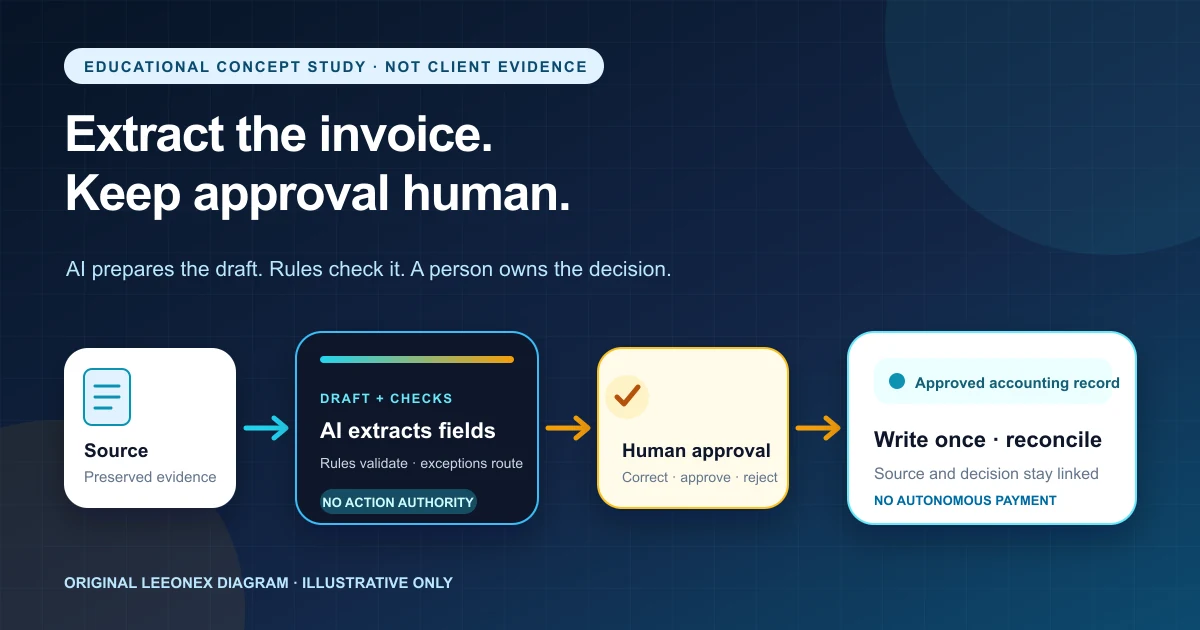
The smallest useful invoice automation prepares an explainable draft for approval; it does not turn document extraction into payment authority.
Start with one intake channel, one legal entity, a bounded set of invoice formats, and one accounting destination. Preserve the source, let AI suggest structured fields, and use ordinary code to check required data, arithmetic, known suppliers, purchase orders, supported policy, and possible duplicates.
Every item then takes one visible route: proceed to human approval, enter an exception queue with the reason attached, or stop because the case is unsupported or unsafe. Only an approved record crosses the accounting boundary. Supplier creation, accounting judgment, bank-detail changes, and payment stay out of the AI step.
Illustrative discovery conversation — not a client quotation
“Send every invoice straight into accounting” becomes buildable only after extraction, validation, approval, and payment authority are separated.
Operations lead
“Invoices arrive by email in several layouts. Can AI read them and send everything straight into accounting?”
Leeonex
“Which fields can be suggested, which checks are fixed rules, and who is accountable when the supplier, purchase order, amount, tax treatment, or duplicate status is uncertain?”
Operations lead
“Finance must approve the record, budget owners handle some mismatches, and nobody wants the automation to create a supplier or release a payment.”
Leeonex
“Then v1 is an assistive intake queue: preserve the document, extract a draft, run deterministic checks, explain exceptions, require approval, and post only the approved record with an audit trail.”
This is Leeonex-authored teaching material. It represents no real company, finance team, supplier, invoice, quotation, accounting system, workflow, approval, payment, deployment, or result.
Starting situation and buyer
This concept is for teams whose invoice inbox has become a hidden operating system.
The intended buyer is a finance operations leader, growing business owner, shared-services manager, or product and automation team supporting accounts payable. Documents arrive by email or upload, staff retype fields, attachments are renamed or moved, approvals happen across messages, and the accounting record may lose the evidence needed to explain how it was created.
The constraint is not simply reading a PDF. Layouts vary; scans can be poor; credit notes, statements, reminders, and unrelated attachments may look invoice-like; supplier and purchase-order data may be incomplete; one invoice may be sent twice; and accounting, tax, approval, retention, security, and payment policies differ by organization and jurisdiction.
The first product decision is therefore the authority boundary. AI can interpret variable documents and prepare evidence. Rules can enforce known checks. Qualified people remain accountable for exceptions, approval, accounting treatment, and any downstream financial action.
Finance operator
Reviews extracted fields and evidence, corrects the draft, resolves ordinary exceptions, and submits the approved record.
Budget owner
Confirms the business context for price, quantity, project, cost-centre, or purchase-order mismatches without editing system rules.
System owner
Controls supplier and accounting master data, permissions, posting rules, connector access, and the final system of record.
Automation owner
Owns evaluation examples, model and rule versions, failed jobs, queue health, rollback, and the decision to expand or pause the workflow.
Smallest useful scope
Close one source-to-approved-record loop before adding invoice breadth.
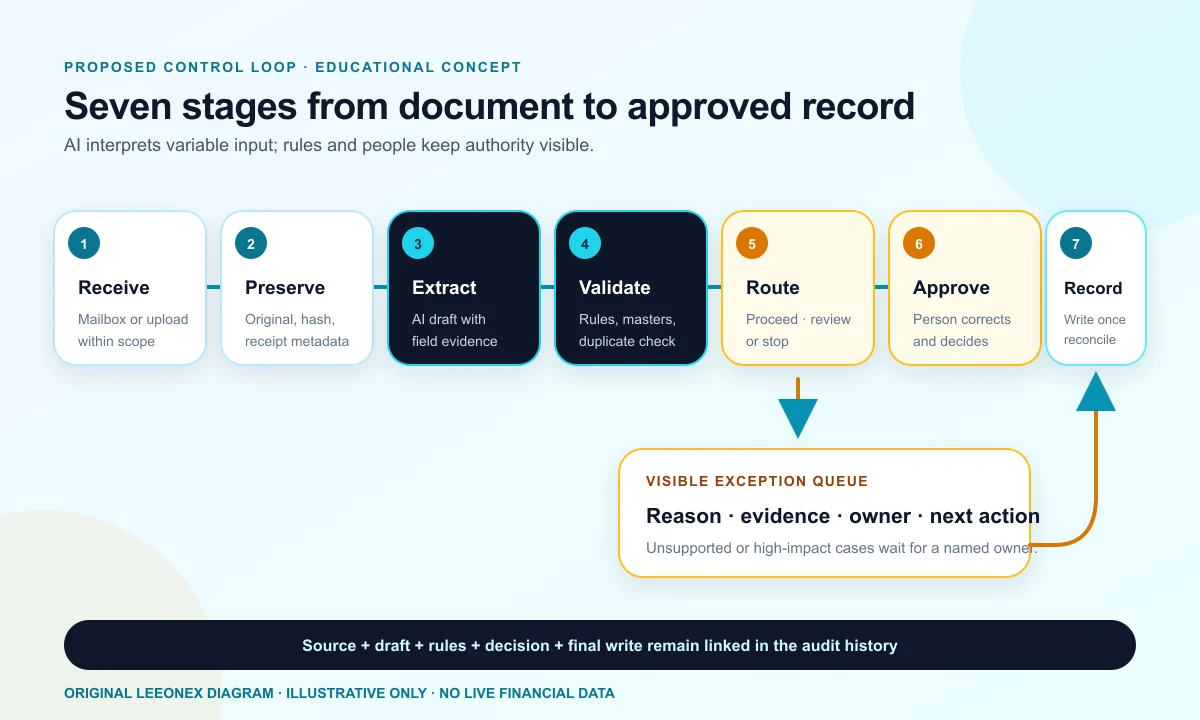
V1 receives documents through one controlled mailbox or upload, stores the original with traceable metadata, identifies supported invoice documents, and creates a structured draft. Each field keeps its source evidence, extraction status, and correction history so the reviewer can compare the suggestion with the document rather than trust a polished form.
The system then runs deterministic checks against the approved scope: required fields, totals, currency, date, supplier identity, purchase-order reference where required, and duplicate candidates. A finance operator sees the document, draft, rule results, and reason for routing in one review state. The approved record is written once through a controlled connector or export, reconciled, and linked back to the source and decision history.
The learning goal is not “prove AI works.” It is to learn which formats are supported, where corrections occur, which exceptions deserve rules or process repair, whether the review queue is usable, and whether the accounting boundary can be operated and reconciled safely.
Architecture and implementation decisions
Keep the source, draft, decision, and accounting write as separate records.
The intake boundary should preserve the original attachment, sender and receipt metadata, content hash, and access policy in an immutable or versioned source record. File-type checks, malware scanning, size limits, isolation, retention, and sensitive-data handling should follow the organization’s approved security and records policies before document content reaches extraction.
The AI step should return a constrained draft schema, field-level evidence, and an extraction status—not free text that becomes a financial instruction. Model output remains untrusted. A rules service independently checks arithmetic, required data, allowed values, master-data matches, purchase-order policy, and duplicate candidates. It also records why an item proceeds, waits for review, or stops.
The review interface should place the source beside the draft, highlight missing or conflicting evidence, and require an explicit decision. Corrections are recorded as evaluation examples, but they do not silently change supplier master data or global rules. Approved writes use a least-privilege integration, idempotency key, stable external reference, retry policy, and reconciliation state so a timeout cannot quietly create a second record.
Queue health, failed intake, extraction errors, review age, rejected writes, duplicate candidates, reconciliation gaps, connector limits, model and rule versions, and pause status need operational visibility. A workflow that cannot be explained, stopped, replayed safely, or reconciled is not ready to become a finance dependency.
Risks and guardrails
A believable extraction is still an unapproved draft.
- Treat invoice text and attachments as untrusted input. The extraction step receives no tools or authority to create suppliers, change policy, post records, approve invoices, or initiate payment.
- Preserve the original file and message metadata, then link every extracted field to its source region or evidence. Never replace the source with a generated summary.
- Use deterministic checks for required fields, supported currency, arithmetic, date ranges, supplier identity, purchase-order references, and duplicate candidates; do not ask a model to imitate fixed policy.
- Route missing, conflicting, low-quality, unsupported, unusual, sensitive, or high-impact cases to a named reviewer. A confidence score alone must not approve the record.
- Keep supplier creation, bank-detail changes, tax treatment, fraud decisions, accounting classification, final approval, and payment outside the AI step and behind qualified business controls.
- Use least-privilege connectors, idempotency keys, explicit posting states, retry limits, reconciliation, and a visible dead-letter queue so failures do not create silent duplicates.
- Log the source, extraction, rule results, reviewer corrections, approval, final write, model and rule versions, and timestamps while minimizing unnecessary sensitive data and access.
- Run in shadow or draft-only mode on representative cases, compare corrections, review false proceeds and false stops, and define pause conditions before widening formats, entities, or actions.
Build now, validate later
Control and evidence belong in v1; autonomous finance decisions do not.
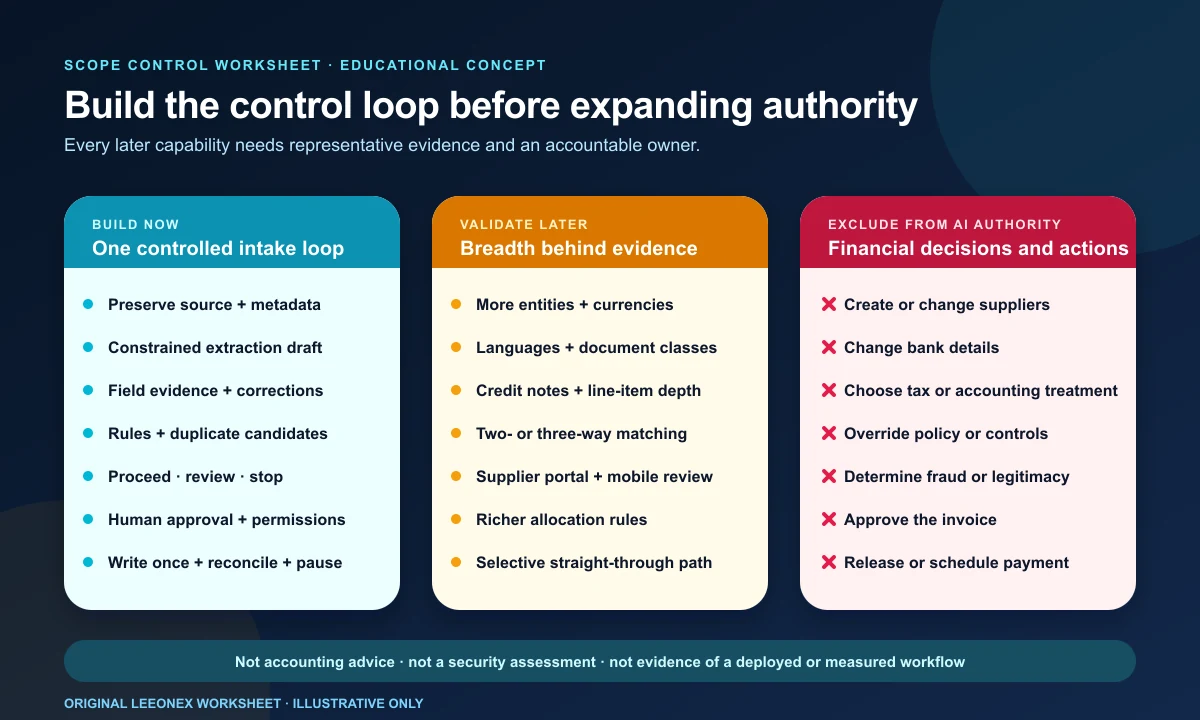
Build source retention, supported-file checks, a constrained extraction draft, field evidence, deterministic validation, proceed-review-stop routing, an operator queue, explicit approval, correction capture, idempotent accounting output, reconciliation, audit history, permissions, monitoring, and a pause control now. These are the minimum product controls, not later polish.
Validate additional entities, currencies, languages, non-PO variants, credit notes, line-item depth, two- or three-way matching, supplier portal intake, richer allocation, mobile review, and selective straight-through processing only after the first scope produces representative correction and exception evidence.
Deliberately exclude autonomous supplier creation, bank-detail changes, tax or accounting judgments, fraud determinations, policy overrides, invoice approval, payment release, and broad mailbox access. Those are separate authority and control decisions; an accurate-looking extraction does not justify them.
Limitations and evidence boundary
This concept proves no extraction accuracy, processing speed, duplicate reduction, approval improvement, cost saving, or finance outcome.
No invoice, supplier record, purchase order, accounting policy, tax rule, email system, accounting platform, API, security control, approval, payment, or finance operation was inspected, implemented, or measured. The four roles, seven stages, three routes, architecture, checks, and diagrams are proposed planning choices. This page is not accounting, tax, legal, fraud, compliance, security, or financial advice.
Stronger delivery claims would require an approved project record, workflow and policy review, representative documents with lawful handling, system and permission design, implemented rules, documented model and connector versions, test and reconciliation records, exception handling, qualified owner sign-off, approved visuals, and publication permission.
Any accuracy, time, cost, queue, duplicate, or business claim would additionally need a defined baseline, representative sample and exclusions, stable metric definition, measurement window, source, calculation, reviewer agreement, attribution limits, and approved public wording. Deployment alone would remain an implementation fact, not an outcome.
Lessons and first consultation
Bring the exception path, not only a folder of clean invoices.
The main lesson is that invoice automation is a controlled operating workflow around document interpretation—not a model prompt. These inputs make a first consultation concrete:
- Representative invoice formats, email or upload routes, attachment types, languages, volumes, seasonality, and examples that currently require rework
- The real approval path, user roles, supplier and purchase-order ownership, accounting-system write boundary, and who may resolve each exception
- Required fields, validation and duplicate rules, supported currencies and entities, sensitive data, retention needs, access constraints, and unacceptable errors
- Available APIs or imports, test environment, sample master data, reconciliation process, current baseline definitions, pilot owner, stop conditions, and evidence needed to expand
Explore LeeonexAI workflow automationfor the closest service path. Use theAI workflow readiness checklistto decide whether the process is stable enough to pilot, and theAI agent versus workflow automation guideto keep autonomy and permissions bounded. You can also return to thecase-study hubto compare other evidence types and product decisions.
Is invoice intake hiding preventable review work?