Answer first
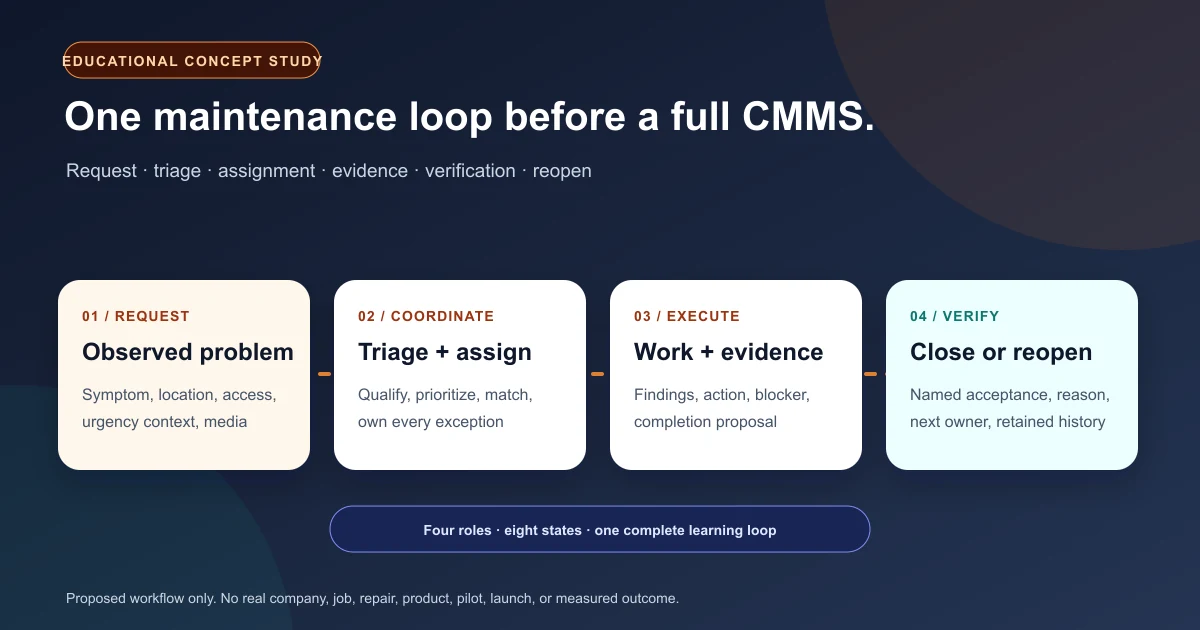
Build one request-to-verified-outcome loop before building a CMMS suite.
The smallest useful maintenance SaaS MVP lets a requester report one supported problem type, gives a coordinator enough context to reject, clarify, prioritize, and assign it, lets a technician record work and completion evidence, and lets an authorized verifier close or reopen the request. Every transition keeps an owner, timestamp, reason, and previous state.
Preventive scheduling, parts inventory, purchasing, billing, predictive maintenance, route optimization, asset telemetry, a vendor marketplace, and a native offline app are not prerequisites for that learning loop. They should enter the roadmap only when observed use shows which missing capability blocks a real outcome.
This is an educational concept study, not a client story, software demo, or delivered platform. No company, facility, asset, maintenance request, technician, repair, pilot, launch, adoption, response-time improvement, cost saving, or operational result described here is real. The counts above describe the proposed design, not measured performance.
Illustrative discovery conversation — not a client quotation
“We need a CMMS, but the full backlog is already too big.”
Illustrative founder: “Customers need asset registers, preventive schedules, work orders, parts, vendors, mobile apps, dashboards, and billing. We need all of it to look credible.”
Illustrative Leeonex response: “Which single maintenance event happens often enough to test the product, who owns every handoff, and what evidence makes the requester accept that the work is actually resolved?”
Both voices are invented teaching examples. They are not a customer conversation, testimonial, product brief, or description of delivered work.
Starting situation and intended buyer
Imagine a founder or service operator who sees maintenance work arriving through calls, messages, email, and spreadsheets. A coordinator rewrites requests, technicians receive incomplete instructions, photos live in chat threads, and “done” can mean the repair was attempted, the symptom disappeared, or someone simply wants the item off a list. The product idea quickly grows into a complete computerized maintenance management system.
The intended buyer is a maintenance software founder, field service operator, facility-service owner, or product team testing a maintenance coordination product. The concept is useful when the buyer has access to real workflow participants but has not yet proved that they will move one end-to-end job into a new product.
This is not a recommendation to build custom software by default. A configured work-order tool, shared form, or existing CMMS may be the better answer when the workflow is standard. The product case becomes stronger when the operating model, user experience, or evidence contract is distinctive enough that packaged workarounds repeatedly break the job.
Constraints that should shape the first release
- The team must choose one customer segment, one request family, and one operating context instead of promising every type of maintenance.
- Requesters may describe symptoms, not causes. The product must preserve what they observed without turning a guess into a diagnosis.
- Technicians may work with weak connectivity, but a full offline mobile architecture adds conflict and support obligations that need separate evidence.
- A completion photo or note can support review; it cannot prove engineering correctness, regulatory compliance, safe return to service, or contractual acceptance by itself.
- Notifications can fail or arrive late. The application state, not an email or message receipt, must remain authoritative.
- Early users need visible support and repair paths because the team is still learning which states, fields, and exceptions are missing.
Four roles keep authority visible
Requester
Reports the observed problem, location, access constraints, urgency context, and supporting media; receives clarification and outcome updates.
Coordinator
Checks completeness and duplication, classifies the request, records priority rationale, assigns an eligible technician, and owns blocked work.
Technician
Accepts or declines the assignment, records arrival and work, explains blockers, and proposes completion with the required evidence.
Verifier
Checks the completion against the agreed acceptance rule, closes it, or reopens it with a reason and next owner.
One person may hold more than one role in a pilot, but the product should still record which authority they used. That distinction makes it possible to separate execution from acceptance later without rewriting the history model.
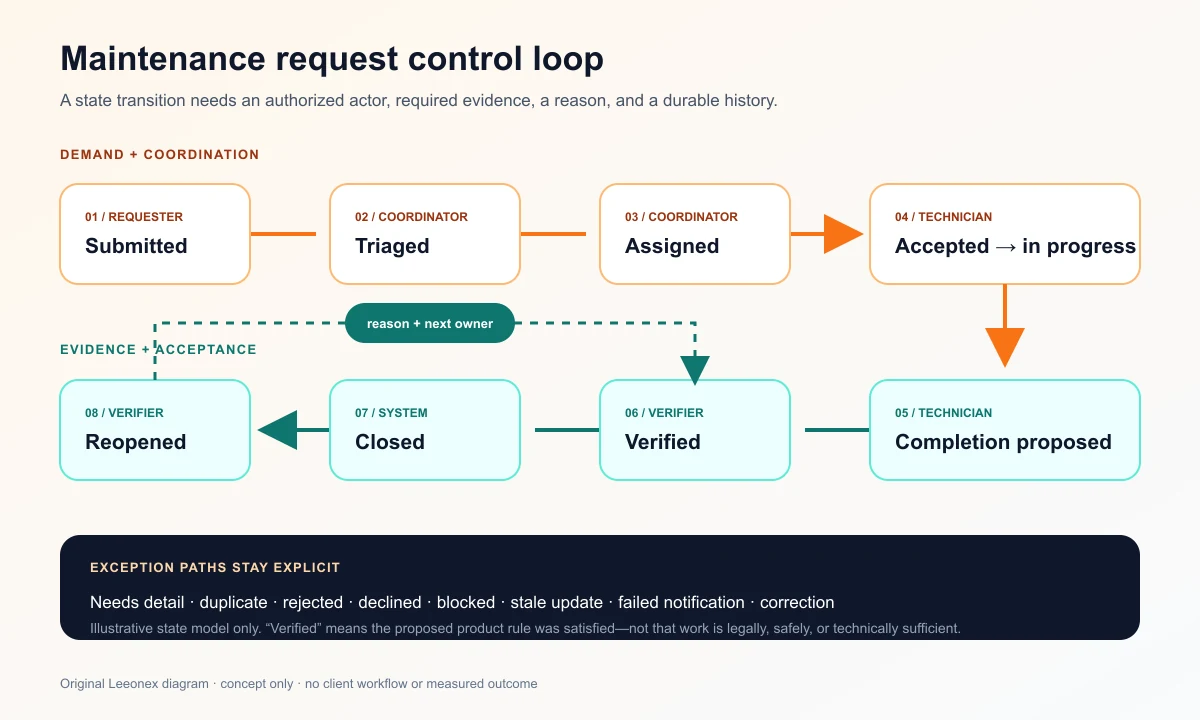
The core flow is a controlled state machine, not a task list
- Submit: the requester creates a stable request with location, observed symptom, access context, urgency reason, contact path, and permitted attachments.
- Triage: the coordinator checks duplicates, missing information, supported scope, and priority. A rejected or clarification-needed request keeps a reason and owner.
- Assign: the coordinator selects an eligible technician and records the expected response window. The technician accepts, declines, or requests clarification.
- Execute: the technician records progress, observations, work performed, permitted materials, blockers, and newly discovered issues without overwriting the original report.
- Propose completion: required fields and evidence are present, unresolved risk is named, and the system records who is asking for acceptance.
- Verify: the authorized verifier accepts the stated outcome or reopens it with a reason, next action, and accountable owner.
- Close: the immutable history remains available for support and learning; edits become correction events rather than silent rewrites.
A notification is an invitation to inspect state, not proof that work advanced. A failed email should be retryable without duplicating the assignment, and a repeated button press should not create a second completion or reopen event.
Smallest useful product scope
Build a responsive web application for one organization shape and one request family. Include authenticated role-based access, request intake, duplicate review, explicit states, assignment, comments, bounded attachments, completion proposal, verification, reopen, searchable history, an operator exception queue, and basic support diagnostics.
Keep asset context deliberately shallow: a stable asset or location reference, readable label, and enough status to prevent work against an invalid target. Do not make the MVP the new master for depreciation, warranties, engineering hierarchies, spare parts, or meter history unless the core workflow truly depends on those facts and no authoritative system exists.
Run service targets, complex dispatch choices, and customer setup manually at first. Manual does not mean invisible: record the decision, actor, reason, and time so the team can identify repeated work worth productizing. The MVP scoping checklist is a useful companion for turning this loop into acceptance criteria and a cut list.
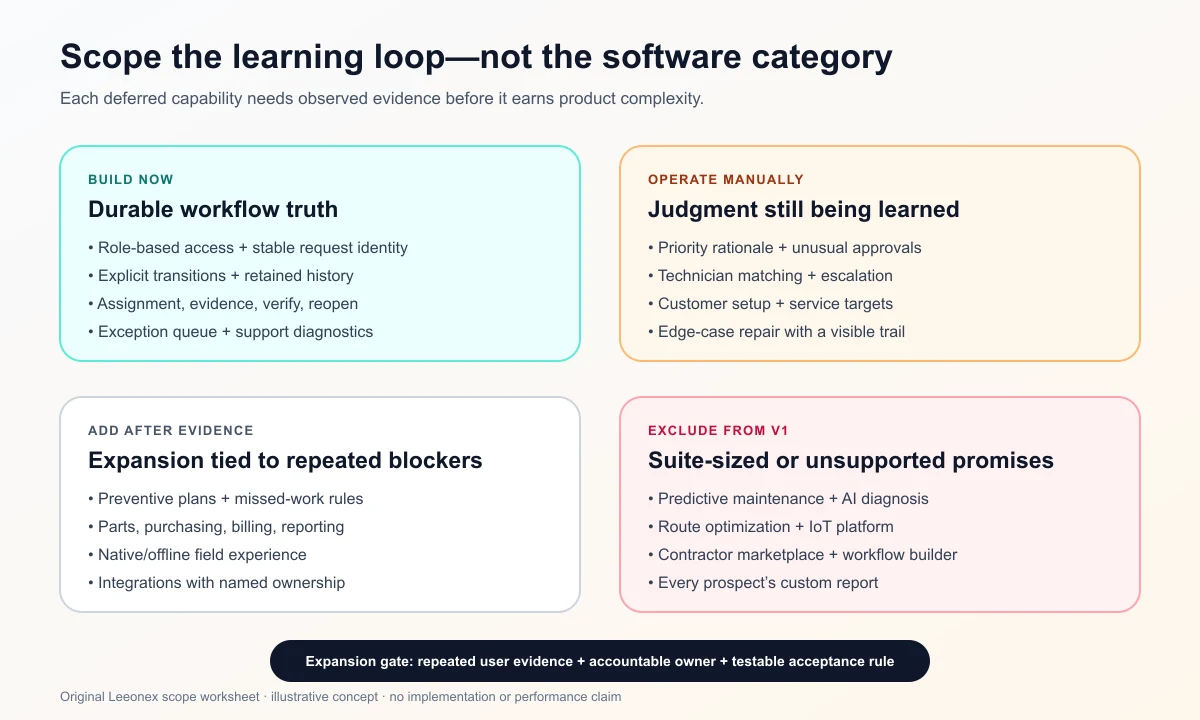
Build now, operate manually, and add only after evidence
Build the durable identity, permissions, state transitions, evidence record, exception ownership, and support trail now. These are expensive to retrofit after users depend on ambiguous statuses. Operate prioritization, technician matching, customer onboarding, and unusual approvals manually while the team learns the true decision rules.
Add preventive schedules only after recurring work is common and generation, suppression, rescheduling, and missed-work rules are understood. Add parts when stock availability repeatedly blocks jobs and an owner can reconcile movements. Add billing when the service event, rates, approval, taxes, credits, and accounting boundary are defined. Add native or offline mobile work when field conditions prove a responsive web experience is insufficient.
Deliberately exclude predictive maintenance, AI diagnosis, autonomous priority changes, route optimization, IoT ingestion, a contractor marketplace, generalized workflow builders, custom reports for every prospect, and enterprise configuration. Those capabilities can each become a separate product discovery effort; none is required to test the first maintenance handoff.
Architecture decisions that keep the MVP supportable
- Use stable organization, user, location, asset-reference, request, assignment, evidence, and transition identifiers. Friendly ticket numbers can change presentation without becoming database identity.
- Store the current state for fast reads and append transition events for explanation. Validate every allowed transition and role on the server.
- Keep original request observations, coordinator classification, technician findings, completion proposal, and verification decision separate. They answer different questions.
- Put attachments in private object storage with size, type, malware, access, retention, and deletion controls. A database row should retain ownership and purpose.
- Use idempotency keys or version preconditions for submit, assignment, completion, and reopen commands so retries and double taps do not create duplicate business events.
- Send notifications from a durable outbox after the business transition commits. Track delivery separately from application truth and expose retry or escalation to an operator.
- Start with a modular application and relational database unless observed scale or isolation requirements justify more moving parts. A microservice diagram is not product evidence.
- Instrument state age, blocked ownership, reopen reasons, notification failures, attachment failures, permission denials, and support interventions before adding vanity dashboards.
Leeonex's MVP development service is the closest fit when the first workflow, technical foundation, acceptance evidence, and post-pilot roadmap need to be designed as one focused release.
Risks, guardrails, and failure recovery
Product failures include duplicate requests, an assignment to an ineligible person, work disappearing during a retry, a completion accepted by the wrong role, private attachments exposed across organizations, notification state mistaken for job state, and a reopened request losing its earlier evidence. Each needs a test, observable signal, owner, and repair path.
Operational failures matter too. A coordinator may inflate urgency, a technician may choose an easy completion code, or a verifier may rubber-stamp a queue. Preserve reason codes and free context, review patterns with the accountable team, and avoid turning a single timestamp into a worker-performance score without understanding access delays, parts, safety, travel, and dependency constraints.
The MVP needs a support console or equivalent diagnostic path: find a request by stable identity, inspect transition history, see failed notifications, identify the current owner, attach a correction reason, and safely retry a reversible side effect. Support should not require direct database edits that erase the trail the product is meant to create.
What a pilot would need to prove
Use representative ordinary, incomplete, duplicate, urgent, unsupported, declined, blocked, completed, rejected, and reopened requests. Include weak connectivity, attachment failure, repeated submission, stale-screen updates, notification failure, unauthorized transitions, role changes, and support correction. Define the expected result and retained evidence before the test.
Useful pilot measures may include the share of requests that reach a valid triage decision, age by state, clarification frequency, assignment acceptance, blocked reasons, completion-evidence defects, reopen reasons, unresolved ownership, support interventions, duplicate prevention, and successful recovery from technical failures. These are proposed measures, not results.
A future claim about response time, downtime, missed work, technician productivity, first-time completion, customer satisfaction, maintenance cost, or asset availability would need a dated baseline, exact unit and calculation, observation window, comparison method, exclusions, source systems, attribution limits, verifier, and publication permission.
Limitations and what this concept cannot decide
This concept cannot define how maintenance should be performed, what makes an asset safe, who may authorize work, which inspection or permit is required, whether lockout/tagout or another control applies, what evidence satisfies a regulator or contract, or when equipment may return to service. Accountable maintenance, engineering, safety, legal, regulatory, labor, security, privacy, and commercial specialists must decide those questions for the real context.
It also does not choose a tenant-isolation model, hosting region, identity provider, notification vendor, storage policy, mobile strategy, accessibility target, support level, or universal state model. Nor does it prove demand. Interviews and clickable screens can reveal language and usability problems, but only observed use of an honest workflow can show whether the product earns its place in daily operations.
For a broader view of asset registers, preventive work, planning, parts, field execution, integrations, safety, reporting, and acceptance, use the CMMS requirements checklist. This study intentionally covers a much smaller first-product boundary.
Lessons for founders and product teams
A credible maintenance MVP is not the smallest number of screens; it is the smallest complete responsibility loop. If the product can create work but cannot explain who triaged it, what happened, who accepted the outcome, or how a mistake is reopened, it has digitized intake without proving coordination.
Manual decisions are useful discovery evidence when they are visible. Repeated clarification fields may justify better intake. Repeated matching judgment may justify eligibility rules. Repeated reopen causes may justify a stronger completion contract. Automate the pattern after it is understood, not the sales-demo version imagined before anyone uses the workflow.
Expansion should follow failure evidence. A blocked job may point to parts, scheduling, mobile access, vendor coordination, or a process problem. Building all five before knowing which one matters turns uncertainty into maintenance burden.
What to bring to a first consultation
Bring one target customer segment, one request family, five to ten privacy-cleared example requests, the current handoffs, role and permission rules, examples of incomplete and duplicate demand, assignment criteria, required completion evidence, reopen cases, current tools, connectivity constraints, known integrations, launch constraint, support owner, and the evidence needed before the product may expand.
Leeonex can use those inputs to map the state model, separate product work from manual operations, identify technical and authority risks, write acceptance scenarios, and define a first release that answers a real product question. Browse the case-study hub for more clearly labeled educational studies, or discuss your maintenance MVP with Leeonex.