The short answer: model shared truth once, then add only maintainable local facts
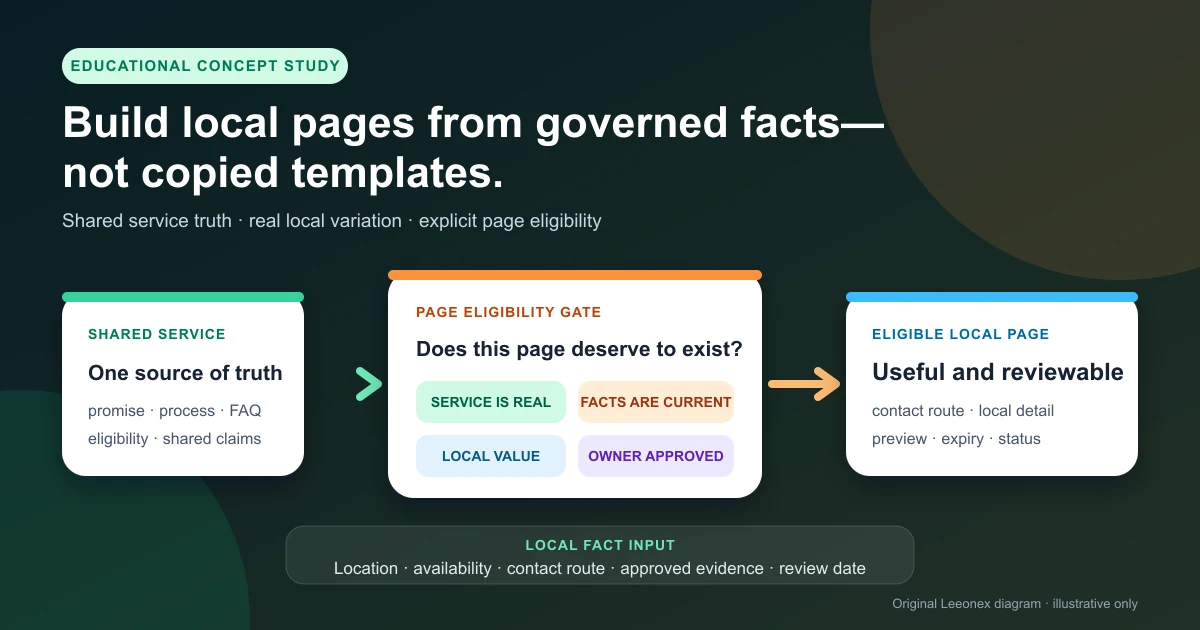
A multi-location CMS should not store twenty copied versions of the same service page. Store the canonical service, each real operating location, the relationship that says where a service is available, and approved local evidence as separate records. Compose a page only when that relationship has enough useful, current information to deserve one.
This keeps shared claims consistent while allowing legitimate local differences such as hours, coverage, contact routing, availability, directions, staff credentials, or approved proof. It also creates an honest stop condition: when a branch has no meaningful local information, the better page may be a shared service page with a location finder—not another near-duplicate URL.
| Content | Source of truth | First-release rule |
|---|---|---|
| Service promise, process, eligibility, shared FAQ | Canonical service record | Edit once; reuse by reference |
| Address, hours, contact, coverage, directions | Location record | Verified owner and review date |
| Local availability, constraints, CTA, approved proof | Service-location relationship | Publish only when eligibility passes |
Starting situation: growth turns one manageable page into a copy-paste estate
The intended buyer is a multi-location service business owner, marketing leader, or website team managing branches, studios, clinics, offices, workshops, or service areas. The business has shared services, but availability and contact details vary by place. Editors are asked to create “local pages” quickly, so a complete page is duplicated and modified by hand.
That shortcut creates several kinds of drift. A central service statement changes but old branches keep the previous wording. A location closes early while its page keeps outdated hours. A form reaches the wrong team. A local claim loses its source. Empty templates are published because the route exists, not because the page helps a visitor.
The constraint is not “make many pages.” It is to let a small editorial team maintain one reliable system while preserving real local differences, existing URLs, accessibility, contact delivery, migration safety, and a clear decision about which pages should exist at all.
Illustrative discovery conversation
The dialogue below is fictional planning material. It is not a client quotation, transcript, delivered project, or result.
Founder: “We have eight locations and six services. Can the CMS generate forty-eight pages?”
Leeonex: “It can, but which service-location combinations are real, useful, and maintainable—and what local facts would make each page different for a visitor?”
Founder: “Three services are everywhere. The others depend on equipment and staff, and local managers own the current details.”
Leeonex: “Then V1 should prove one shared service, one variable service, a representative location set, and the approval path. Route volume comes after the content model can explain why every page exists.”
Give contribution, truth, and publication different owners
“Marketing edits the website” is not a sufficient permission model. The first release needs three accountable roles even if one person temporarily holds more than one. Permissions should follow the information each role can verify, not the broad convenience of an all-powerful editor account.
Service subject owner
Owns the canonical service promise, shared descriptions, requirements, FAQs, and claims that should stay consistent across the website.
Local contributor
Supplies location-specific hours, coverage, contacts, availability, directions, and approved local evidence without editing global service truth.
Publisher
Checks completeness, evidence, page eligibility, preview quality, accessibility, internal links, and release or expiry dates before publication.
Content and page model
Treat availability as a relationship, not a copied page
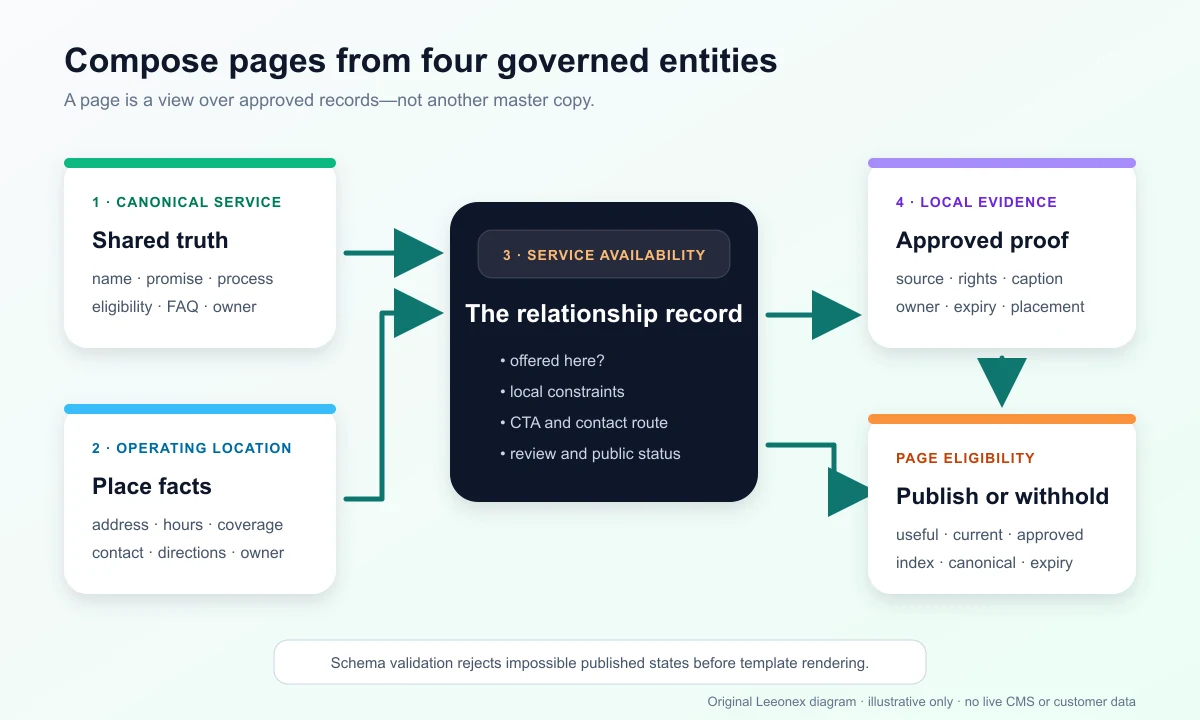
The core model has four entities. A service record holds shared truth. A location record holds stable place facts. A service-availability record connects the two and carries local constraints, contact routing, CTA behavior, and review status. Evidence records hold approved local proof with source, rights, owner, expiry, and placement rules.
A page template composes those entities but does not decide page eligibility by itself. A separate rule checks that the service is genuinely offered, required fields are current, the destination contact route works, local content adds visitor value, and the publisher has approved preview and index status.
Reusable presentation blocks can reference the same records, but editors should not paste page layouts into a rich-text field. Schema validation should reject impossible states such as a published service-location page with no active service, expired hours, missing owner, or unverified CTA destination.
Smallest useful scope
Prove the hardest variations before multiplying routes
Build V1 around one widely available service, one service with local constraints, and three representative locations: a complete location, a location missing evidence, and a location that should not receive the service page. That slice exercises reuse, variation, refusal, preview, contact routing, and stale-content handling without creating the full route matrix.
Build the entity schema, validation rules, editorial permissions, preview, page-eligibility decision, route and canonical policy, redirects for migrated URLs, form routing, accessibility checks, change history, and review dates now. Include structured data only where the visible page and business facts support it.
Validate more languages, bulk editing, campaign variants, personalization, automated localization, store or practitioner directories, complex territory search, content syndication, and additional proof types later. Deliberately exclude empty pages, generated local claims, fabricated reviews, automatic publication from incomplete records, and indexing every possible route.
Core publishing flow
Make freshness and approval part of the content lifecycle
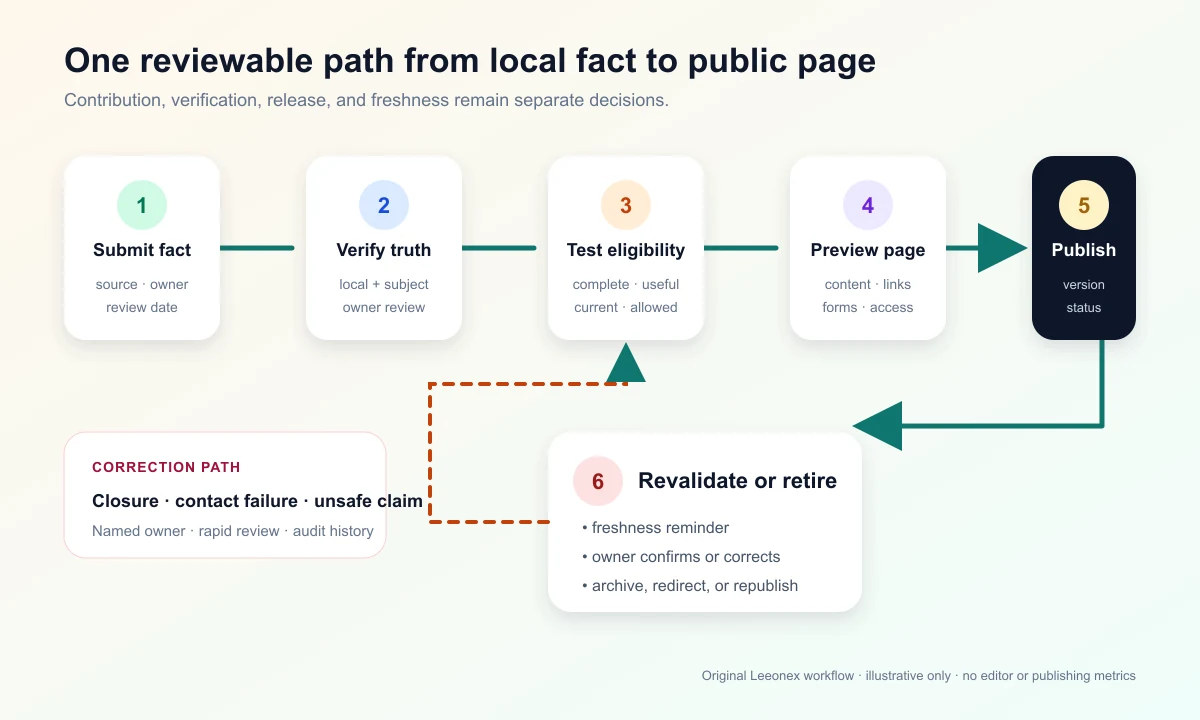
A local contributor submits a bounded fact change with its source and review date. The subject owner reviews changes that affect the shared service promise. The system calculates page eligibility, then the publisher inspects a representative preview and release checklist before changing public status.
Publication creates a versioned record and schedules revalidation. Expired content returns to review; it does not stay silently “approved.” High-risk changes such as closures, contact routing, service withdrawal, or regulated claims should use a faster correction path with an accountable owner and clear audit history.
Release acceptance should test the user flow, not merely the CMS save action: find the correct location, understand whether the service is available, inspect trustworthy local details, and complete the right contact step on desktop, mobile, keyboard, and assistive-technology paths.
Risks and guardrails
The main risk is not too few pages; it is publishing more promises than the business can verify and maintain.
- A location-service page is created only when the business truly offers that service there and can maintain useful local facts.
- Shared service claims live once; local editors cannot silently replace price, eligibility, safety, or compliance language.
- Local proof requires an approved source, rights status, owner, and review date; absence of proof is not filled with a generated testimonial or image.
- Every generated route has an explicit index, canonical, redirect, archive, and expiry decision rather than inheriting a blanket SEO setting.
- Preview and acceptance checks cover headings, links, forms, structured data, alt text, keyboard use, responsive layout, and empty states.
- Stale hours, availability, contacts, and proof enter a review queue; the system does not pretend old local facts are current.
Limitations and evidence boundary
This concept proves no publishing speed, content quality, search visibility, indexation, traffic, leads, or conversion.
No client, company, location, editor, CMS, page inventory, migration, service catalogue, schema, form route, analytics account, search property, accessibility test, structured-data result, or production environment was inspected. The four entities, three roles, release slice, workflow, guardrails, and diagrams are proposed planning material—not implementation, legal, compliance, accessibility, content-quality, technical SEO, or performance evidence.
Stronger delivery claims would require an approved content model, populated records, permissions, workflow history, migration map, live templates, editor acceptance tests, accessibility review, form-delivery tests, structured-data validation, release record, monitoring, known issues, and permission to publish accurate visuals and wording.
Any business or search claim would additionally need a defined baseline and measurement window. Possible measures include time to publish an approved change, stale-field incidence, failed contact routing, task completion, qualified inquiries, indexed eligible pages, impressions, or conversions. Sources, exclusions, confounding changes, attribution limits, verifier, and approved public language would be required before use.
Lessons and first consultation
Bring content ownership and real variation—not a target page count
The first useful CMS brief explains which information is shared, what genuinely differs by location, who can verify each field, when it expires, and what makes a page useful enough to publish. These inputs make the first consultation concrete:
- A list of real operating locations, service areas, and services actually available at each one.
- Three representative current pages: one strong, one duplicated, and one difficult for editors to maintain.
- The source and accountable owner for shared service claims, local facts, contact details, and proof.
- Editor roles, approval needs, publishing frequency, languages, and any legal or brand-review constraints.
- Existing URLs, valuable content, analytics and search evidence, forms, CRM routes, and redirect requirements.
- The smallest location and service combination that exercises the hardest content and publishing rules.
Leeonex's CMS website development service fits teams that need structured content, reusable templates, and an editor-friendly publishing system. The website redesign or rebuild guide helps identify whether the content model or only the visible experience is constrained, while the website migration checklist covers URLs, redirects, content parity, forms, analytics, and rollback when existing pages must move.
Explore the Leeonex case-study hub to compare other evidence types and product decisions. Structured content, internal links, metadata, sitemaps, and clear entities can support discovery, but none guarantees rankings, traffic, indexing, AI citations, trust, leads, or conversions.
A problem-aligned next step
Model one difficult service-location combination before expanding the page estate.
Bring the service and location lists, current URLs, editor roles, local facts, and content owners. Leeonex can turn them into one focused CMS and publishing brief.