Answer first
Launch one complete journey in a second locale, not a translated copy of every source page.
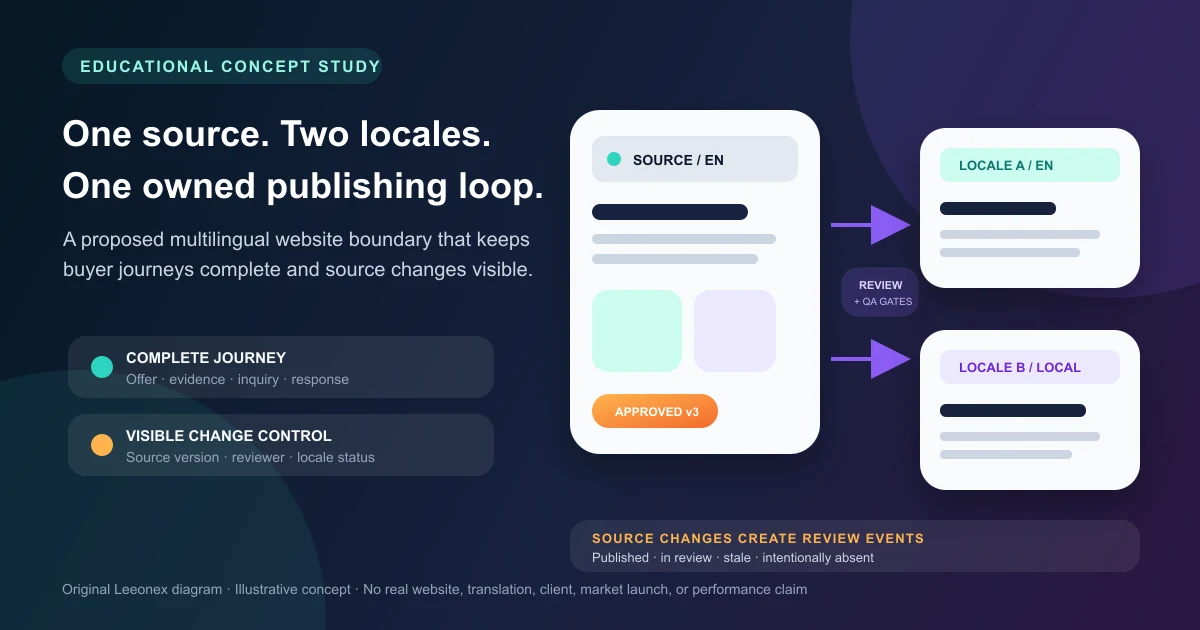
A multilingual company website needs an operating model, not only a language switcher. The smallest useful release should give one priority market a coherent route from discovery to inquiry: localized meaning, navigation, evidence, forms, metadata, consent, confirmations, routing, analytics, and a named owner for the response.
Start with one source locale and one target locale. Give every content unit an identity, source version, owner, translator, market reviewer, and status. When source meaning changes, the related locale should become visibly due for review instead of remaining silently “published.” Add more pages, languages, and regional variants only after that change loop can be operated.
Evidence boundary
This is a Level E educational concept study. Leeonex has not researched, translated, designed, implemented, reviewed, launched, indexed, or measured this proposed website for a client or market. The conversation, company situation, roles, locales, workflow, architecture, diagrams, counts, and decisions are illustrative planning material—not a website demo, translation sample, testimonial, search result, legal assessment, or business outcome.
Starting situation and intended buyer
The business sees a new market; the website team sees an unowned second publishing operation.
This concept is for an international B2B team, service business, marketing leader, or website owner with evidence that another language or market matters. A local salesperson may be translating documents manually, buyers may arrive at the source-language site, or a planned market launch may need a credible company presence before campaigns begin.
The initial request often sounds simple: duplicate the current pages, translate the text, and add a toggle. That request hides product decisions. The market may need different proof, services, claims, addresses, phone formats, forms, consent, response teams, or legal wording. Even a faithful translation can lead to the wrong commercial or operational path.
The main constraint is usually ownership after launch. Source copy changes, terminology evolves, staff move, offers differ, forms are reconfigured, and one locale gradually stops matching the business. Scope must therefore cover the ongoing decision and release loop—not only the first translation file.
Illustrative discovery conversation — not a client quotation
Translation scope follows the local buyer journey and the people who can keep it true.
Marketing lead
“We are entering a second market. Can we translate the current website and add a language switcher?”
Leeonex
“Which buyer journey must work in that market, who can approve its meaning, and what should happen when a source page changes?”
Marketing lead
“The local team can review important pages, but the form routes to headquarters and nobody owns translation updates after launch.”
Leeonex
“Then the first release is not every page in another language. It is one complete localized journey with owned review, routing, fallback, QA, and change control.”
This exchange is Leeonex-authored teaching material. It describes no real company, employee, market, quotation, translation, website, inquiry flow, or engagement.
User roles and decision ownership
Separate language quality from business, market, and technical authority.
Business owner
Chooses the priority market, offer, commercial boundary, acceptable launch scope, and the decision the website should support.
Source-content owner
Owns the approved meaning, reusable terminology, source changes, page relationships, and the signal that existing translations need review.
Language reviewer
Checks terminology, tone, grammar, and meaning in context without being asked to invent product, legal, or commercial policy.
Market owner
Confirms local buyer expectations, evidence, contact details, offers, regulations, and the destination of each inquiry.
Website owner
Implements routing, templates, components, metadata, forms, analytics, release checks, monitoring, and rollback behavior.
A professional translator can protect language without owning the offer. An in-market salesperson can recognize buyer expectations without owning source accuracy. A developer can implement locale routing without deciding legal language. The workflow should request each approval from the person qualified to give it.
Core publishing flow
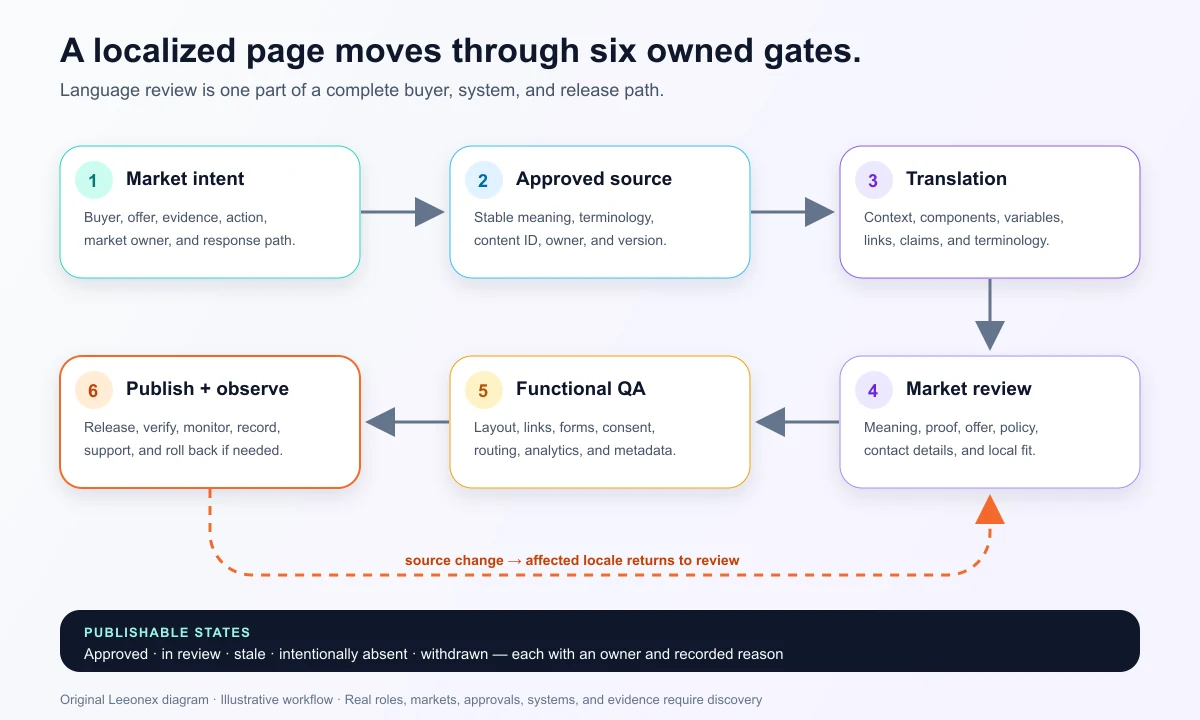
Move each localized page through six explicit gates.
First confirm the local buyer intent and the action this page supports. Then approve the source meaning and terminology. A translator works from that stable source, with context about components, character limits, variables, links, and claims. The market owner reviews the assembled page rather than an isolated spreadsheet cell.
Functional QA follows language review. The team checks the route, navigation, responsive layout, keyboard path, images, links, validation, consent, confirmation, CRM delivery, notifications, analytics, metadata, alternate-page relationships, and fallback behavior. Publication occurs only when the required evidence and approvals exist.
After release, a source change creates a review event. The locale owner decides whether the change is shared, needs market adaptation, makes the translation stale, or does not apply. That decision is recorded so “published” never means “probably still current.”
Smallest useful release
Build the narrow locale path the business can review, operate, and support.
Build now
- One source locale and one priority market locale, with a written rule for language, country, currency, date, address, and regional variants
- One complete buyer journey per locale: entry page, relevant service or offer, evidence, contact path, confirmation, and operational follow-up
- A stable locale URL model, language switch behavior, localized metadata, canonical and alternate relationships, sitemap inclusion, and explicit fallback rules
- A structured source inventory with content IDs, owners, approved terminology, translation status, reviewer, source version, and last-reviewed date
- Localized navigation, buttons, validation, consent, form fields, confirmation, email, CRM routing, analytics events, and error states—not body copy alone
- Representative desktop and mobile QA for content meaning, layout expansion, keyboard access, links, forms, metadata, analytics, and release rollback
Later or deliberately excluded
- Every existing page, every future market, and country-specific variants before the first localized journey has an owner and release path
- Automatic machine translation published without source approval, terminology control, contextual review, and an explicit risk decision
- Personalization by location, browser language, account, campaign, or behavior before predictable URLs and user-controlled language choice work
- A global product catalogue, pricing engine, tax logic, ecommerce, gated account area, or support knowledge base hidden inside a marketing-site translation scope
- A promise of rankings, indexing, leads, conversion, regulatory compliance, or cultural fit based only on translated pages and metadata
Use the website requirements checklist to record the wider outcome, content, system, quality, operating, and acceptance boundary. This concept adds the locale-specific ownership and change decisions that a general website brief can otherwise hide.
Architecture and implementation decisions
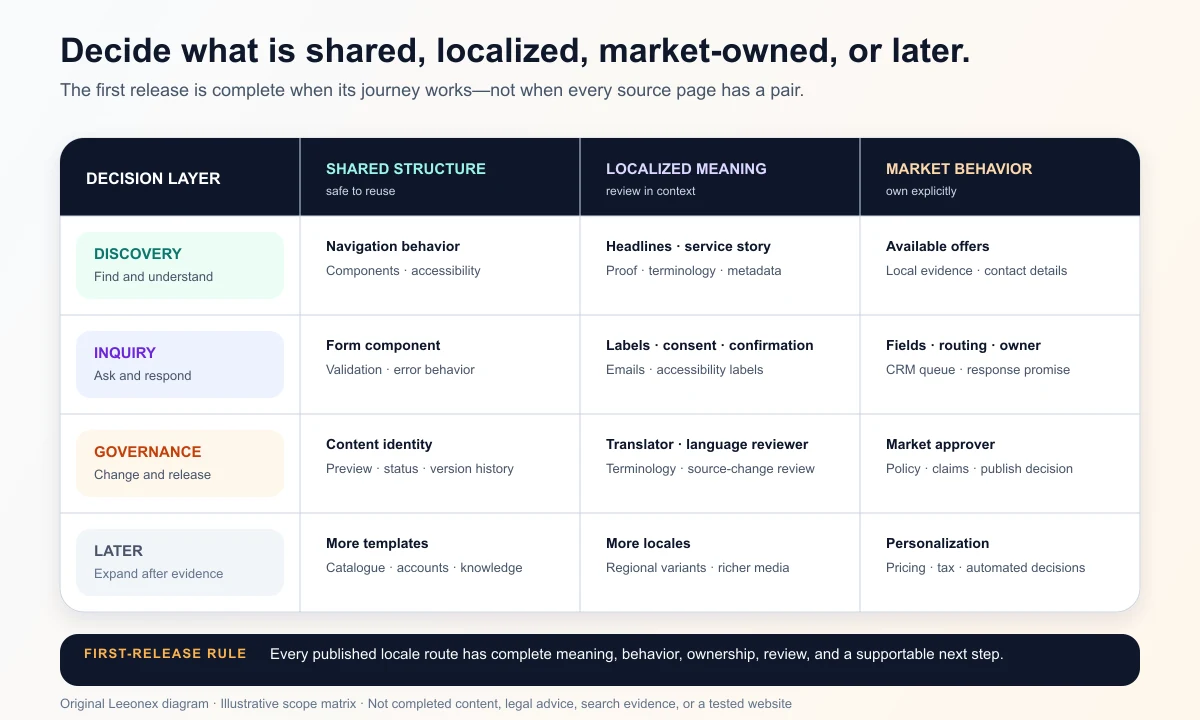
Share structure without pretending every market shares the same content.
Locale and URL model
Define language and market identifiers separately, choose durable localized paths, preserve a user-selected locale, and avoid silent redirects that make another version unreachable.
Content identity
Give related locale entries a shared content identity and source version. A page can then be complete, in review, stale, intentionally absent, or replaced instead of merely existing or missing.
Component boundary
Share layout and accessible behavior where it is genuinely common, while allowing market-specific copy, order, proof, legal blocks, contact details, and calls to action.
Publishing boundary
Require the right approvals before a locale can publish, record source changes after approval, and support preview, scheduled release, rollback, and removal without breaking its paired pages.
The content model should distinguish reusable identity from localized meaning. A service can remain the same entity while its headline, proof, price visibility, legal note, contact path, and availability differ by market. This lets editors see what is shared, what is adapted, and what is intentionally absent.
Route behavior must be decided with content. Define the default locale, switch destinations, missing-page behavior, alternate relationships, canonical intent, sitemap rules, preview URLs, redirects, removals, and not-found behavior. Metadata and structured data should describe the page that actually renders; they do not compensate for a partial buyer journey.
If editors will publish frequently or many templates share translated records, the headless versus traditional CMS guide can help decide where the locale workflow should live. The CMS choice follows ownership and publishing needs; it does not solve them by itself.
Risks and guardrails
Do not let fluent copy hide broken ownership, behavior, or claims.
Do not use flags as language labels or assume language equals country. Let people choose a clearly named language or market and return to that choice.
Do not redirect solely from IP address or browser language without a reachable alternative. Detection can suggest; it should not remove user control or hide a canonical route.
Do not publish untranslated navigation, validation, consent, confirmations, email, metadata, accessibility labels, or error states around translated body copy.
Do not let translators decide prices, claims, guarantees, regulated language, privacy promises, or legal meaning. Assign those decisions to accountable business and specialist owners.
Do not treat equal page counts as completeness. A smaller local journey with every step working is more testable than a broad inventory with broken forms or stale proof.
Do not describe locale metadata, structured data, sitemaps, or alternate links as guarantees of crawling, indexing, rankings, citations, traffic, leads, or conversions.
Limitations and evidence needed
This blueprint cannot prove language quality, market fit, compliance, search performance, or commercial demand.
Real localization depends on the organization, offer, languages, countries, terminology, culture, claims, laws, privacy duties, accessibility requirements, systems, content volume, team, release process, and buyer evidence. Some markets need a translated shared site; others need materially different content, operations, contracts, or a separate product boundary.
No delivery date, budget, word count, translation accuracy, publishing-time reduction, crawl result, index coverage, ranking, traffic, engagement, inquiry, qualification, conversion, revenue, or return is claimed. Stronger public wording would require at least:
- Approved source pages, terminology, translations, reviewer records, source-version history, change notifications, and release approvals
- Representative in-market buyer review plus linguistic, functional, accessibility, privacy, legal, security, and brand checks appropriate to the release
- Locale routing, alternate-page relationships, metadata, sitemap, crawl, indexability, redirect, fallback, and not-found test evidence
- End-to-end form, consent, email, CRM, notification, analytics, retention, and inquiry-ownership tests for each published locale
- Defined measurement windows and source systems for content freshness, translation defects, journey completion, inquiries, qualification, or any stronger public outcome claim
- Approved website screenshots, organization identity or anonymization, visual rights, project evidence, and publication permission
Lessons for an international website team
A multilingual site is a set of owned market promises, not a pile of translated strings.
Translate journeys before inventories. If a buyer can understand the offer but cannot complete the form, receive a useful confirmation, or reach the right team, the page count is not a meaningful sign of readiness.
Treat source changes as operational events. Content identity, version status, named reviewers, preview, and release history make drift visible. A spreadsheet can support a small launch, but only when its decisions and owners are explicit.
Finally, allow real market differences. Shared components and terminology reduce accidental inconsistency; forced sameness can preserve the wrong proof, offer, or workflow. The design system should make approved variation safe rather than making every locale look mechanically identical.
What to bring to a first consultation
Bring the market path, source inventory, and decision owners—not only a list of languages.
- The priority market, buyer, offer, desired action, business reason for launching now, and which decisions remain global versus market-owned
- The current site map, source pages, analytics or inquiry evidence, known content gaps, redirects, domains, existing translations, and pages that must not launch yet
- Language, country, currency, date, phone, address, units, pricing, policy, legal, consent, accessibility, and cultural requirements for the proposed locales
- Named source owners, translators, in-market reviewers, legal or privacy reviewers, website editors, developers, approvers, support owners, and escalation contacts
- Form fields, validation, routing, CRM and email destinations, confirmation behavior, analytics events, data residency or retention constraints, and failure handling
- Hosting, CMS, repository, domain, search, analytics, tag-management, consent, CRM, email, translation, preview, release, rollback, and support access
Leeonex can use those inputs to define a two-locale release, content and URL model, translation workflow, acceptance plan, and maintainable company-site build. Explore company website development or review other evidence-labeled planning examples in the case-study hub.