The answer first
Scope a recoverable order handoff, not a chain of successful API calls
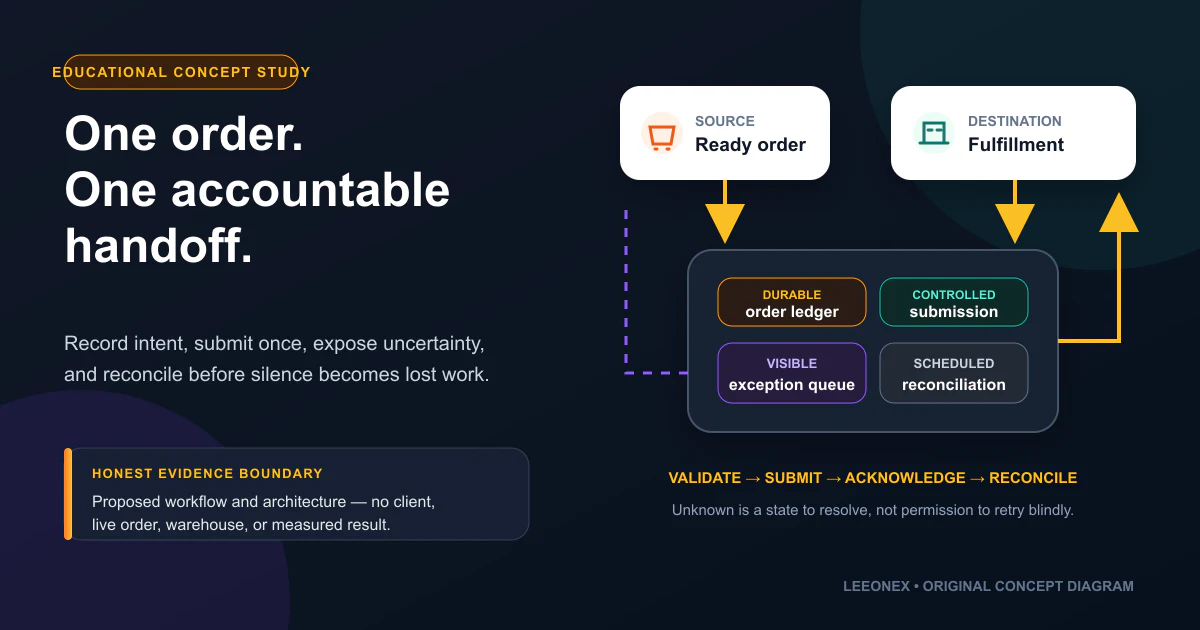
The smallest useful order-to-fulfillment integration records each ready order in a durable ledger, validates one explicit fulfillment contract, submits an idempotent command, and waits for the evidence that the destination actually promises. Rejected, delayed, and uncertain orders enter an owned exception path. Reconciliation checks source and destination state before silence becomes a lost order or a manual retry becomes a duplicate.
One durable ledger
Source identity, order version, attempts, destination references, and recovery evidence stay connected.
States the business can use
Received, accepted, rejected, and uncertain are not collapsed into one technical success flag.
Recovery before expansion
Operators can explain and recover one handoff before more channels, warehouses, and edge cases enter scope.
Evidence disclosure
This is a Level E educational concept study, not a client story or implemented Leeonex integration. The conversation, roles, state counts, diagrams, architecture, and scope are illustrative. No real order, system, warehouse, launch, fulfillment result, error reduction, time saving, revenue, or reliability outcome was measured. Stronger claims would need an implemented flow, representative tests, production evidence, approved identity and visuals, and publication permission.
Starting situation
“Send the paid order to the warehouse” hides several different promises
Imagine a commerce team whose storefront captures an order, an ERP records the commercial document, and a fulfillment provider allocates stock and ships it. The integration usually works, but operations still searches dashboards, email, and provider portals when an order has no warehouse reference, appears twice, or stays unchanged after a timeout.
The visible request sounds simple: connect the APIs. The real decisions concern readiness, authority, identity, partial failure, and recovery. A payment response does not prove an order is fulfillable. An accepted HTTP request does not prove stock was allocated. A retry does not prove the original attempt failed. Without explicit states, the team turns uncertainty into manual side effects.
Illustrative conversation — not a client quotation
Commerce operations lead
When an order is paid, we send it to the ERP and fulfillment provider. Most arrive, but the team still searches three systems when one is missing or duplicated.
Leeonex
What proves the order was accepted for fulfillment, and what state appears when the request times out after the destination may already have created it?
Commerce operations lead
A successful API response usually means it worked. If we do not see a warehouse reference, someone retries or creates it manually.
Leeonex
Then the first release needs a durable order ledger, stable operation keys, separate submission and acceptance states, an owned exception queue, and reconciliation before another create is allowed.
Intended buyer and constraints
This scope is for a team whose customer promise depends on a handoff it cannot see end to end
The intended buyer is a commerce or operations leader, business owner, product team, or integration owner moving orders between a sales channel and an ERP, order-management system, warehouse, or fulfillment partner. It is most useful when the team has real volume, customer commitments, and manual recovery—but no single place that explains what happened to one order.
Commerce owner
Defines when an order is ready to leave the sales channel, which changes are still allowed, and what the customer may be told.
Fulfillment operator
Owns acceptance rules, allocation and hold exceptions, destination corrections, and the physical-work states the source may read.
Integration owner
Owns contracts, identity, credentials, queues, mappings, retries, observability, reconciliation, and provider-change response.
Support owner
Needs a customer-safe explanation, the last confirmed state, and an approved recovery action without reading raw logs or creating another order.
Constraints include changing orders, unstable product mappings, regional address and tax rules, destination maintenance, rate limits, delayed webhooks, stock decisions, manual destination edits, privacy, and the fact that providers use words such as “received,” “accepted,” and “allocated” differently. The first design task is to turn those words into a shared operating contract.
Core flow
Make an uncertain result a first-class state
The source emits or exposes an order that meets the agreed readiness rule. The integration stores that version, validates required data and mappings, and creates one stable operation key. A worker submits the command and records the destination evidence. If the destination rejects the order, the failed rule and owner are visible. If the response is unknown, the order enters an uncertain state until lookup or reconciliation proves the result.
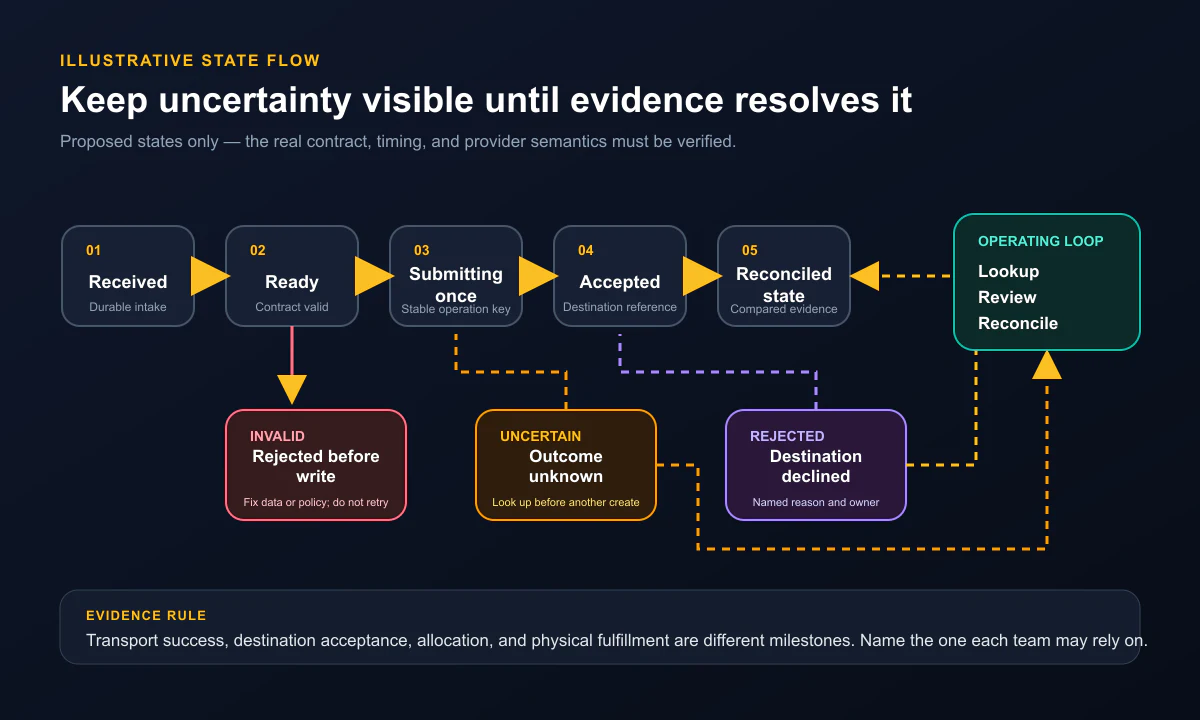
Destination acceptance may be the end of the integration command, but it is not the end of fulfillment. Later status updates should carry stable references, allowed transitions, event time, and processing time. Support may read the last confirmed state; only named operators may correct or replay it. That boundary keeps a customer question from becoming an unsafe write.
Smallest useful scope
Build one complete handoff before connecting every source and exception
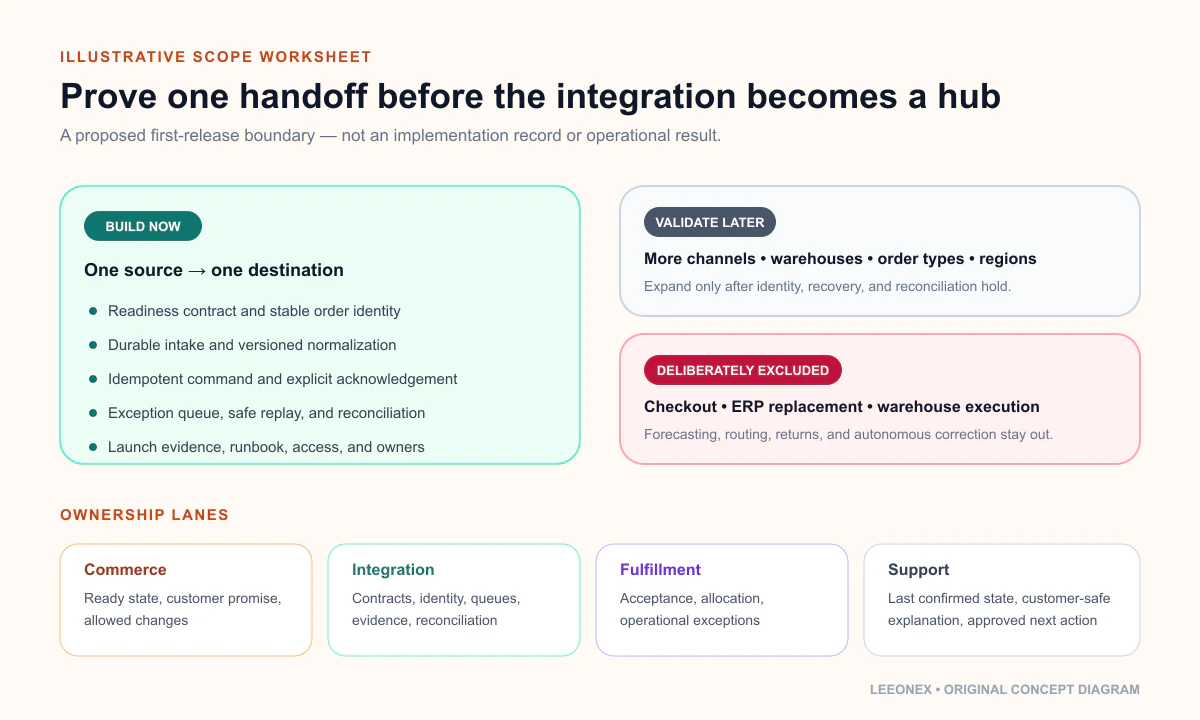
Build now
- One order source, one destination, one legal entity, and one fulfillment path
- A readiness contract for payment state, address, items, quantity, price reference, tax result, and required fulfillment data
- Stable source order, operation, and destination references held in one canonical ledger
- Durable intake, validation, idempotent submission, destination acknowledgement, and explicit exception states
- Controlled replay that checks existing destination state before issuing another side effect
- Scheduled reconciliation for accepted orders, missing references, cancellations, and status drift
- Operator evidence, alerts, runbook, access rules, retention, and launch acceptance scenarios
Later or deliberately excluded
- Every storefront, marketplace, region, legal entity, warehouse, carrier, and order type
- Procurement, replenishment, demand forecasting, warehouse planning, and route optimization
- Complex substitutions, split allocations, bundles, backorders, drop shipping, and multi-party settlement
- Replacing the ERP, warehouse management system, order management system, or customer-support platform
- Autonomous correction of address, product, tax, payment, inventory, or compliance conflicts
- A universal real-time promise where provider contracts and business consequences do not require it
A narrow cohort gives the team enough repetition to test the contract without mixing several operating models. One source, destination, order type, entity, and fulfillment path can reveal whether the identity, mappings, acknowledgement, recovery, and ownership model is sound before the integration becomes a hub.
Architecture and implementation decisions
Put a durable operating boundary between source and destination
Record before calling
Persist the source event, normalized order version, operation key, and intended destination before any external write. A worker can resume from durable intent instead of reconstructing truth from logs.
Separate order identity from attempts
The business order stays stable while submission attempts receive their own identifiers. A retry asks about the same operation; it does not become permission to create another order.
Treat transport success as evidence, not completion
A 2xx response, webhook delivery, queue acknowledgement, ERP document number, and warehouse acceptance can describe different milestones. The state model names which one the business may rely on.
Reconcile business state
A scheduled comparison checks the records and states that matter, including accepted-but-unreferenced orders, destination-only orders, cancellations, and stale fulfillment status.
Make exceptions operable
Operators see the order, failed rule, last safe action, destination evidence, owner, and permitted next steps. Restricted replay and correction are designed before launch.
Version contracts and mappings
Order schemas, item mappings, address rules, status translations, provider versions, and feature flags change under controlled rollout with representative fixtures and rollback evidence.
Whether this boundary uses custom code or an integration platform depends on connector quality, transformation complexity, duplicate and ordering behavior, security, recovery, volume, change control, and team ownership. The iPaaS vs custom integration guide helps frame that choice. The design still needs the same business contract and evidence either way.
Risks and guardrails
Protect the side effects the customer and operator cannot easily undo
Do not submit until the order meets one named readiness contract; payment captured, authorized, or invoiced are different commercial states.
Use a stable business operation key for duplicate-sensitive writes and verify the destination's exact idempotency retention and parameter rules.
Do not turn an unknown timeout into an automatic create retry until a lookup or reconciliation path has ruled out prior success.
Preserve received payload, normalized version, validation result, request reference, response evidence, webhook delivery, and operator action without storing unnecessary sensitive data.
Verify inbound signatures, restrict outbound credentials, rotate secrets, validate schemas, and keep support access narrower than integration-owner access.
Test duplicates, delay, reordering, partial outages, expired credentials, throttling, schema changes, invalid items, address changes, cancellations, and destination-only records.
Define who may cancel, correct, replay, release a hold, or create a manual order—and how the integration learns about that decision.
Launch with a bounded cohort, reconciliation counts, stop criteria, rollback or pause controls, provider contacts, and named business ownership.
Provider-specific behavior must be verified from current documentation and representative tests. The broader API integration requirements checklist covers contracts, security, retries, webhooks, reconciliation, testing, release, and ownership that should be resolved before an estimate becomes a commitment.
Limitations and claim boundary
This concept defines questions and controls, not a proven fulfillment result
No real order source, ERP, order-management system, warehouse, carrier, contract, volume, data set, operator team, or customer communication was inspected. The eight-state model is a teaching device, not a universal standard. The right states and controls depend on the destination's meaning, the cost of delay or duplication, and what people may safely correct.
The concept deliberately excludes checkout, payment, tax, forecasting, procurement, warehouse execution, routing, returns, and ERP replacement. It does not prove security, compliance, availability, correctness, speed, error reduction, or financial impact. SEO, structured data, sitemaps, and AI-readable discovery make the study easier to find and interpret; they do not guarantee ranking, indexing, citations, leads, or conversions.
Evidence needed before stronger claims
- An implemented source, integration boundary, destination, versioned contract, state model, runbook, and named operating owners
- Representative end-to-end, duplicate, timeout, ordering, retry, reconciliation, credential, provider-change, cutover, pause, and recovery tests
- Production telemetry, incident and exception records, reconciliation results, and approved definitions for any reliability or time claim
- Approved project identity or anonymization, screenshots or system diagrams, security and privacy review, visual rights, and publication permission
Lessons for a similar buyer
The important integration question is what the team can prove about one order
Start with the customer and operating promise, then define the records and evidence that uphold it. A connector demo can show data moving; it cannot decide when an order is ready, what destination acceptance means, or who owns an uncertain result.
Recovery is part of the product. If support and operations cannot explain, correct, pause, or reconcile a failed handoff, the happy path is not production-ready. The exception path also reveals whether the business has made the policy decisions the software needs.
Expansion should follow evidence. Add channels, warehouses, order types, and richer automation only after the first cohort demonstrates stable identity, clear states, safe replay, usable alerts, owned exceptions, and reconciled outcomes.
What to bring to a first consultation
Bring one order and the hard cases around it
- The source and destination systems, API or file contracts, provider contacts, sandbox access, and credential ownership
- One accepted-order journey plus representative invalid, duplicate, changed, cancelled, split, delayed, rejected, and uncertain examples
- The exact commercial state that permits fulfillment and the data fields the destination requires at that moment
- Stable identifiers, item and status mappings, expected volume, peak patterns, acceptable delay, rate limits, and provider maintenance behavior
- Current manual recovery steps, support messages, exception owners, reconciliation reports, and any destination-only work
- Security, privacy, retention, tax, geographic, regulated-product, audit, and customer-communication constraints
- The first source, destination, cohort, and order type that can prove the boundary without expanding into a full operations replacement
Those inputs are enough to identify missing policy, test provider assumptions, compare build approaches, and draw a first release boundary. You can then discuss the proposed handoff through Leeonex's API and integration development service or review other evidence-labelled blueprints in the case-study hub.
Problem-aligned next step
Map the order contract before choosing the connector
Leeonex can help turn one order journey, its source and destination contracts, and its exception evidence into a scoped integration decision. The output may be a custom boundary, an iPaaS flow, a staged discovery, or a recommendation to repair data ownership before development.
Discuss your order handoff