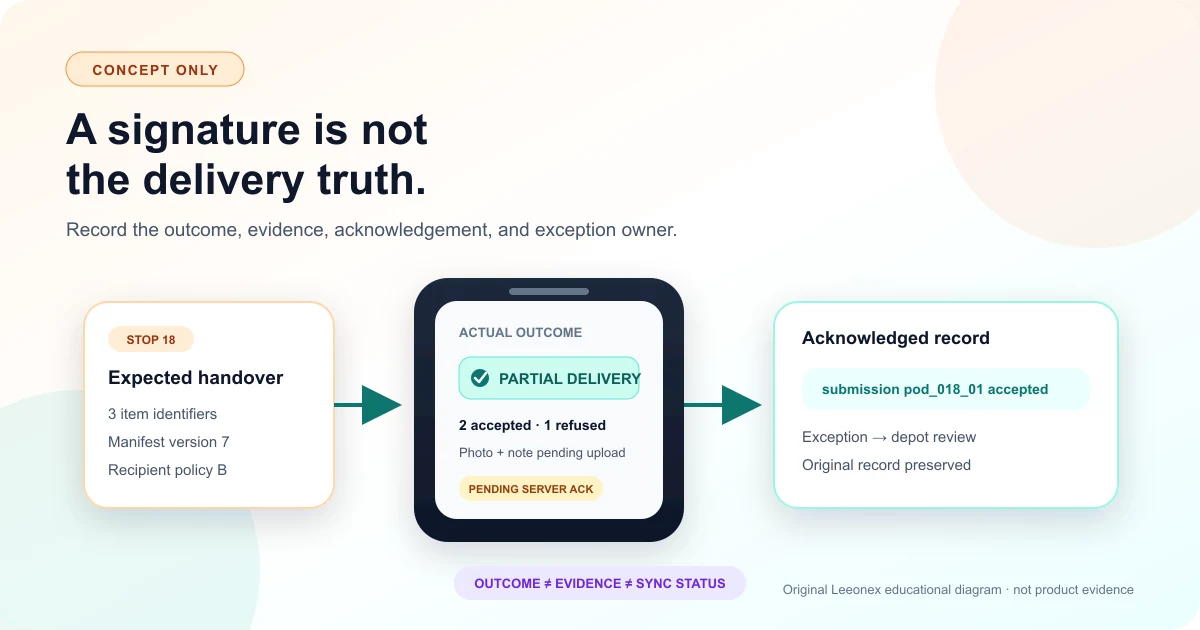
The answer first: model a delivery outcome, then attach the evidence that supports it
Scope proof of delivery as an accountable stop record, not a signature screen. The first useful app should identify the assigned stop and manifest version, verify what was actually handed over, record an explicit accepted, partial, refused, or unresolved outcome, collect only the evidence that policy requires, survive poor connectivity, obtain server acknowledgement, and send every mismatch to a named recovery owner.
This study is for delivery operators, logistics leaders, field operations owners, and mobile product teams whose disputes cannot be answered by “the driver captured a signature.” The buyer problem is reconstructing which items were expected, what happened at the stop, who recorded or acknowledged it, which evidence was available, whether it synchronized, and how later corrections changed the record.
Outcome first
Record the real handover result before asking evidence to support it.
Offline is visible
A durable device submission stays pending until the server acknowledges it.
Exceptions return
Partials, refusals, conflicts, and rejected evidence go to an owner instead of disappearing.
Evidence disclosure
This is a Level E educational concept study, not a client story or an implemented Leeonex app. The delivery operation, roles, dialogue, state counts, evidence rules, diagrams, architecture, and scope are illustrative. No carrier, recipient, route, production record, legal approval, app-store release, dispute reduction, delivery rate, time saving, cost saving, or other outcome was measured. Stronger claims would require implementation evidence, representative field and failure testing, production records, approved identity and visuals, and publication permission.
The starting situation: the paperwork says delivered, but the operation cannot explain the handover
A delivery operation already has routes in a transport system, package labels, driver phones, and a recipient-signature field. Most stops close cleanly. The hard cases arrive later: a customer says one package was missing, a recipient accepted only the undamaged items, a photo uploaded after the stop was marked complete, or the driver submitted offline and support cannot tell whether the record reached the server.
The natural response is to add more proof: require a photo, capture coordinates, force a signature, or collect more notes. That can create more sensitive data without making the delivery easier to interpret. A useful app begins with the delivery decision and its exceptions, then asks which evidence is proportionate and what each field is allowed to mean.
The intended buyer and constraints
- An operations owner needs one delivery type to become supportable without replacing the transport platform.
- Drivers work under time pressure, variable connectivity, imperfect lighting, device limitations, and real safety constraints.
- The expected manifest can change while the device holds an older assignment, so stale data cannot silently authorize completion.
- Signatures, photos, notes, timestamps, and location may be sensitive and may not prove identity, condition, consent, or complete handover by themselves.
- Customer service and operations need a correction path that preserves the original record and downstream consequences.
Illustrative discovery conversation: ask what the signature is supposed to prove
Illustrative conversation—not a client quotation. The following exchange is invented to expose decisions a real discovery session should resolve. It does not represent a Leeonex client, carrier, recipient, project, or delivered result.
Operations lead
“We need a driver app that captures a signature, photo, and location so disputes stop coming back to the depot.”
Leeonex
“What does the signature prove in your operation: who received which items, that someone was present, or only that the driver handed over the device?”
Operations lead
“It depends. Some stops are unattended, some orders are partial, and sometimes the recipient refuses one damaged item but accepts the rest.”
Leeonex
“Then the first release needs an outcome and evidence contract for each stop. A signature can belong inside that bundle, but it cannot silently turn every exception into delivered.”
The decision sequence should then walk one disputed stop backwards. Which manifest version was assigned? Which item identifiers were scanned or manually confirmed? What outcome did the driver choose? Was the recipient named, merely present, or unavailable? Which evidence was mandatory under that service policy? Did the device persist and sync it? Which system closed the stop, and who could correct it?
Four roles cover the first boundary
Driver or field operator
Sees an assigned stop, verifies the destination and items, records the real outcome, preserves work offline, and knows whether the server accepted it.
Recipient or site contact
Receives a clear explanation of what they acknowledge and can accept, refuse, or note a discrepancy without being forced into a false all-or-nothing result.
Dispatcher or operations owner
Sees pending sync, partials, refusals, failed evidence, and unresolved stops with an owner and a lawful next action.
Support or dispute reviewer
Reconstructs the manifest version, actor, device submission, evidence bundle, server acknowledgement, corrections, and customer communication.
The core flow: preserve the stop contract from assignment to reconciliation
The mobile client receives an assigned stop with a stable stop identifier, expected items, service policy, manifest version, and allowed actions. At arrival, it makes stale assignments and unavailable authority visible. The driver verifies items, records the actual outcome, and captures only the required evidence. The app then creates one durable local submission with its own identifier.
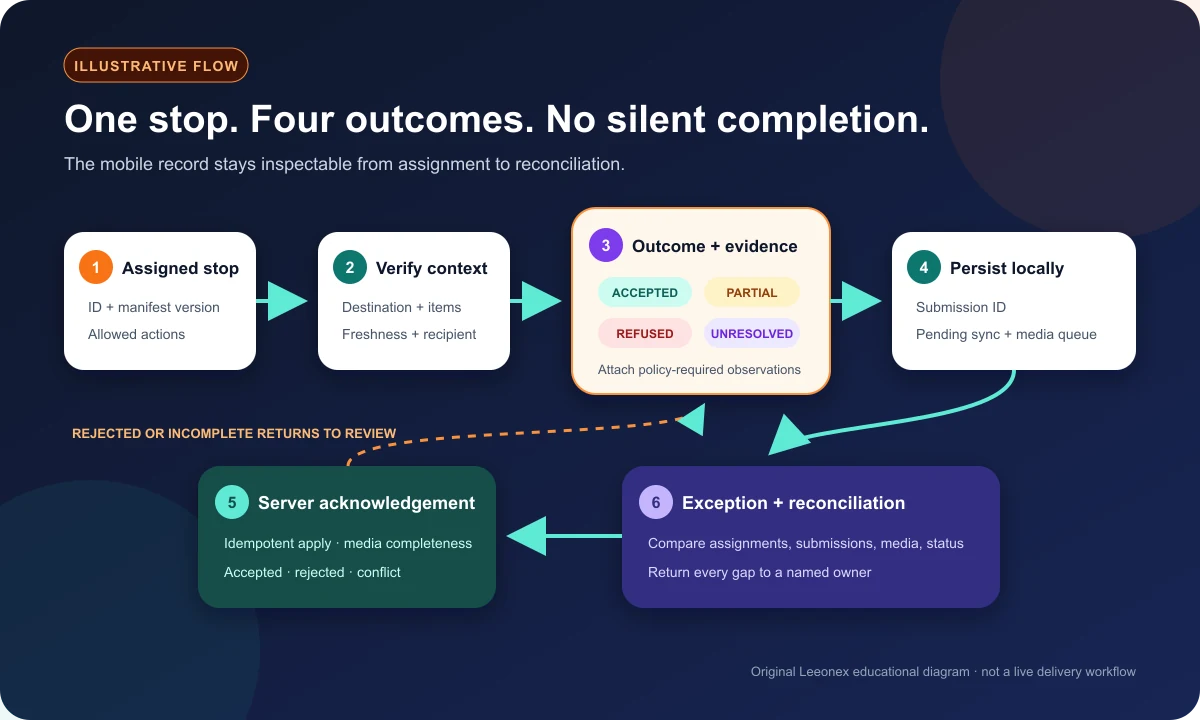
Structured fields and media may synchronize at different times. The server should apply duplicate protection, verify the assignment and state transition, and return an authoritative acknowledgement. A required photo still uploading means the evidence bundle is incomplete; an API timeout means the client should ask for the existing submission result rather than create another delivery event.
Reconciliation compares assigned stops, device submissions, server acknowledgements, required media, and downstream status. It finds the gaps neither the device queue nor the transport platform sees alone. This is where unresolved stops return to an operator instead of aging into customer disputes.
The smallest useful scope: one complete delivery slice, not a fleet platform
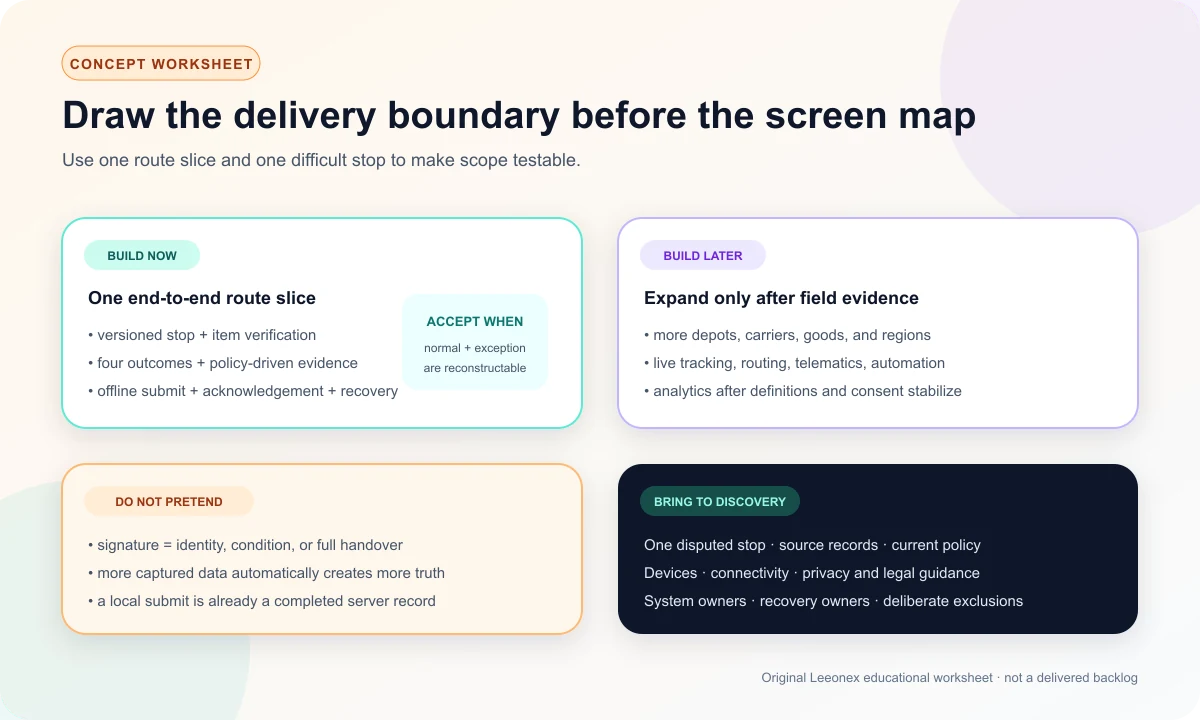
Choose one depot or operating group, one delivery type, one source manifest, and one evidence policy. Include a difficult but representative exception such as partial acceptance or refusal. The slice is useful when the driver can complete the normal and exception paths, operations can see every pending or rejected record, and a reviewer can reconstruct an approved correction.
Build now
- One depot, route type, delivery type, and explicit manifest source
- Assigned-stop cache with package or item identifiers and version awareness
- Arrival, recipient or unattended rule, item verification, and outcome selection
- Accepted, partially delivered, refused, and unresolved outcome paths
- Policy-driven notes, photo, signature, barcode, timestamp, and location capture where appropriate
- Durable local submission, visible pending state, idempotent sync, and server acknowledgement
- Operations queue for exceptions, rejected submissions, corrections, and reconciliation
- Restricted audit history connecting the original record to every approved amendment
Build later, after evidence
- Route optimization, live ETA prediction, customer map tracking, and multi-depot dispatch
- Every carrier, subcontractor, service level, return type, package class, and jurisdiction
- Computer vision that judges damage or automatically accepts image quality
- Dynamic geofences, background tracking, advanced telematics, and driver scoring
- Automated claims, credits, replacement orders, invoice decisions, and customer compensation
- Broad analytics until event definitions, device coverage, consent, and operating ownership are stable
Deliberately excluded from the concept
- A signature described as proof of identity, consent, condition, or complete handover when policy does not support that meaning
- Forced completion when packages, manifest data, evidence, recipient, or safe access do not match
- Silent overwriting of a synchronized record after a driver or operator correction
- Continuous location collection simply because the device can provide it
- A universal proof rule for regulated, high-value, age-restricted, hazardous, or chain-of-custody deliveries
For the wider job, dispatch, parts, invoicing, and service operation around the mobile stop, use the field service management software requirements checklist. When long disconnections and conflict resolution dominate the product risk, pair this scope with the offline-first mobile app requirements guide.
Architecture decisions: keep evidence meaning, device state, and delivery authority separate
The manifest owns the expected handover
The app caches an assigned, versioned delivery contract. It does not invent items or treat an old manifest as current when the authoritative record changed.
Outcome and evidence are separate
Accepted, partial, refused, and unresolved describe the business result. Photos, scans, notes, location, and signature are policy-dependent observations attached to it.
Local submit is not server complete
The device creates a durable submission identifier and shows pending sync. Only a server acknowledgement moves the authoritative stop into its accepted state.
Media follows an observable queue
Structured facts can sync before large files, but the record remains evidence-incomplete until required media is uploaded, validated, retained, or explicitly waived by an authorized role.
Corrections append instead of erase
A wrong quantity, recipient label, or outcome is amended through a reasoned, permissioned event that preserves the original submission and downstream consequences.
Reconciliation closes the invisible gap
Operations compares assigned stops, device submissions, server acknowledgements, required media, and downstream status so missing or conflicting records return to an owner.
Cross-platform does not erase device edges
Shared navigation, forms, state rules, validation, and sync logic can make a cross-platform client practical. Camera capture, barcode scanning, permissions, background transfer, secure storage, file handling, accessibility, power management, and OS lifecycle behavior still require platform-specific adapters and tests. The framework choice follows those pressures; it should not be decided from the wish to share code alone.
Keep the authoritative stop transition behind an API owned by the operation. The app can capture facts and request a result; it should not become a second transport management system. If assignment, manifest, recipient, package, media, customer communication, and billing facts live elsewhere, name the owner and reconciliation rule for each boundary.
Risks and guardrails: more evidence can create more liability, not more truth
Name what each evidence field can and cannot establish; do not let interface labels make legal promises.
Collect signatures, photos, notes, device data, timestamps, and location only under approved purpose, access, retention, deletion, and consent rules.
Make accepted, partial, refused, unresolved, pending sync, rejected, and corrected states visually distinct.
Protect against duplicate taps, retries, app restarts, device restarts, media retries, and two devices submitting the same stop.
Warn when assignments or manifests are stale and define the few safe actions available while authority cannot be reached.
Let the driver report unsafe access, wrong address, damaged goods, absent recipient, identity mismatch, and app failure without fabricating completion.
Restrict evidence access, exports, corrections, and overrides; retain who did what, when, why, and from which accepted source.
Test with representative devices, lighting, gloves, camera permissions, battery pressure, storage limits, noise, language needs, and weak networks.
Define acceptance evidence before build
| Scenario | Expected behavior | Acceptance evidence |
|---|---|---|
| Clean handover | Verify all expected items and allowed recipient path | One acknowledged outcome with complete required evidence |
| Partial acceptance | Record accepted and refused items plus reason | Manifest and downstream status preserve both results |
| Offline submit | Persist once, display pending, retry idempotently | Restart and reconnect return the same server record |
| Media failure | Keep evidence incomplete and recover upload | Operations sees the missing asset and its owner |
| Stale assignment | Warn, restrict unsafe completion, and recheck authority | No old manifest silently closes the current stop |
| Correction | Append an approved amendment with consequences | Original and corrected facts remain reconstructable |
Limitations: this blueprint does not establish a lawful or production-ready proof standard
The concept has not been implemented, observed with drivers, reviewed by recipients, tested on devices, connected to a transport system, assessed for security or privacy, or reviewed for any jurisdiction, contract, insurance policy, or category of goods. It cannot say which evidence is legally sufficient, how long it should be retained, or whether a signature, photograph, scan, timestamp, or location may be collected in a real operation.
It also cannot support claims about delivery completion, first-attempt success, disputes, claims, driver time, route efficiency, support work, loss, revenue, or cost. Before any stronger statement, the team would need the following evidence:
- An implemented app, API, local store, media queue, authoritative delivery record, audit path, and operations recovery interface
- Representative offline, duplicate, stale-manifest, partial, refusal, recipient, media, correction, reconciliation, deployment, and rollback tests
- Field research across real devices, users, environments, accessibility needs, and connectivity conditions
- Approved legal, privacy, security, safety, retention, and evidence-meaning decisions for every captured field
- Production telemetry and dispute records with approved metric definitions, baselines, windows, exclusions, attribution limits, source systems, and verifier
- Approved identity, screenshots, quotations, visual rights, redaction, and publication permission
Lessons for teams deciding what to build
Start with a disputed stop
The hard exception reveals more useful requirements than a happy-path feature list.
Give evidence a defined meaning
A field should support a named decision, not become proof because the UI calls it proof.
Treat pending as a real state
A local record, an uploaded file, and an accepted server outcome are different facts.
Preserve corrections
An auditable amendment is more trustworthy than overwriting the inconvenient original.
Keep custom scope narrow
Extend a stable platform when it already owns the operation; build the differentiated mobile boundary only where needed.
Test in the field
Device labs cannot reproduce every interruption, light level, permission, glove, battery, language, or connectivity constraint.
What to bring to a first consultation
The most useful first conversation is not a tour of desired app screens. Bring one route, one disputed stop, the records that exist today, and the people who own driver work, delivery truth, customer communication, privacy, and recovery.
- One recent route and one disputed, partial, refused, or failed delivery reconstructed from source records
- The manifest, stop, package, recipient, service-level, and exception rules currently used by operations
- Current driver paperwork, app screens, scans, photos, signatures, notes, support tickets, and manual corrections
- The system of record, stable identifiers, APIs, update timing, retry behavior, and downstream customer or finance effects
- Representative devices, OS versions, cameras, scanners, permissions, connectivity gaps, working conditions, and accessibility needs
- Approved privacy, consent, retention, location, safety, insurance, customer communication, and legal guidance
- The one delivery slice worth proving and the features, routes, goods, partners, and regions the first release can exclude
Leave with a delivery boundary, not a screen backlog
A focused discovery should identify the authoritative stop contract, evidence meanings, offline promise, exception owners, system boundaries, test scenarios, exclusions, and the smallest route slice worth proving. Explore Leeonex cross-platform app development, review other educational work in the case-study hub, or bring your delivery workflow to a consultation.