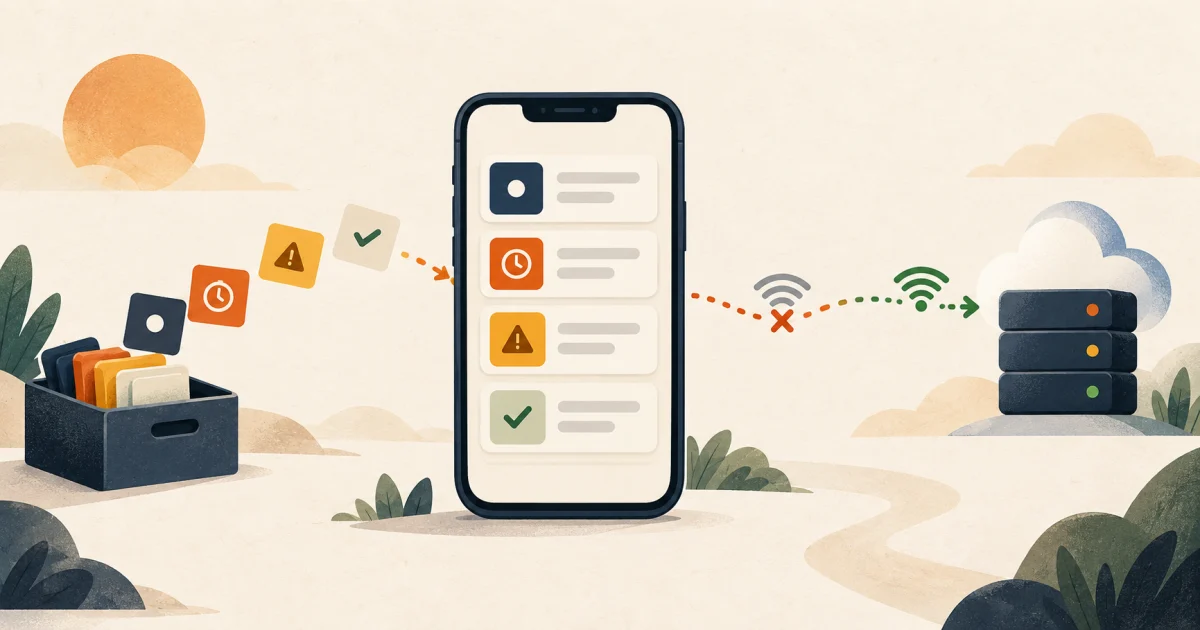
The short answer: define what users can trust before choosing a sync stack
Offline-first mobile app requirements should name the journeys that remain useful without a dependable network, the data held locally, which actions save or queue, how pending work becomes confirmed, what happens when records conflict, and the evidence that proves recovery after interruption. “Works offline” is not a testable requirement.
Begin with one outcome in its real operating setting: a field inspector completes a visit in a basement, a warehouse operator records a movement behind metal shelving, or a travelling team updates a case between connections. Decide what the person must finish, what may wait, and what still requires server authority.
Persist
Save permitted work before delivery
Reveal
Show pending, failed, and confirmed state
Reconcile
Resolve conflicts by business rule
Write an offline action contract for each critical journey
A cached screen and a durable offline workflow are different products. Seeing yesterday's job list may be safe. Marking a controlled asset as transferred, taking a payment, or approving a regulated result may require current authorization and server confirmation. Classify actions before engineering estimates the local database or synchronization engine.
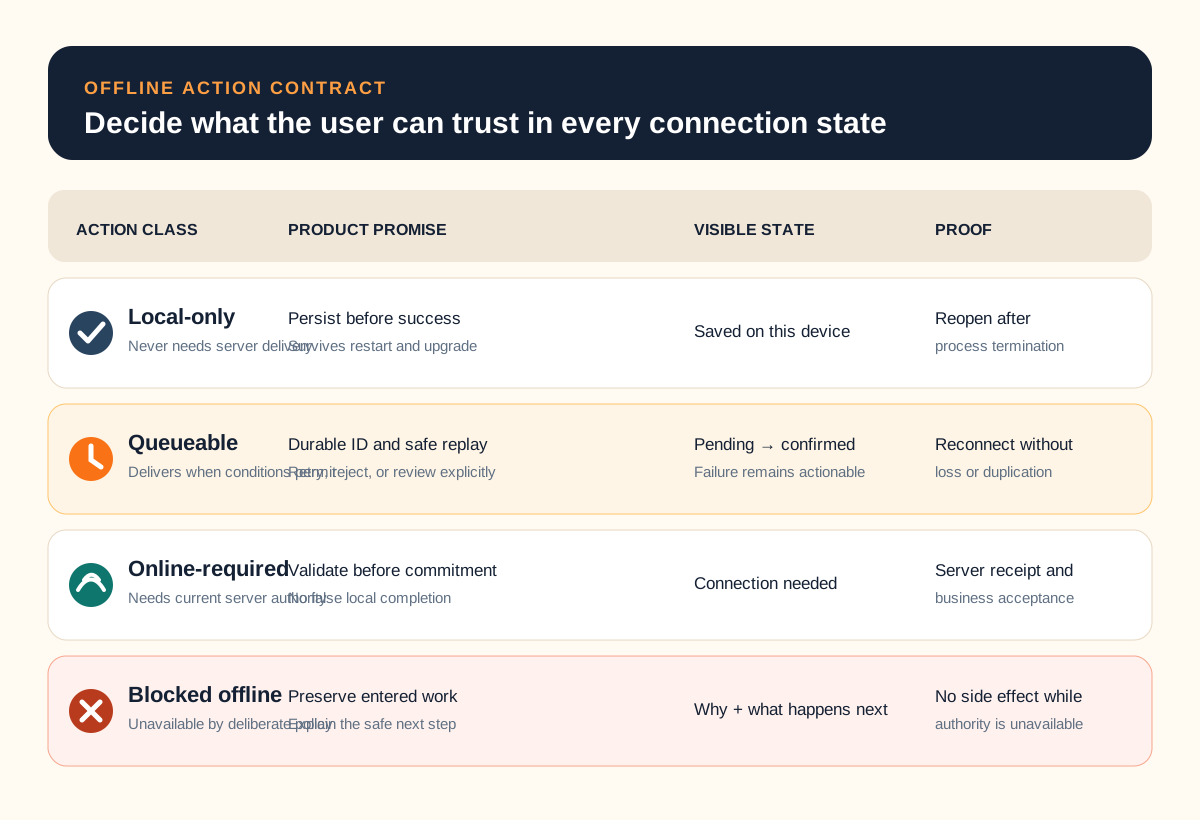
| Action class | Product promise | Example |
|---|---|---|
| Local-only | Completes on the device and never needs server delivery | Save a private draft or display preference |
| Queueable | Persists locally, shows pending state, and can be replayed safely | Capture a checklist result or photo |
| Online-required | Starts only when the server can validate and confirm it | Charge a card or claim scarce inventory |
| Blocked offline | Explains why the action is unavailable and preserves entered work | Approve a record after permission expiry |
The broader mobile app requirements checklist helps define platforms, permissions, backend scope, release, and ownership. This guide goes deeper only where connectivity changes the product contract.
Define the local data and server-authority boundary
List the objects, fields, files, reference data, and relationship depth needed for the offline journey. For each one, record its local retention, freshness signal, sensitivity, storage size, and authoritative owner. A device can be the immediate source for the interface without becoming the final authority for every business decision.
Android's official offline-first architecture guidance recommends a local data source for critical reads and separates local state from the network source. It also distinguishes online-only, queued, and lazy write strategies. Treat those as implementation patterns selected after the product has named the consequence of delay or failure.
The server contract must support the mobile promise. Define stable client-generated operation identifiers, idempotent replay, version or revision metadata, incremental downloads, deletions, attachment resumption, permission revalidation, and a response that distinguishes retryable failure from permanent rejection. Otherwise the client may preserve an action but duplicate or silently lose it at the API boundary.
Make synchronization state observable to people
“Saved” is ambiguous. It might mean held in memory, committed to durable device storage, accepted into a delivery queue, or confirmed by the server. Use explicit internal states and plain user language. A practical mutation can move through local draft, pending, sending, confirmed, retryable failure, rejected, or conflict-review states.
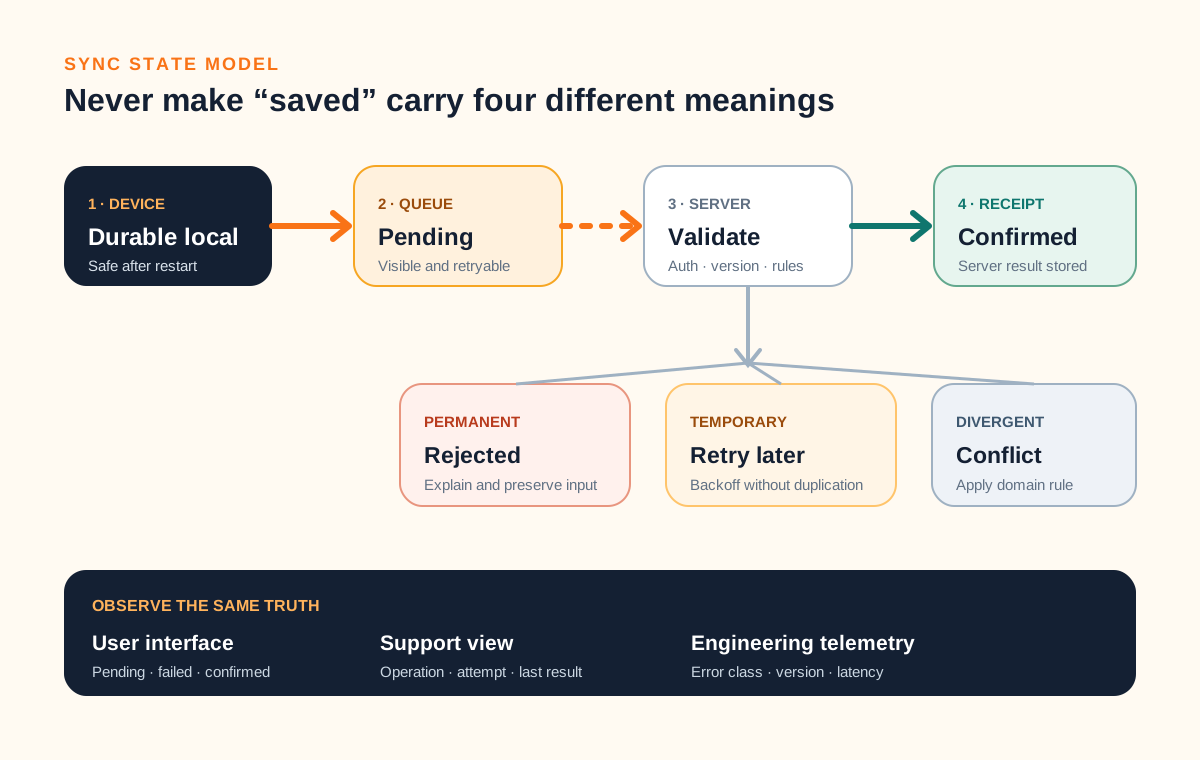
Support and operations need the same truth. Capture a safe operation ID, record type, state, attempt count, last error class, app version, schema version, and timestamps without copying sensitive business content into logs. Give authorized staff a way to distinguish a device that has not attempted sync from a server that rejected the operation.
Background work is an opportunity, not an immediate-delivery guarantee. Apple's Background Tasks framework schedules important work under system control. Persist the queue first, make reconciliation safe to resume after process termination, and run a foreground check when the user returns.
Resolve conflicts by business meaning, not one global rule
Last-write-wins can be reasonable for a display preference and dangerous for stock, approvals, or completed work. Decide at object or field level whether the server wins, the client wins, values merge, events append, or a person reviews the difference. Include deletion and permission changes: a queued update should not recreate a record intentionally removed or bypass a role revoked while the device was offline.
- Detect: compare expected revision, server revision, actor, and operation ID.
- Classify: determine whether the difference is harmless, mergeable, forbidden, or needs a decision.
- Resolve: apply the named domain rule and preserve the original attempt.
- Explain: show the user what changed, what remains unsent, and the next action.
The Leeonex offline-first field inspection concept shows why captured evidence, supervisor review, and sync integrity belong to one workflow boundary rather than three disconnected feature lists.
Test security, lifecycle, and connection transitions
Offline capability increases what lives on the device. Define which data is encrypted by platform storage, which values need stronger protection, how authentication expiry affects reads and writes, what remote sign-out can and cannot do, and how local data is removed on account change, device transfer, or retention expiry. Security owners should review the final controls for the actual data class and threat model.
Build an acceptance matrix around transitions: launch with no data and no network; lose connection before and during a write; terminate the app with queued work; reconnect after hours or weeks; switch networks; upload a large attachment; edit the same record on two devices; receive a permission rejection; migrate the local database during an app update; and recover from a partially applied server response.
For every scenario, verify the visible state, durable device state, queue state, server result, duplicate behavior, reconciliation, telemetry, and support explanation. That is the acceptance evidence—not a demo that one screen opens in airplane mode.
Use a one-journey offline release brief
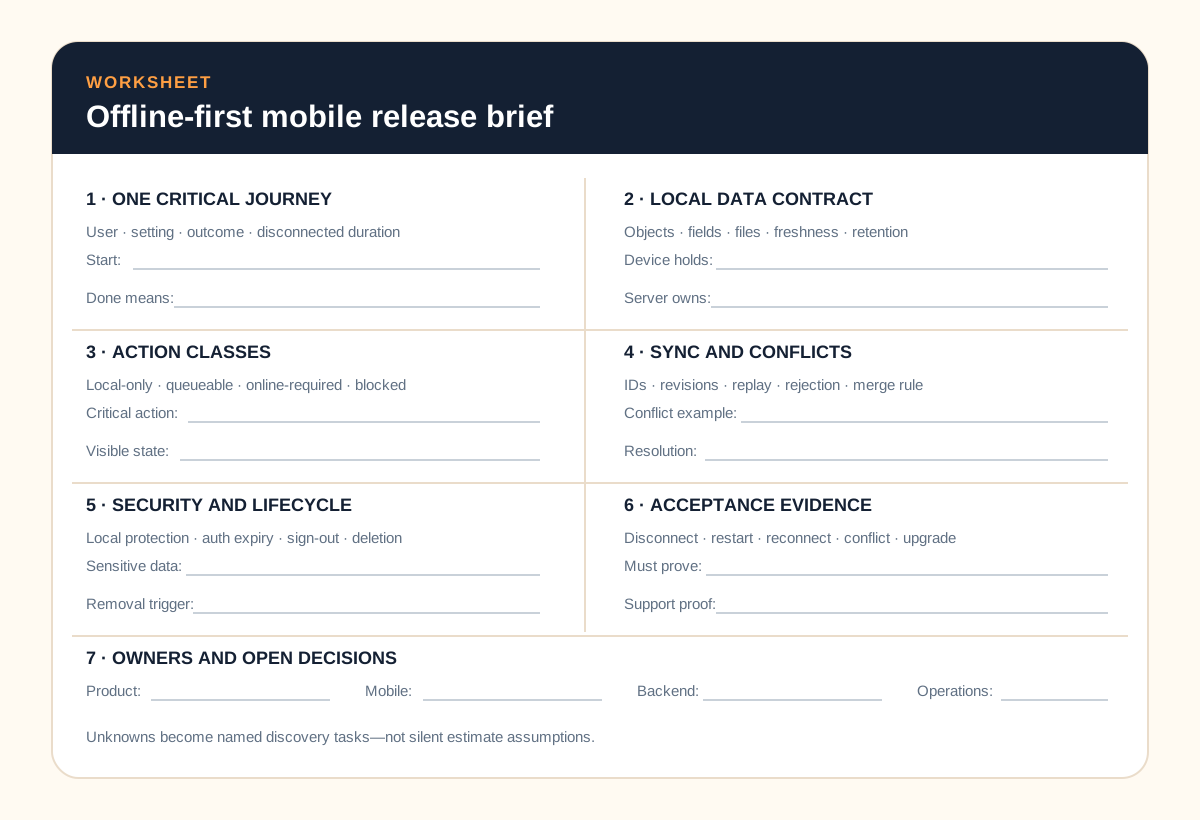
Keep the first release bounded. Choose one complete journey, its representative data, expected disconnected duration, supported devices, action classes, conflict examples, security constraints, and transition tests. Mark every unresolved rule as a discovery task with an owner. Leeonex's mobile app development service can help turn that contract into a maintainable client, API, and operational plan without pretending every feature needs offline write support.
Offline-first mobile app requirements FAQ
What should offline mobile app requirements include?
Define the critical journeys, data available locally, permitted offline actions, durable queue behavior, synchronization triggers, idempotency, conflict rules, visible states, authentication and local-data controls, retention, background-work limits, acceptance scenarios, telemetry, support tools, and accountable product and technical owners.
Does offline-first mean every feature works without internet?
No. It means the product deliberately defines useful behavior without dependable connectivity. Some reads may use local data, some writes may queue, and high-risk actions such as payments or server-authorized decisions may remain online-only. The boundary should be visible rather than discovered through failure.
How should an offline app handle sync conflicts?
Choose a rule per business object or field. Options include server authority, client authority, last-write-wins, merges, append-only events, or human review. Preserve versions and operation identifiers, explain the outcome to the user, and never use a generic timestamp rule where overwriting the wrong value is costly.
Can background sync be guaranteed on iOS and Android?
No product brief should assume immediate, continuous background execution. Mobile operating systems schedule, constrain, or defer background work. Persist operations before attempting delivery, resume safely when the app reopens, and make foreground reconciliation part of the design.
How do you test an offline-first mobile app?
Test transitions, not only airplane-mode screens: start offline, disconnect during a write, restart with queued work, reconnect after long gaps, change the same record on two devices, receive authorization or validation rejection, retry attachments, rotate credentials, upgrade the local schema, and confirm support can explain every unresolved state.