Answer first
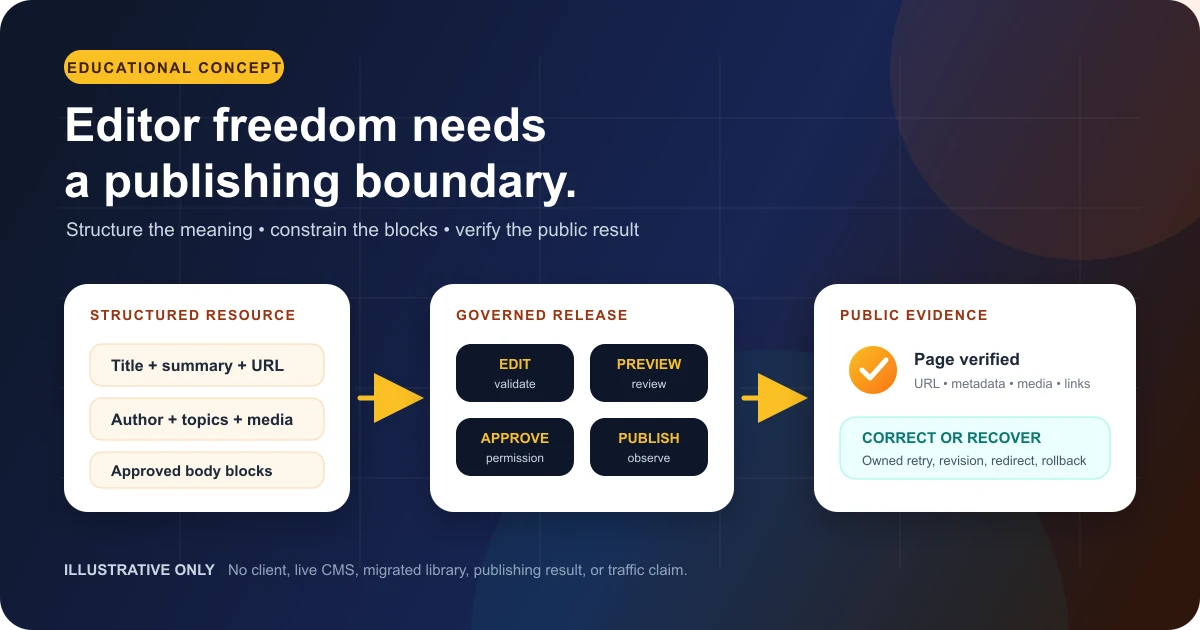
Give editors controlled choices, not control over every rendering decision.
Scope a resource-library CMS around editorial meaning and a complete publishing job. Model the resource as structured fields and references, offer only the body blocks that real examples need, and keep layout, responsive behavior, and component quality inside the delivery system. Then make draft, review, preview, publish, verify, correct, archive, and redirect explicit.
The smallest useful release is one representative resource type operated by the real publishing roles. It should prove that an editor can create useful variation without breaking URLs, design, accessibility, metadata, or delivery—and that the team can detect and recover when publication does not reach the public page. It is not automatically a headless build, a replatform, or a promise of faster publishing or search growth.
Evidence boundary
This is a Level E educational concept study. Leeonex has not implemented, migrated, tested, operated, or measured this model for a client or real editorial team. The dialogue, roles, content types, states, counts, diagrams, architecture, technology labels, and acceptance examples are illustrative planning material—not a product screen, CMS record, testimonial, benchmark, traffic result, publishing result, or business outcome.
Starting situation and intended buyer
“Make every page editable” is not yet a CMS requirement.
This concept is for a marketing leader, content owner, editorial team, or website product owner whose resource library has outgrown developer-authored pages but still needs a coherent public experience. New formats arrive as copied templates, authors work around rigid fields, taxonomies split into near duplicates, and exceptional pages become requests for more page-builder freedom.
The tempting response is to expose layout controls until an editor can reproduce almost any design. That moves hidden product decisions into individual entries: spacing, hierarchy, responsive behavior, link treatment, media use, metadata, and component combinations can drift page by page. The editor gains options but inherits quality decisions the interface may not explain.
The alternative is not a locked template that makes every meaningful change an engineering ticket. It is a bounded system where editors control content meaning and approved composition, while the delivery layer owns consistent rendering. The scope should begin with real examples and real publishing jobs—not a vendor feature list or a hypothetical component catalog.
Illustrative discovery conversation — not a client quotation
Flexibility should answer a recurring editorial need.
Content lead
“We want the team to launch reports, guides, and articles without engineering, so should editors be able to assemble any page they want?”
Leeonex
“Which differences carry meaning for readers, and which are only presentation choices that the design system should own?”
Content lead
“The format, author, topics, call to action, related resources, and downloadable file matter. Most pages still follow the same reading pattern.”
Leeonex
“Then start with one typed resource model and a small set of safe editorial blocks. Prove draft, review, preview, publish, verify, correct, and redirect before adding a general page builder.”
This exchange is Leeonex-authored teaching material. It describes no real customer, quotation, content team, CMS, resource library, implementation, migration, or result.
User roles and decision ownership
Separate content decisions, release authority, and platform change.
Content owner
Defines audience, formats, taxonomy, required fields, quality policy, lifecycle, and the decision each resource should support.
Editor or author
Creates and revises structured content, selects approved blocks, supplies accessible media details, and resolves validation feedback.
Reviewer or publisher
Checks meaning, permissions, links, preview, metadata, and release readiness before approving a public state change.
Platform owner
Owns schema changes, components, delivery contracts, roles, environments, observability, recovery, and controlled releases.
A small team may assign several roles to one person, but the decisions should remain visible. Writing copy is different from approving public release. Publishing an entry is different from changing the schema or rendering component that affects every entry. Explicit boundaries make later team growth and incident review less ambiguous.
Core publishing flow
A CMS task ends at the verified public result, not the publish button.
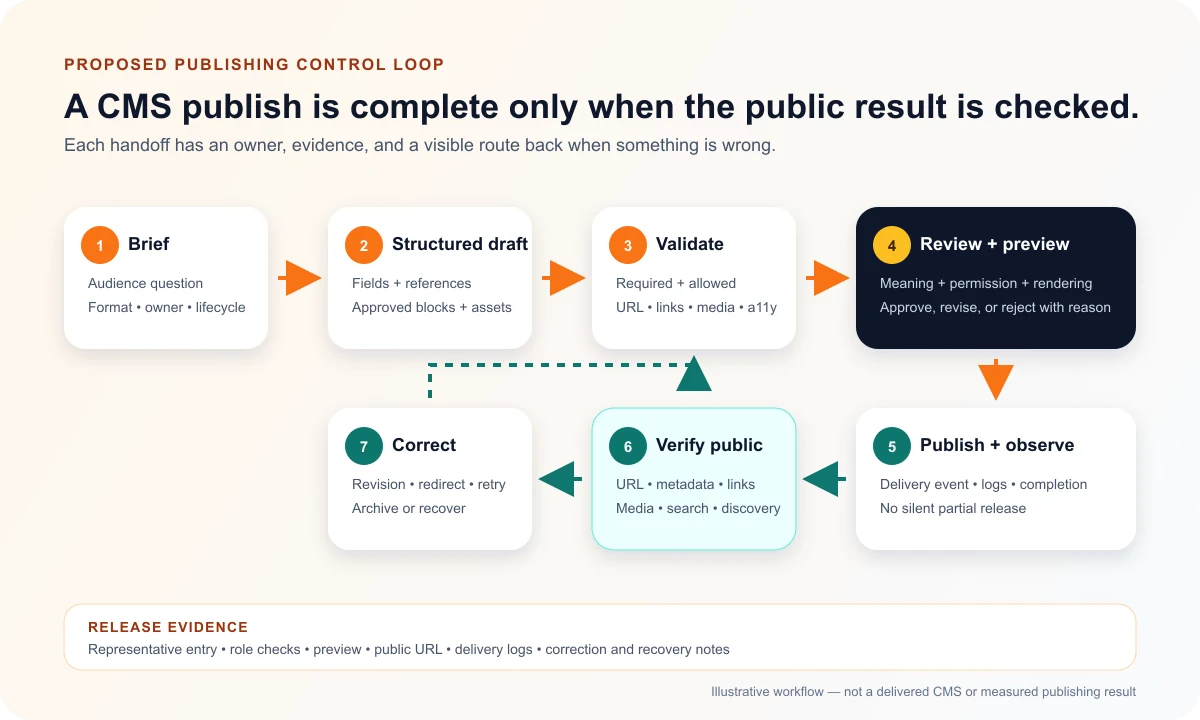
Begin with a brief that names the audience question, format, owner, required evidence, call to action, and lifecycle. The editor creates a structured draft, selects only approved blocks, relates authors and topics, supplies media alternatives and rights information, and sees validation before requesting review. Validation should prevent known-invalid states without pretending it can judge editorial quality.
Review should inspect both meaning and rendering. The reviewer needs the intended URL, title, description, heading hierarchy, media, links, call to action, related resources, and responsive preview—not merely a collection of fields. If the delivery system cannot render a block or reference, the item should not quietly publish a partial page.
After approval, a publish event may update a server-rendered page, trigger revalidation, start a build, refresh search, or notify other channels. Whatever the architecture, the team needs observable completion. Verify the public URL and its important discovery surfaces. If delivery fails, retain the approved content state, show the operational failure, and give an owner a safe retry or rollback path.
Smallest useful scope
Prove one end-to-end publishing job before growing the component menu.
Build now
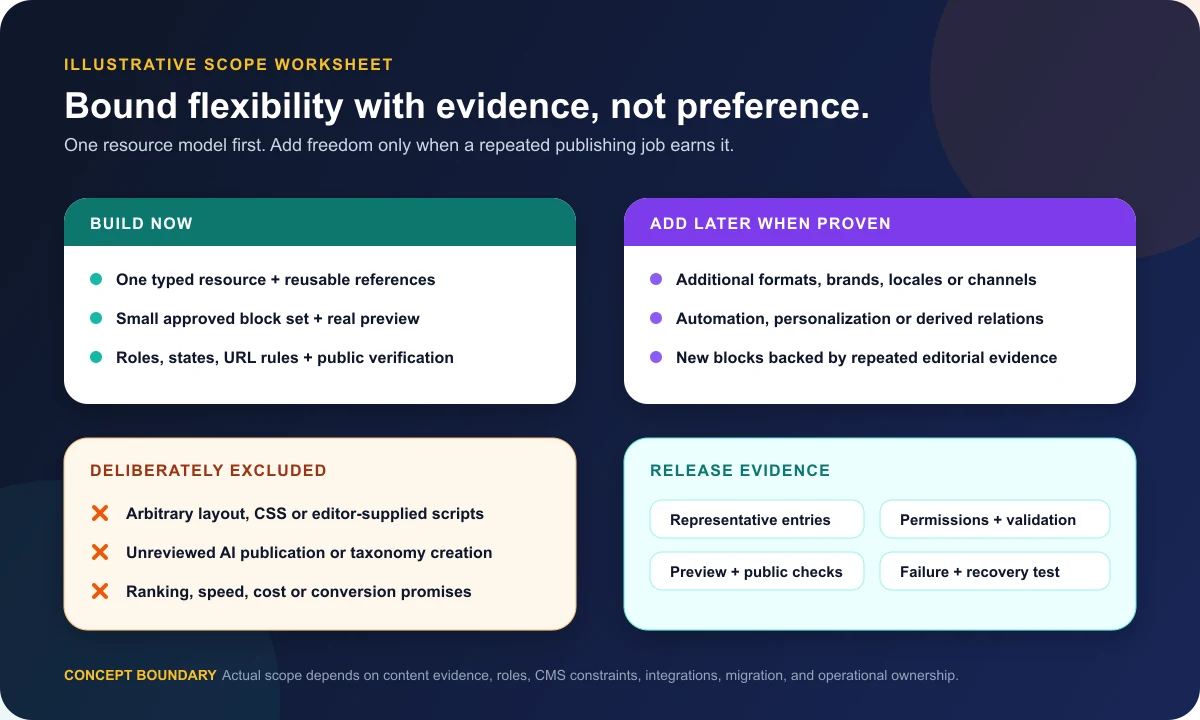
- One core resource type with stable fields for title, summary, body, format, author, topics, hero media, call to action, related content, canonical URL, and publication state
- A deliberately small allowlist of tested body blocks, such as prose, heading, list, quotation, image, callout, and download—only where each block has a real editorial job
- Draft, review, approved, scheduled or ready, published, corrected, and archived states with explicit permissions and a visible owner
- A preview that renders the real delivery components and checks required fields, heading order, media alternatives, links, URL, metadata, and unsupported combinations
- Publish, correction, archive, and redirect behavior with revision history, public-page verification, failure visibility, and a practiced recovery path
Later or deliberately excluded
- A universal drag-and-drop page builder, arbitrary layout controls, custom CSS, or editor-supplied scripts that bypass design, accessibility, security, and rendering contracts
- Every content format, team, brand, locale, channel, campaign, personalization rule, gated-download path, or historic content exception in the first model
- AI-generated drafts, metadata, taxonomy, related-content choices, translations, or summaries that publish without accountable human review
- Replacing editorial strategy, legal or subject review, asset rights management, analytics interpretation, search strategy, or the wider website migration plan
- Claims that a CMS architecture guarantees faster publishing, better rankings, more traffic, accessibility compliance, lower cost, or higher conversion
If the first representative set genuinely needs several distinct formats, model that evidence. Do not force unlike content into one type merely to keep the schema tidy. Equally, do not create a new content type or block for every visual variation when a field, reference, or delivery rule expresses the difference more clearly.
Architecture and implementation decisions
Choose the CMS model separately from the content contract.
The content contract should survive a platform comparison. It defines fields, references, validation, roles, states, URL policy, and lifecycle. A traditional CMS may render the public page inside the same platform. A headless model may deliver the same contract through a separate application. A hybrid may keep some page composition coupled while sharing structured resource objects elsewhere.
The closest supporting decision guide is Leeonex’s headless CMS versus traditional CMS guide. It compares operating models. This concept starts one step later: whichever model wins still needs a bounded resource schema, preview contract, publish path, and operational owner.
Separate asset storage and transformation decisions from the resource body. Define accepted media, focal behavior, captions, alternatives, rights metadata, responsive variants, and what happens when an asset is missing or removed. Decide whether related content is selected manually, derived from taxonomy, or computed elsewhere, and show editors when the public result will differ from the draft form.
Existing content adds a migration workstream: inventory, mapping, transformation, media transfer, redirects, validation, rehearsal, cutover, and rollback. Use the website migration checklist for that broader launch control. Do not let a clean future schema hide the cost of exceptional legacy content or URL preservation.
Risks and guardrails
Most CMS risk lives at the boundary between a valid entry and a trustworthy public page.
Model editorial meaning as fields and references; keep layout rules, spacing, responsive behavior, and component accessibility in the delivery system.
Allow flexibility only through named blocks with documented purpose, constraints, preview behavior, fallback behavior, and representative test content.
Treat URL, slug, canonical, redirect, publication date, author, taxonomy, and archive decisions as governed content—not incidental text boxes.
Render preview and production through the same component contracts where practical, and make environment, draft status, and stale-preview risk visible.
Queue and observe publish events. A CMS success response is not proof that the public page, cache, search index, sitemap, feed, analytics, or linked asset updated.
Version schema and component changes, test existing entries against them, provide migrations or compatibility paths, and keep a recovery decision owner.
Taxonomy deserves the same control. Topics should serve navigation, retrieval, editorial planning, or reporting—not exist because an author typed a new label. Name who can create, merge, rename, and retire terms, and test what those changes do to URLs, filters, related content, feeds, and existing entries.
Acceptance evidence
Test the ordinary path, the awkward content, and the failed release.
Editorial completion
An editor can create a representative resource from the brief, understand every required field, preview it, resolve validation, and submit it without hidden developer steps.
Approval boundary
Unauthorized roles cannot publish, change governed URL fields, introduce unsupported blocks, or bypass required review; permitted corrections remain practical.
Delivery verification
After publish, the expected public URL returns the intended content and metadata, responsive media and links work, discovery surfaces update, and failures are visible.
Change and recovery
A correction, scheduled release, archive, slug change, redirect, component update, and failed delivery event each have an observable, owned, and tested path.
Evidence should include representative entries, role tests, validation output, preview and public URLs, metadata and link checks, delivery logs, and recovery notes. Counts of fields, blocks, or migrated items are implementation facts. They do not prove that editors work faster, readers find content, or the library creates commercial value.
Limitations and evidence needed
This blueprint cannot tell us whether a real team should replatform.
No current content inventory, editor observation, CMS configuration, vendor constraint, integration, traffic pattern, migration sample, accessibility review, performance trace, security review, or support model was supplied. The concept therefore cannot select a CMS, estimate effort, define a full schema, promise migration completeness, or establish a delivery architecture.
Stronger public claims would require an approved project record, implemented model, redacted or public examples, role and delivery tests, release evidence, and clearly defined baseline and follow-up measures. Any statement about publishing time, developer dependency, content errors, search visibility, accessibility, traffic, conversion, or cost would need a source, time window, exclusions, verifier, and attribution limits.
Platform security, privacy, compliance, backup, retention, and availability requirements also depend on the organization and content. They require specialist review where the risk demands it. This study is product-scoping guidance, not legal, security, accessibility, or search-performance certification.
Lessons for a similar buyer
Design the publishing contract before choosing how much freedom the interface exposes.
A resource library is easier to maintain when the model captures stable meaning and the components absorb visual consistency. Too little flexibility creates engineering queues; too much transfers product and quality decisions to every entry. Real content examples reveal the useful boundary better than a generic promise of editor freedom.
Preview, publishing, and verification are one product flow. Treating the CMS form as the whole system hides the parts most likely to surprise the team: component compatibility, stale caches, missed events, invalid URLs, broken media, discovery updates, and rollback. Ownership and observability belong in the initial scope.
Finally, schema evolution is ongoing product work. Content types and blocks affect existing entries, editor training, migrations, delivery code, and public behavior. Add a capability when a repeated editorial job earns it, then test the old library before releasing the change.
What to bring to a first consultation
Bring examples and ownership, not a preselected component count.
- Two or three representative resources, including the awkward example that breaks the current template or requires a developer workaround
- The audience question, content formats, required fields, reusable relationships, taxonomy rules, calls to action, and lifecycle for each example
- Who drafts, reviews, approves, publishes, corrects, archives, changes URLs, manages rights, and responds when the public result is wrong
- Current CMS or repository exports, content inventory, URL list, media library, redirects, integrations, search behavior, feeds, analytics, and publishing pain points
- Required preview, scheduling, localization, accessibility, security, privacy, legal review, retention, backup, export, hosting, and support constraints
- Representative acceptance cases for ordinary content, long copy, missing media, duplicate slugs, broken links, unsupported blocks, correction, archive, and delivery failure
Map one real resource from brief to verified publication.
Leeonex can help define the content contract, editorial boundary, delivery path, acceptance evidence, and the smallest useful CMS website development scope before a replatform or page builder is assumed.
Continue browsing the Leeonex case-study hub for other clearly labeled build, research, and concept evidence.