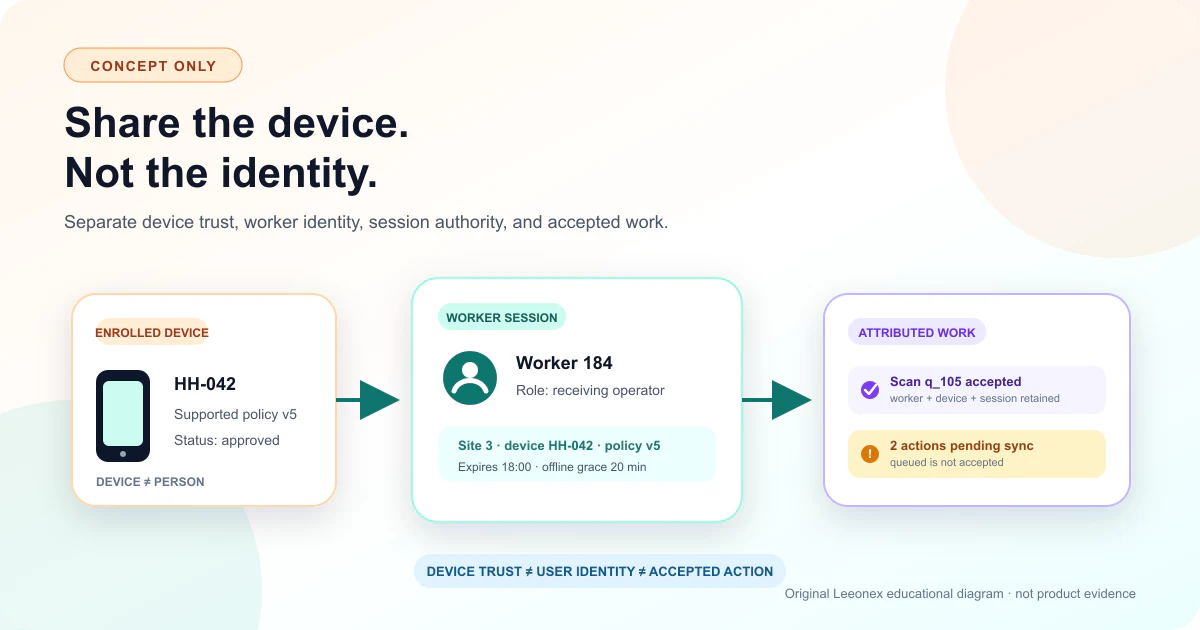
The answer first: authenticate the worker and the device, then bound what the session may do
Scope shared-device access as one accountable shift loop. Enroll the installation as a known device, identify the individual worker, issue a short-lived session tied to the current role and site, make offline authority narrow and visible, attribute every queued action, close the session at handoff, and give operations a recovery path when the device, credential, network, or policy cannot be trusted.
This study is for field operations leaders, warehouse operators, security owners, and mobile product teams that need people to share managed phones or rugged handhelds without sharing identity. The buyer problem is not merely sign-in speed. It is knowing which person had which authority on which device, whether an action was online or queued, and what happened when a shift, session, or device ended badly.
Known device
Enrollment establishes the installation boundary, not the identity of the acting worker.
Individual session
Role, site, device, policy, and expiry travel with the worker's server-issued authority.
Bounded offline
Offline grace permits a narrow action set and never pretends queued work is already accepted.
Evidence disclosure
This is a Level E educational concept study, not a client story, implemented Leeonex app, security design approval, or workforce deployment. The organization, roles, dialogue, state counts, device controls, offline policy, diagrams, architecture, and scope are illustrative. No authentication strength, attribution accuracy, incident reduction, worker productivity, support saving, compliance result, or other outcome was measured. Stronger claims would require an implemented system, representative device and adversarial testing, specialist review, production evidence, approved identity and visuals, and publication permission.
The starting situation: the device is known, but the person behind the action is not
An operation keeps handhelds in a charging cabinet. Workers take any available unit, enter a shared PIN, scan inventory or record field work, and return it at the end of the shift. The process is fast until a disputed adjustment, missing scan, or safety check needs a named actor. Logs identify the device or generic account, while supervisors reconstruct the rest from schedules and memory.
Replacing the shared PIN with a personal login helps, but it does not close the system. A previous session may survive sleep. Work captured offline may synchronize after the next person signs in. A badge can be lent. A locally unlocked device may hold a revoked role. A support override may keep the operation moving while making the audit history less trustworthy.
The intended buyer and constraints
- Workers need a quick start on a shared device, often with gloves, noise, time pressure, intermittent connectivity, and accessibility or language needs.
- The organization needs individual accountability without collecting unnecessary biometric, location, or workforce surveillance data.
- Device management can report posture or enforce kiosk policy, but the application still owns its users, sessions, authorization, queued work, and business events.
- Revocation must work for a person and a device independently, including what happens during a short, explicitly approved offline interval.
- Handoffs, abandoned sessions, device loss, and rejected sync need operating owners—not just authentication error messages.
Illustrative discovery conversation: ask what survives the handoff
Illustrative conversation—not a client quotation. The following exchange is invented to expose decisions a real discovery session should resolve. It does not represent a Leeonex client, workforce, device fleet, project, or delivered result.
Operations lead
“The handhelds belong to the site, so we want workers to pick up any device and start the shift quickly.”
Leeonex
“When a scan or approval is disputed, can the current process identify the person, the device, the active role, and whether the app was online?”
Operations lead
“Usually we can identify the device. People share the same local account, and the next shift sometimes inherits whatever was left open.”
Leeonex
“Then the first release is not a faster login screen. It is an accountable handoff loop that keeps device trust, person identity, session authority, queued work, and recovery separate.”
The decision sequence should follow one device through a real shift. Who enrolls it? How does the worker prove identity? Which role and site are current? What can happen after the network disappears? Which locally queued actions remain associated with the old session? What must synchronize before handoff? What is cleared, retained, or quarantined? Who handles an unfinished queue or a device that never returns?
Four roles cover the first boundary
Worker or field operator
Starts an individual session on an enrolled device, sees the permitted work, understands offline limits, and ends the shift without leaving authority behind.
Shift supervisor
Confirms assignment and exceptional handoffs, sees unresolved queued work, and cannot quietly borrow another worker's identity to keep the line moving.
Identity and device administrator
Manages worker status, role grants, device enrollment, revocation, supported OS policy, and the difference between device compliance and app authorization.
Security or support owner
Investigates lost devices, lockouts, suspicious sessions, sync conflicts, and recovery with redacted evidence and a controlled override path.
The core flow: prove device, worker, authority, work, and handoff as separate facts
An administrator enrolls the app installation and the server records the device identifier, management or attestation facts it can honestly verify, supported policy, and status. At shift start, the worker uses an approved sign-in method. The server issues a session for that person, device, role, site, and policy version rather than allowing the client to infer authority from the credential alone.
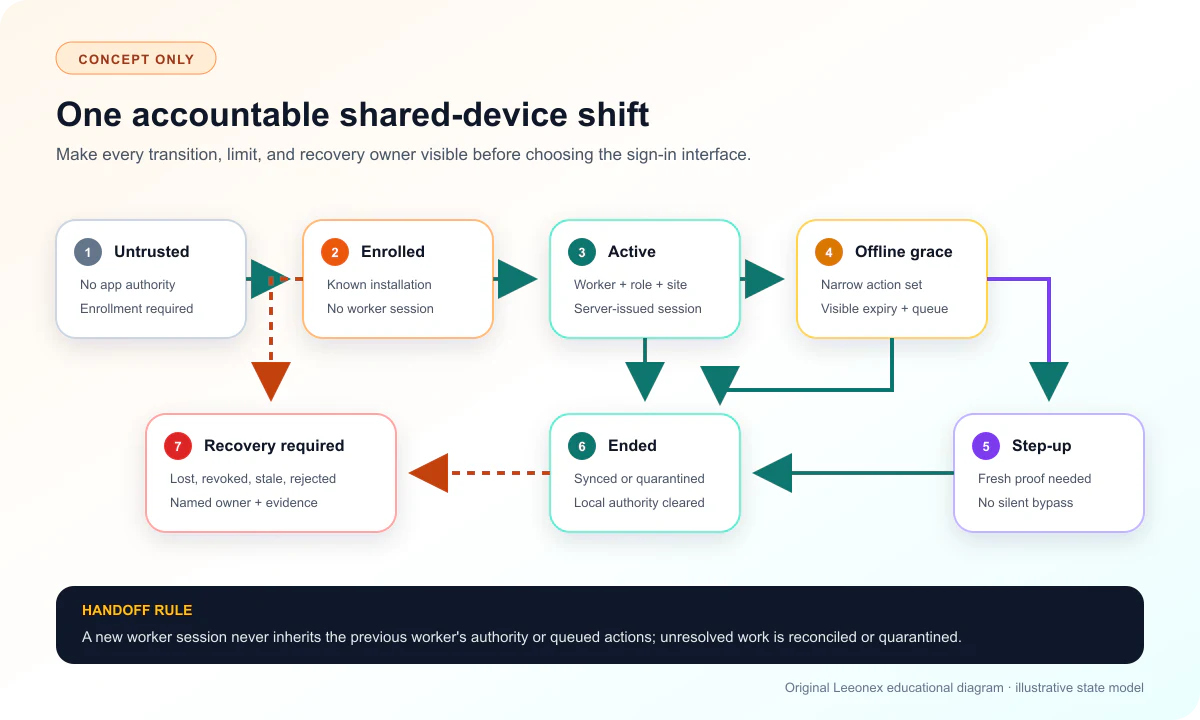
If the network disappears, the app enters a visible offline grace state. It uses an expiring authorization snapshot for a deliberately small action set, creates stable local submission identifiers, and records worker, device, session, policy, and sequence provenance. Queued does not mean accepted. On reconnect, the backend checks revocation, current authority, duplicate submission, state transition, and business rules before it acknowledges each result.
End shift either closes a reconciled session or quarantines unresolved work for an owner. The next worker never inherits the old session merely because the device remained unlocked. A lost or unreturned device triggers independent device revocation, while worker access remains governed by the person's actual status.
The smallest useful scope: one shared-device shift, not an enterprise identity platform
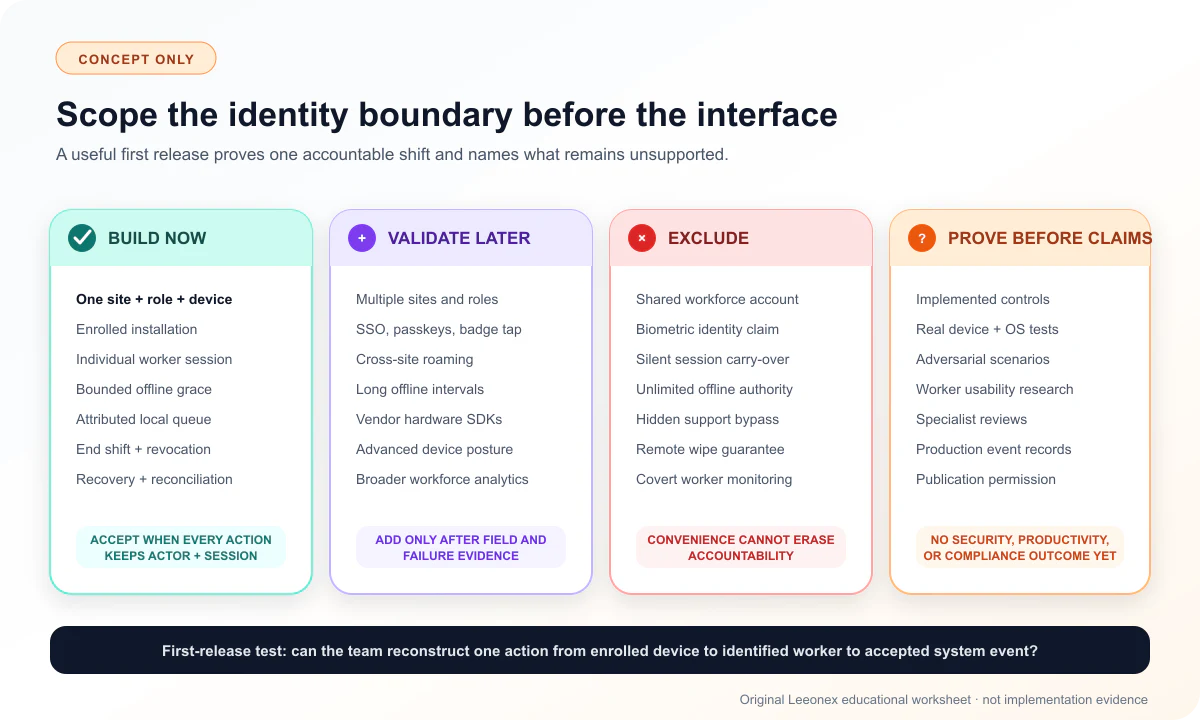
Choose one site, one role, one managed device class, one identity source, and one set of operational actions. Include an ordinary handoff plus a difficult boundary such as network loss, a revoked worker, or a device that does not return. The slice is useful when support can reconstruct every action and operations can finish or quarantine every unresolved queue without borrowing another identity.
Build now
- One organization, site, operating role, managed device class, and representative shift
- Administrator-led device enrollment with a server record, installation identity, status, and revocation path
- Individual worker sign-in using one approved method plus a supervised recovery path
- A short-lived server session bound to the worker, device, role, site, and current policy version
- A deliberately bounded offline grace state with visible expiry and a narrow set of permitted actions
- Encrypted local work queue that records actor, device, session, policy version, event time, and submission identifier
- Explicit end-shift, handoff, forced sign-out, revoked-worker, revoked-device, and app-restart behavior
- Operations and support views for pending work, rejected actions, abandoned sessions, device loss, and reconciliation
Build later, after evidence
- Multiple identity providers, sites, legal entities, job families, device ownership models, and contractors
- Passwordless sign-in, enterprise SSO, proximity badges, hardware keys, or biometrics beyond the proved first method
- Long-duration offline access, cross-site roaming, peer-to-peer handoff, or fully offline enrollment
- Continuous location, productivity scoring, behavioral profiling, or automated fraud decisions
- Remote application data wipe claims until the chosen OS, management platform, and application behavior prove them
- High-risk approvals, regulated identity proofing, payments, safety interlocks, or privileged administration on the shared client
Deliberately excluded from the concept
- One shared username, PIN, badge, or QR code that turns the whole workforce into the same actor
- A local biometric prompt described as proof of which worker performed a server-side action
- Silent session carry-over when a device changes hands, returns from sleep, restarts, or reconnects
- Unlimited offline authority based on a cached role that cannot be revoked or reconciled
- A support master code, hidden bypass, or supervisor impersonation path that erases accountability
- Covert monitoring or collection that is not necessary, disclosed, retained proportionately, and reviewed by accountable specialists
Use the supporting mobile app authentication requirements checklist to define enrollment, sign-in, sessions, step-up, revocation, and recovery. When queue persistence and conflict behavior are the dominant risk, pair it with the offline-first mobile app requirements guide.
Architecture decisions: separate device trust, user identity, authorization, and accepted work
Device identity is not person identity
Enrollment establishes that this installation belongs to an approved device record. The worker still needs an individual authentication event and server-side account before actions can be attributed.
The server issues bounded authority
A session carries the worker, device, role, site, policy version, expiry, and permitted actions. The app does not infer durable authorization from a badge scan or local unlock alone.
Offline is a named mode
The client shows when authority was last refreshed, when offline grace ends, which actions remain allowed, and which work is only queued—not accepted by the system of record.
Every queued action keeps provenance
A durable event includes the actor, device, session, local sequence, policy version, and stable submission identifier so retries do not create a new action or lose attribution.
Handoff closes or quarantines work
End shift attempts to synchronize, exposes unresolved items, clears protected local material according to policy, and prevents the next worker from inheriting the previous session.
Reconciliation owns the uncertainty
The backend compares sessions, device state, queued submissions, accepted results, revocations, and shift boundaries so missing or late work returns to an accountable owner.
Native capability should follow the real device boundary
A shared-device client may depend on OS-managed secure storage, device attestation signals, credential APIs, restricted kiosk behavior, background execution, managed configuration, barcode hardware, or vendor SDKs. Those needs can justify native work or a thin native boundary around shared product logic. They still do not make every management signal trustworthy or remove the need for server-side authorization and representative tests.
Treat mobile device management as a related control plane, not the business identity system. It can help inventory, configure, restrict, update, or revoke a managed device. The app and backend still need to know the worker, session, role, queued events, accepted transitions, and recovery owner. If an existing workforce platform already owns those facts, extending it may be safer than creating a parallel source of truth.
Risks and guardrails: convenience cannot become invisible impersonation
Use a supported secure-storage boundary and protect keys, tokens, and local records from ordinary app storage, logs, screenshots, backups, and exports.
Expire cached authorization and require fresh server proof for sensitive actions; do not let device-clock changes silently extend offline access.
Make active worker, device, site, offline status, pending count, and session expiry visible without exposing unnecessary personal data.
Prevent duplicate taps, retry storms, replayed submissions, stale policy use, and a second device acting under an already ended session.
Define app backgrounding, lock screen, OS user change, device reboot, process death, reinstall, and restored-backup behavior explicitly.
Revoke the worker and the device independently; a lost handheld should not suspend the person everywhere, and a suspended worker should not poison the device permanently.
Keep supervisor and support overrides narrow, reasoned, time-limited, notified, and auditable; never make convenience bypasses invisible.
Review privacy, employment, accessibility, records, device-management, security, and sector obligations with the accountable specialists for the real workforce.
Define acceptance evidence before build
| Scenario | Expected behavior | Acceptance evidence |
|---|---|---|
| Clean shift start | Verify enrolled device and individual worker | Session names actor, device, role, site, policy, and expiry |
| Network loss | Enter visible, expiring offline grace | Only approved actions queue with full provenance |
| Worker revoked offline | Reject unsafe work on reconnect and route recovery | No cached role silently becomes accepted authority |
| Shift handoff | Close or quarantine old work before new session | Next worker cannot inherit session or private data |
| Lost device | Revoke device independently and investigate queue | Worker status remains correct on other approved devices |
| Duplicate retry | Return the original submission result | One accepted business action retains one actor and session |
Limitations: this blueprint does not prove identity assurance, security, or lawful workforce monitoring
The concept has not been implemented, tested on a managed device, connected to an identity provider, integrated with MDM, reviewed with workers, assessed against threats, or examined under an employment policy, accessibility standard, sector rule, records obligation, or jurisdiction. It cannot determine the correct credential, assurance level, offline duration, retention period, management policy, or recovery evidence for a real operation.
It also cannot support claims about unauthorized access, attribution accuracy, incident frequency, shift-start time, worker productivity, training, support workload, loss, audit findings, or cost. Before any stronger statement, the team would need the following evidence:
- An implemented identity backend, device enrollment path, native client, secure local store, authorization service, attributed queue, reconciliation view, and recovery interface
- Representative device, OS, MDM, network-loss, clock-change, process-death, reboot, reinstall, revocation, handoff, concurrency, replay, and tampering tests
- Observed usability and accessibility research with real workers, supervisors, administrators, support owners, gloves, lighting, noise, language needs, and time pressure
- Independent security, privacy, employment-policy, records, legal, and sector review for the actual data, operation, workforce, and jurisdiction
- Production telemetry and incident records with approved definitions, baselines, windows, exclusions, attribution limits, source systems, and verifier
- Approved identity, screenshots, quotations, visual rights, redaction, client review, and written publication permission
Lessons for teams deciding what to build
Trace one handoff
The boundary between workers reveals more identity risk than a polished login mockup.
Keep identities separate
A trusted device, authenticated person, active session, and accepted business action are different facts.
Make offline authority expire
A cached role should permit only the narrow promise the team can test, revoke, and reconcile.
Design recovery with sign-in
Lost devices, lockouts, abandoned queues, and support overrides are primary journeys, not edge tickets.
Collect less workforce data
Accountability comes from clear identity and event boundaries, not automatically from more monitoring.
Extend before duplicating
Use existing identity, workforce, and device systems when they already own reliable facts and controls.
What to bring to a first consultation
The most useful first conversation is not a list of login methods. Bring one shift, one device, one disputed action, the current worker and device records, and the people who own operations, identity, support, security, privacy, and recovery.
- One representative shift, role, site, and device class with the actual pickup, sign-in, work, break, handoff, and return sequence
- Current worker identity source, badge or credential process, joiner/mover/leaver rules, role ownership, and lockout or recovery path
- Device inventory, ownership, OS versions, management platform, kiosk settings, secure-storage capability, update policy, and loss procedure
- The exact actions the app performs, their risk, their systems of record, stable identifiers, and which ones may occur offline
- Representative connectivity gaps, shift length, device sharing frequency, clock behavior, app interruptions, and sync or queue failures
- A recent attribution dispute, lost device, abandoned session, shared credential, rejected sync, or emergency support override
- Approved security, privacy, accessibility, employment, records, monitoring, retention, and sector guidance
Leave with an accountable shift boundary, not a login backlog
A focused discovery should identify the device and worker identities, session authority, offline promise, handoff rules, recovery owners, system boundaries, acceptance scenarios, exclusions, and the smallest shift worth proving. Explore Leeonex native app development, review other educational work in the case-study hub, or bring your shared-device workflow to a consultation.