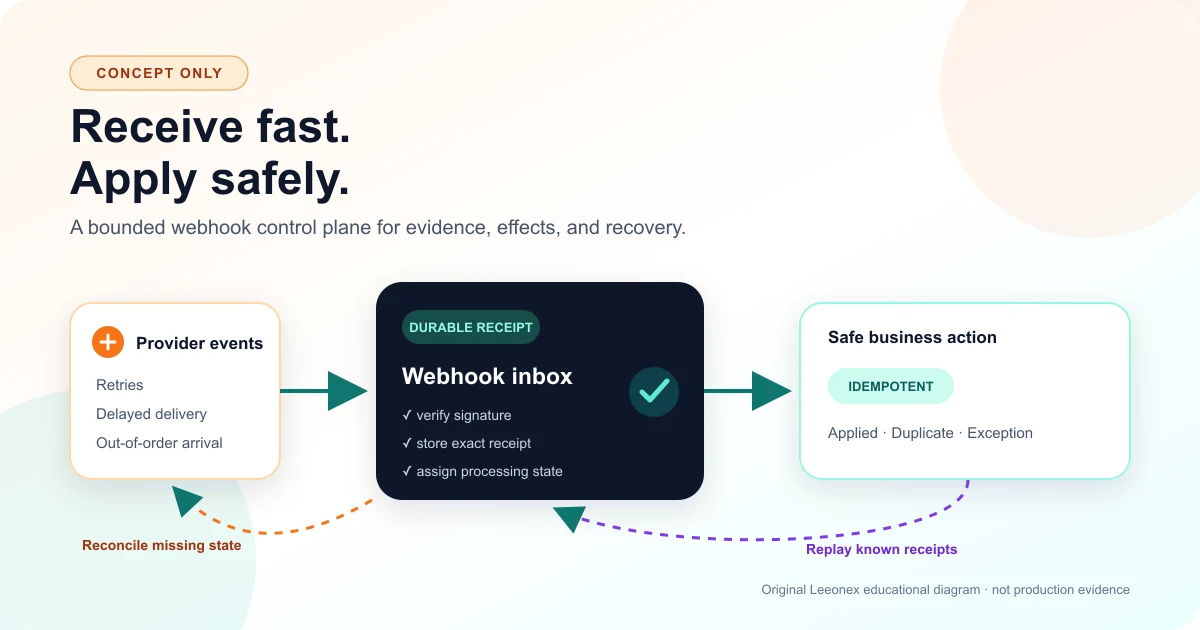
The answer first: acknowledge receipt quickly, finish the business action safely
Scope webhook ingestion as a durable control boundary, not a controller that verifies a signature, updates a record, and returns 200. The receiver should authenticate the sender, preserve the original receipt, assign an internal identity, acknowledge within the provider's window, and let an independently recoverable worker apply one safe business action. Duplicates, exceptions, replay, and reconciliation need explicit states and owners from the first consequential flow.
This study is for SaaS product teams, integration owners, operations leaders, and engineering managers whose product depends on asynchronous provider events: a payment changes an entitlement, a booking changes availability, a CRM change starts fulfilment, or a vendor status unlocks the next step. The common buyer problem is not receiving JSON. It is proving whether each important event was authentic, stored, applied once, rejected for a reason, or still awaiting recovery.
Receipt is evidence
Preserve the authenticated envelope before downstream work can fail.
Actions must be safe
Deduplicate deliveries and make the business operation idempotent under concurrency.
Recovery is designed
Replay known receipts and reconcile what may never have arrived.
Evidence disclosure
This is a Level E educational concept study, not a client story or an implemented Leeonex integration. The provider, event family, roles, state counts, dialogue, diagrams, architecture, and scope are illustrative. No production events, security result, availability, latency, duplicate reduction, incident recovery, cost saving, revenue protection, or other outcome was measured. Stronger claims would require implementation evidence, representative failure tests, production records, approved identity and visuals, and publication permission.
The starting situation: a successful response hides an unfinished workflow
A product team adds a provider webhook to replace polling. The first implementation verifies a shared secret, parses the body, calls application code, and returns success. It works in a demo. Then the provider retries during a slow deployment, two workers process the same event, an old event arrives after a new one, or the destination times out after committing its write.
The provider sees delivery attempts. Engineering sees logs. Operations sees the business consequence: access granted twice, a booking reopened incorrectly, a status never advanced, or a customer record that disagrees with the provider. Nobody has a durable answer to “what happened to event X?” because transport, processing, and business outcome were collapsed into one code path.
The intended buyer and constraints
- A product or operations owner needs one consequential provider flow to become supportable without funding a general event platform.
- Engineering must acknowledge within a provider-controlled timeout even when downstream work takes longer.
- The provider may redeliver, delay, batch, reorder, or omit events according to its real contract—not the team's ideal model.
- Payloads may contain personal, financial, or commercially sensitive data with explicit retention and access needs.
- Operators need recovery tools that do not require editing a database or asking an engineer to replay production traffic by hand.
Illustrative discovery conversation: separate delivery from completion
Illustrative conversation—not a client quotation. The following exchange is invented to expose decisions a real discovery session should resolve. It does not represent a Leeonex client, project, provider, or delivered result.
Founder
“The provider retries until we return 200. Can we just make the handler retry-safe?”
Leeonex
“First, what does 200 promise: that we authenticated and stored the event, or that the business action finished? If processing needs ten seconds and the provider waits three, those cannot be the same promise.”
Founder
“Stored is enough for the provider. But operations needs the status applied within a few minutes, and duplicate actions would be serious.”
Leeonex
“Then the first release needs two contracts: a receipt contract with the provider and an application contract with the business. We also need to know whether duplicate event IDs, repeated business facts, and concurrent workers require different controls.”
Name the roles before choosing tooling
Provider and credential owner
Owns endpoint registration, secrets or keys, rotations, versions, environments, and provider escalation.
Integration owner
Owns receipt health, queues, mappings, reprocessing, alerts, deployment, and contract changes.
Business-state owner
Defines what the event means, which facts are authoritative, and which action may safely occur.
Exception operator
Reviews malformed, disputed, stale, or unrecoverable events using bounded actions and an audit trail.
The core flow: preserve the receipt, then earn the business transition
The control loop below is deliberately provider-neutral. Its purpose is to separate evidence from effects. A request may be authenticated and durably received even though its application is still processing or has entered an exception state. That distinction makes support, replay, and reconciliation possible.
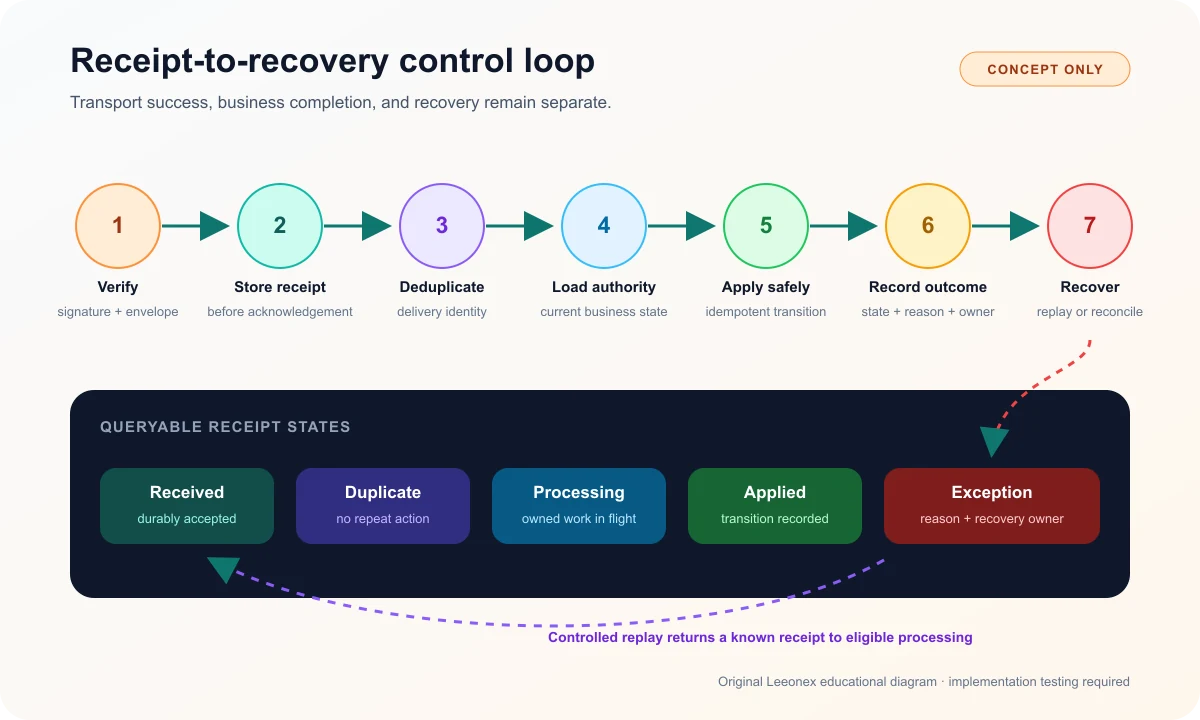
- Receive exact bytes.Capture the headers and raw body required by the provider's signature scheme before parsing changes their representation.
- Authenticate and validate the envelope. Check the signature, timestamp tolerance, endpoint version, size, and content type. Reject unauthenticated input without storing it as trusted work.
- Persist a durable receipt. Store the provider identity, event identifier, type, received time, verification result, payload reference, and initial state before returning the provider acknowledgement.
- Deduplicate delivery. Use the provider event ID when its uniqueness is documented. Where it is not, define a cautious internal key without pretending ambiguous events are identical.
- Apply an idempotent business operation. Load the current authoritative state, verify transition rules, and use a transaction, conditional write, or stable operation key so concurrency cannot repeat the side effect.
- Record the outcome. Applied, duplicate, superseded, retryable, or exception must be queryable without reconstructing the answer from scattered logs.
- Recover deliberately. Replay a known receipt after the cause is addressed; reconcile provider and local records to discover receipts that never arrived or states that drifted later.
The smallest useful scope: one event family, one consequence, one recovery owner
Do not begin by building a provider-agnostic event bus. Choose one event family whose missed or repeated action matters, define its business transition, and prove receipt-to-recovery. The first release can still create a reusable seam, but reuse is earned by the second real flow rather than guessed from the first.
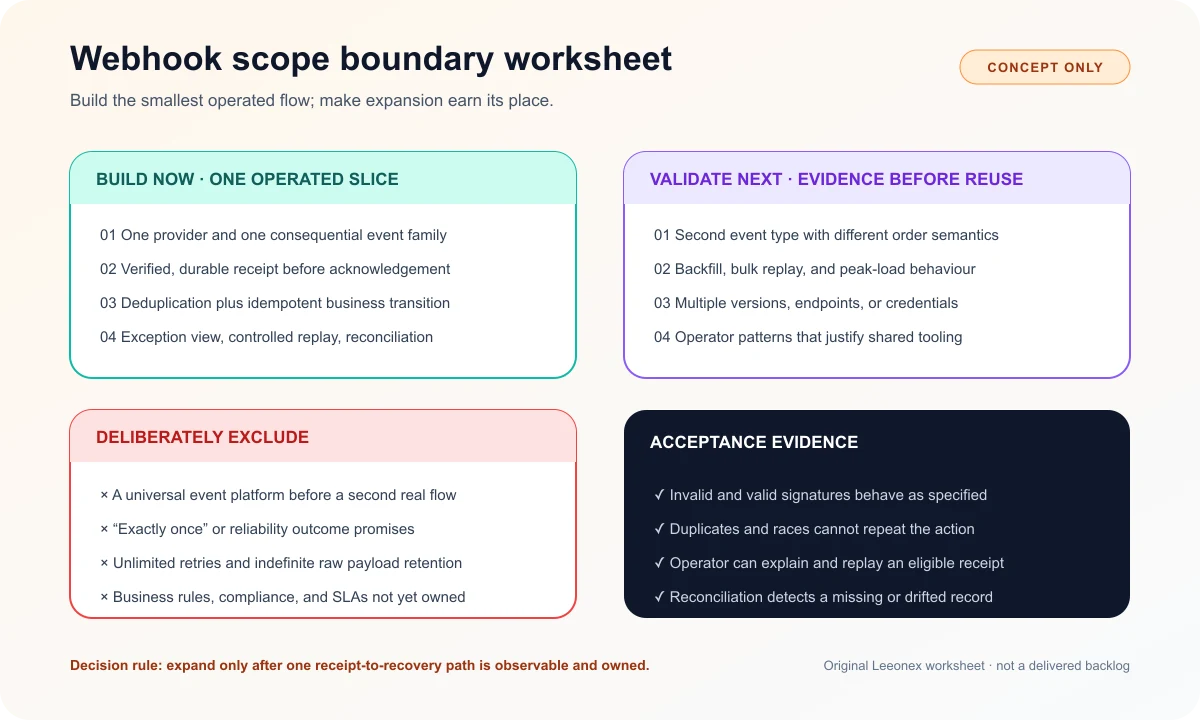
| Build now | Validate next | Deliberately exclude |
|---|---|---|
| One provider, endpoint, event family, and business action | A second event type with different ordering or ownership | Universal provider adapters and schema registry |
| Signature verification and secret rotation runbook | Key-based verification or multiple endpoint versions | Broad identity platform changes unrelated to the flow |
| Durable receipts, deduplication, bounded retry, exception view, replay, and reconciliation | Backfill tools, bulk replay, and longer-term analytics | Exactly-once marketing claims or indefinite raw payload retention |
For the wider intake—ownership, data contract, credentials, limits, mapping, testing, and go-live—use the supporting API integration requirements checklist. This study narrows that checklist to the asynchronous receipt and recovery boundary.
Architecture decisions that should stay explicit
Acknowledge the durable handoff, not the completed workflow
The acknowledgement contract must match provider documentation. If success means “authenticated and durably accepted,” return it only after that storage succeeds. If the store is unavailable, a retryable failure may be more honest than acknowledging an event the system cannot recover. Downstream processing then has its own completion target and alerting.
Deduplication is not the same as idempotency
Deduplication recognizes that the same delivery was seen before. Idempotency protects the business operation if two apparently distinct deliveries represent the same action, or two workers race. A unique event ID can stop one kind of repeat; a conditional state transition, destination idempotency key, or transaction protects the consequence.
Ordering should be scoped by entity
Global order is usually unnecessary and expensive. Ask whether order matters for one subscription, booking, order, or account. Compare provider sequence, occurrence time, and current authoritative state carefully: timestamps alone may be late, duplicated, or generated by clocks with different guarantees. A stale event may be recorded as superseded rather than applied.
Raw payload retention is a risk decision
Raw receipts help verification, debugging, replay, and audit, but may contain data that should not be retained broadly or indefinitely. Define encryption, access, redaction, residency, deletion, and retention with the real data classification. A payload reference and extracted safe fields may be preferable to unrestricted copies in logs and dashboards.
Operator tools need narrow, auditable powers
Operators should see provider ID, event type, subject, received time, current state, attempts, reason, and related business record. Actions such as retry, dismiss, or mark resolved need eligibility rules, confirmation, actor identity, timestamp, and outcome. “Edit status” is not a safe recovery design.
Risks and guardrails for the first release
Forged or replayed requests
Verify the exact signed representation, use the documented algorithm, enforce a justified timestamp window, rotate secrets, isolate environments, and test invalid signatures. Network allowlists can supplement—not replace—cryptographic verification when provider ranges change.
Poison events and retry storms
Classify failures, bound retries with backoff, quarantine permanent errors, cap concurrency, observe queue age, and give exceptions an owner. Unlimited retries are not recovery.
Schema and semantic change
Store the event version, reject unknown critical shapes, tolerate documented additive fields, contract-test fixtures, monitor provider notices, and deploy new handlers before switching endpoint versions.
A green queue with wrong business state
Monitor both transport and business invariants. Reconcile authoritative provider records against local state on a consequence-based cadence and track unresolved differences.
Acceptance evidence before release
- Valid, invalid, expired, oversized, malformed, and unsupported-version requests produce the agreed response and evidence.
- Duplicate, concurrent, delayed, and out-of-order deliveries do not repeat or regress the protected business action.
- Receiver, durable store, queue, worker, and destination failures exercise bounded retry, exception, and alert paths.
- An authorized operator can explain one receipt, replay an eligible failure, and see the new outcome without privileged database access.
- Reconciliation detects an intentionally missing or drifted record and assigns it to a named owner.
- Deployment, rollback, endpoint rotation, backlog handling, retention, and incident runbooks have accountable owners.
Limitations and what this concept deliberately cannot claim
This blueprint does not prove that a particular provider offers stable event IDs, strict ordering, replay APIs, delivery logs, or sufficient source-of-truth queries. It does not establish the correct queue, database, cloud, framework, retry schedule, throughput, retention, recovery objective, or service level. Those decisions depend on the real contract, volume, data, consequence, and operating team.
“Exactly once” is deliberately excluded as an outcome claim. Distributed delivery can fail at ambiguous boundaries. The practical goal is observable at-least-once receipt where available, safe repeat handling, idempotent consequences, explicit exceptions, and reconciliation. Even that goal requires implementation and evidence; the diagram alone proves nothing.
A managed integration platform may already provide adequate receipt, retry, replay, and operations for a low-risk flow. A scheduled poll may be simpler when freshness is relaxed and the provider offers reliable listing APIs. The separate iPaaS versus custom integration guide helps evaluate that boundary. Custom code is justified by the workflow and controls, not by a preference for infrastructure.
Lessons and what to bring to a first consultation
The main lesson is simple: a webhook is an asynchronous claim from another system, not permission to perform an irreversible action immediately. Preserve the claim, verify its source, compare it with current authority, make the transition safe, record the result, and keep a recovery path for ambiguity.
A useful first conversation does not need a complete technical specification. Bring the material that makes one consequence concrete:
- the provider documentation and endpoint configuration;
- one consequential event family with representative redacted payloads and headers;
- the business record and action the event is meant to change;
- known retry, ordering, versioning, timeout, and replay behaviour;
- recent incidents, manual checks, or reconciliation work—even if the evidence is incomplete;
- data sensitivity, retention constraints, expected peaks, and acceptable delay;
- the credential, integration, business-state, and exception owners.
The next step should be a bounded decision, not an architecture promise.
Leeonex can help determine whether the first release should use managed tooling, polling, a provider-specific receiver, or a custom ingestion boundary. Explore the API and integration development service, review more evidence-labeled work in the case-study hub, or bring one event family to a scoping call.