Answer first
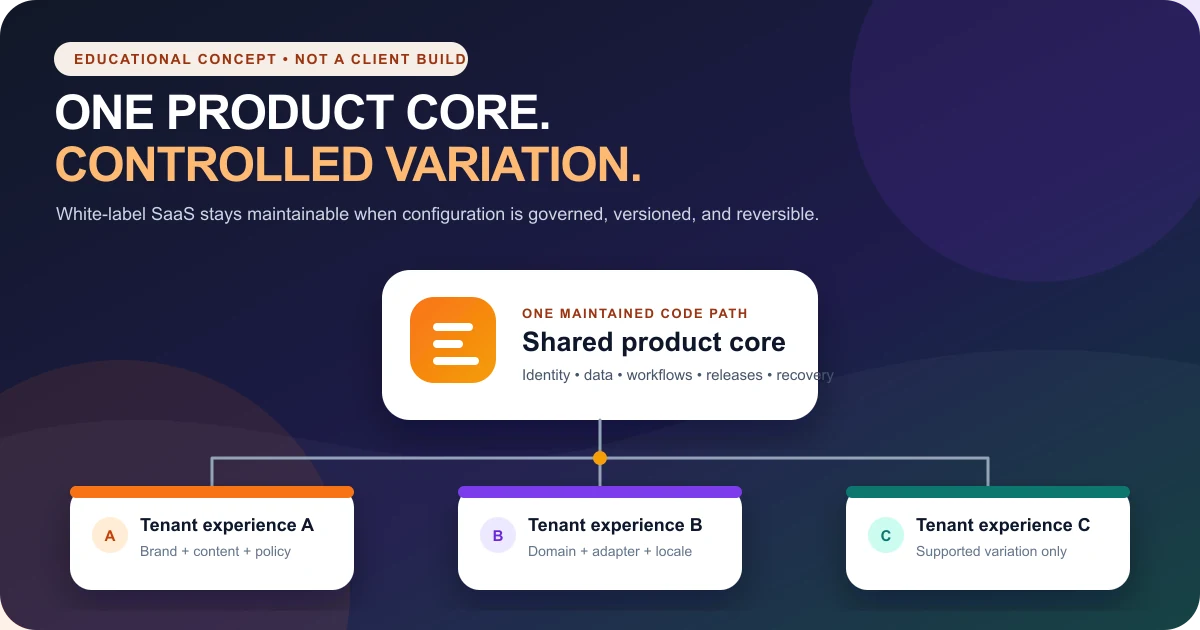
A maintainable white-label SaaS product varies configuration, not its core code path.
Keep one product model, one security patch path, and one release train. Define a small contract for what each tenant may vary; validate those values; render them in an isolated preview; require accountable approval; then publish an immutable configuration version that can be observed and rolled back.
The smallest useful release usually supports bounded brand tokens, named content slots, supported capability policy, approved integration adapters, and delivery settings such as domain and sender identity. Arbitrary layouts, custom code, per-customer branches, and independent release calendars stay outside the first boundary because they turn a product into a fleet of projects.
Illustrative discovery conversation — not a client quotation
“Can we clone the product?” is usually a request to define where the product may vary.
SaaS founder
“A larger customer wants their logo, colors, domain, emails, terminology, integrations, and a few workflow changes. Can we clone the product and customize it?”
Leeonex
“Which requests are presentation, which change product policy, and which would create a separate product that your team must release and support?”
Product leader
“Sales needs a credible answer now, but engineering cannot maintain a branch, release calendar, and incident process for every account.”
Leeonex
“Then the first scope is not a cloned application. It is a governed configuration contract around one product core, with explicit variation domains, preview, approval, versioning, and rollback.”
This is Leeonex-authored teaching material. It represents no real founder, client, tenant, customer brand, contract, product, quotation, implementation, release, launch, support result, or business outcome.
Starting situation and buyer
This concept is for SaaS teams entering larger accounts without wanting a separate product per logo.
The intended buyer is a B2B SaaS founder, product leader, platform owner, or enterprise delivery lead with a working product and a serious customer asking for a branded experience. The request may start with colors and a domain, then expand into terminology, email, identity, roles, workflow, integrations, reporting, and support expectations.
Sales sees a strategic account. Product sees repeated demand that might justify a platform capability. Engineering sees tenant conditionals, cache risk, untested combinations, migrations, and release burden. Delivery sees assets, DNS, sender verification, integration credentials, acceptance, and a deadline. All four views are real; none alone defines the scope.
The constraint is to make a credible customer promise without pretending every request is configuration. The product needs a boundary that says what can change safely, who owns the input, how it is tested, and what remains shared. Requests outside that boundary become product decisions, paid platform work, or a clear “not supported”—not hidden forks.
Product owner
Owns the shared product promise, commercial packages, allowed variation, and the decision to reject a request that would create another product.
Platform owner
Owns tenant context, configuration schemas, resolution, caching, capability policy, migrations, releases, observability, and rollback.
Brand and content owner
Supplies approved assets and language, checks contrast and content completeness, and signs off the tenant preview before promotion.
Delivery and support owner
Coordinates domain and integration setup, verifies acceptance evidence, explains active versions, and owns the first recovery response.
White-label boundary
Separate five variation domains before estimating screens.
“White label” is not one feature. It is a commercial label covering several kinds of variation with different security, testing, and operating consequences. Classify each request before accepting it. If a change cannot fit a named domain with a schema, owner, fallback, acceptance check, and support rule, it is not ready to be configuration.
Brand
Logo variants, color and typography tokens, approved asset dimensions, favicon, product name, and a safe fallback when an asset is absent.
Content
Named labels, email templates, help links, policy references, sender identity, and bounded content slots rather than arbitrary page markup.
Capabilities
Versioned product modules, limits, roles, and workflow options selected from supported policy—not customer-specific conditional code.
Integrations
Approved adapter types, endpoints, event mappings, credentials held outside ordinary configuration, health state, and recovery ownership.
Delivery
Verified domains, locale and time settings, notification channels, release cohort, support contacts, and observable configuration version.
Core flow
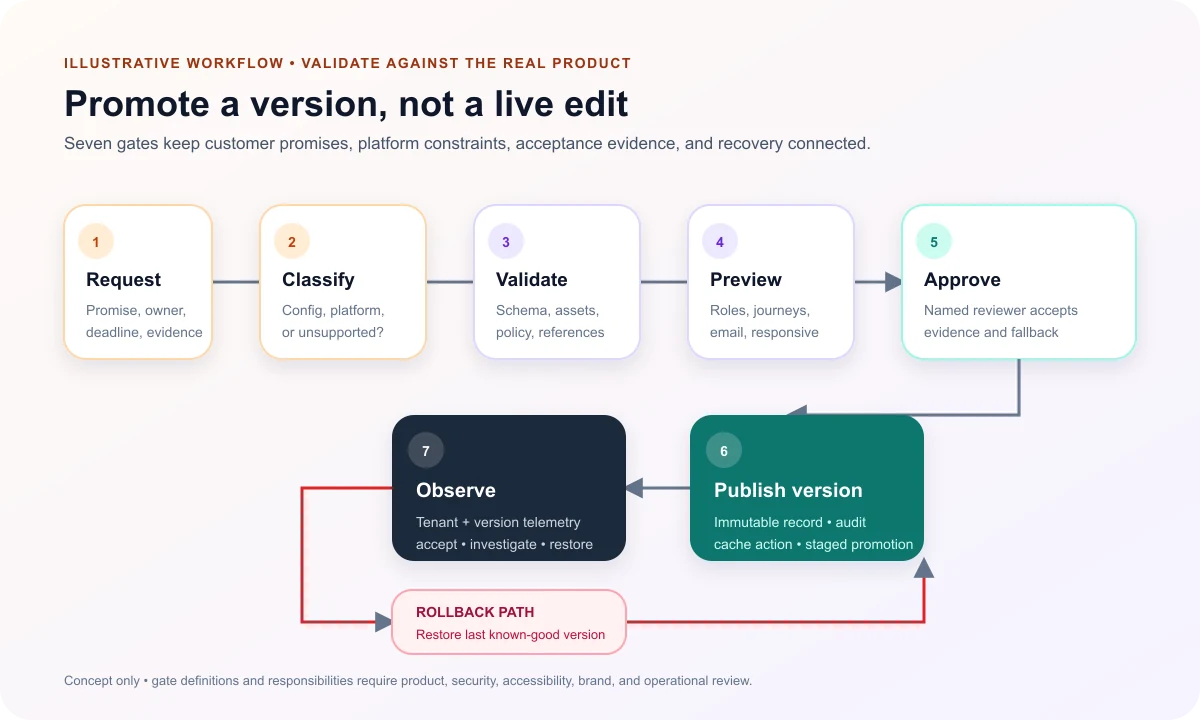
Promote a configuration version; do not edit a live tenant by hand.
First, capture the request against a real customer promise and assign each item to brand, content, capability, integration, or delivery. Anything that changes the shared domain model, workflow semantics, authorization rules, or release behavior returns to product discovery instead of slipping into a configuration file.
Next, create a draft against a versioned schema. Validate required values, allowed ranges, references, asset formats, contrast, content completeness, domains, adapter compatibility, and safe fallbacks. Render the draft inside the target tenant context with representative roles, pages, email, empty states, errors, and responsive widths.
An accountable product or delivery owner approves the evidence, not just the raw values. Publishing creates an immutable version, records actor and reason, invalidates or versions affected caches, and promotes through a bounded cohort. Monitoring ties errors and fallback use to the tenant and version. If acceptance fails, the operator restores the previous known-good version while the draft remains available for diagnosis.
Smallest useful scope
Prove two meaningfully different tenants on one supported release.
V1 needs one explicit tenant resolver, one versioned configuration record per tenant, one schema, one precedence rule, a compact set of design tokens and content slots, a small supported capability catalog, and one or two integration adapter types that already belong to the product. Include a draft, preview, approval, publication, audit, observation, and rollback path.
Use two deliberately different acceptance tenants: for example, one uses the platform defaults and one exercises every permitted override. Test owner, administrator, member, and support views; direct URLs and APIs; email; background work; caches; exports; errors; empty states; mobile widths; and a return to the default configuration. The purpose is to expose coupling, not to simulate customer adoption.
The first release does not need a customer-facing visual builder. An internal form or reviewed manifest can be safer while the team learns which settings are stable. Self-service becomes useful only after validation, permissions, preview, support language, and rollback are proven enough that an operator is no longer the hidden safety system.
Build now versus later
Build the control plane before the customization marketplace.
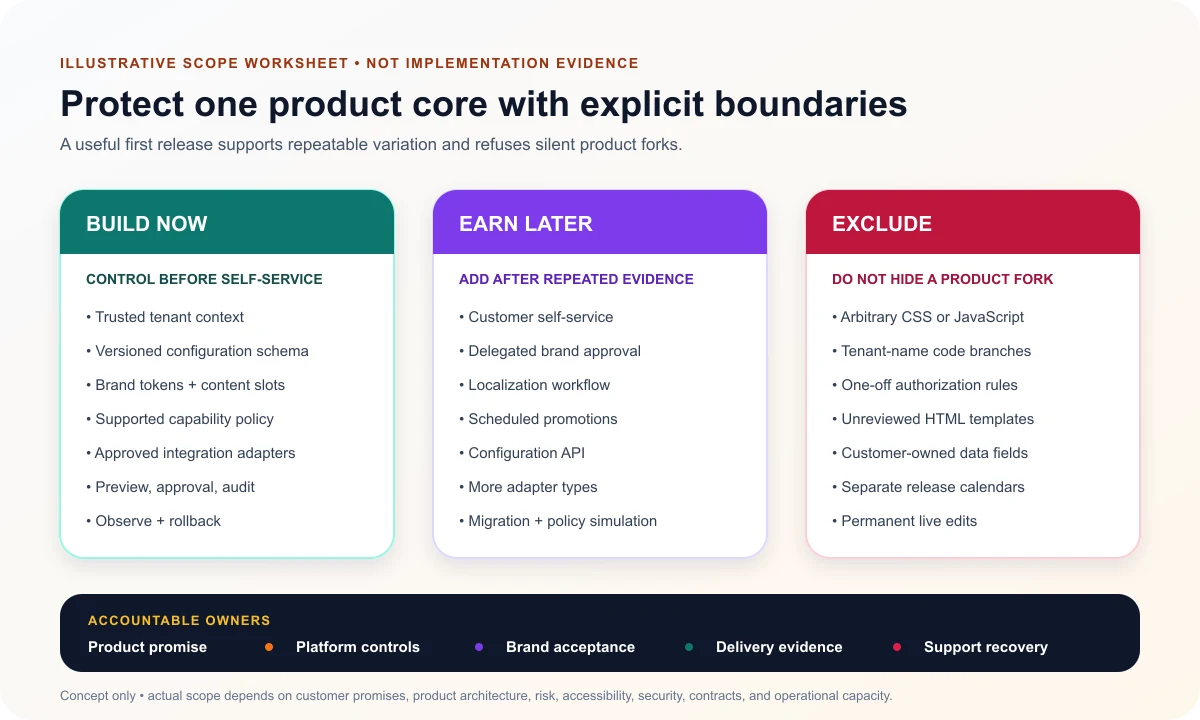
Build now: explicit tenant context; schema-backed tokens and labels; asset validation; safe capability selection; approved adapter configuration; domain and sender setup with verification; role-based editing and approval; tenant preview; immutable versions; audit; monitoring; and rollback. These controls make a limited promise operable.
Build later when repeated evidence justifies it: customer self-service, delegated brand approval, more content slots, localization workflows, scheduled promotions, environment comparison, configuration APIs, more adapter types, migration assistants, and policy simulation. Each extension expands the combinations the team must test and support.
Deliberately exclude arbitrary CSS or JavaScript, customer-owned database fields, duplicated screens, tenant-name branches, one-off authorization rules, unreviewed HTML templates, customer-specific release trains, and permanent manual production edits. If the commercial opportunity truly requires those, scope a separate product or delivery model honestly instead of hiding it behind “white label.”
Architecture decisions
Make variation data-driven, typed, tenant-aware, and observable.
Define a global product schema and store tenant configuration as a versioned document or normalized model with clear migration rules. A resolver combines product defaults, supported package policy, and the active tenant version through one documented precedence order. The result should expose where a value came from and why a fallback was used.
Establish tenant context from trusted identity and routing data, not from a client-supplied identifier alone. Carry that context to authorization and data access independently of branding. Design tokens can shape presentation; content slots can shape language; neither may grant access. Capabilities and permissions need server-side policy with forbidden cross-tenant tests.
Integrations should use a registry of supported adapters with typed settings, isolated credentials, health checks, rate and failure behavior, and an owner. A tenant can select or configure a supported adapter without receiving a private integration branch. New protocols or workflow semantics return to platform backlog and acceptance design.
Treat version as part of delivery. Include it in preview URLs, cache keys, background jobs where behavior depends on it, structured logs, support views, and incident timelines. Release product code and configuration independently only when their compatibility range is explicit; otherwise a valid configuration can become invalid during an ordinary code deployment.
Risks and guardrails
White-label failures often appear where tenant context was assumed instead of enforced.
- Treat a customer request as input to product discovery, not permission to add a tenant-name condition or long-lived branch.
- Resolve tenant context once from a verified identity, domain, or route boundary, then carry it explicitly through authorization, data, cache, jobs, files, search, integrations, analytics, and logs.
- Validate configuration against a versioned schema, supported values, asset rules, accessibility checks, and referential constraints before it can reach a preview.
- Keep secrets, private keys, identity-provider credentials, and integration tokens in an access-controlled secret store; configuration may reference them but must not expose them.
- Separate capability policy from visual branding. Hiding a button does not remove an API permission, and a plan flag is not a substitute for server-side authorization.
- Key caches, generated pages, email templates, file paths, and background work by tenant and configuration version so one tenant cannot receive another tenant’s presentation or behavior.
- Publish immutable versions through an approval gate, record actor and reason, support staged promotion, and preserve a known-good rollback target.
- Observe errors, latency, delivery failures, and fallback use by tenant and configuration version without leaking one tenant’s data into another tenant’s logs or support view.
Acceptance evidence
Accept the release with observable tenant journeys, not a branded home screen.
Record the exact configuration schema and active version. For each permitted domain, retain the approved input, automated validation, preview reference, reviewer, decision, publication event, cache or build action, smoke-test result, and rollback target. For every rejected request, record why it belongs in product development or outside the supported offer.
Exercise the same core journeys for a default tenant and the configured tenant: sign-in and domain routing, role-sensitive navigation, a protected product action, email delivery, an integration event, background processing, export or file access, error handling, support inspection, configuration rollback, and a product release that changes no customer configuration.
This evidence can show that the scoped controls behaved as tested in a defined environment. It cannot prove adoption, satisfaction, reduced support effort, faster enterprise sales, retention, revenue, reliability, or security. Those claims need approved definitions, baselines, production windows, source systems, attribution limits, and a verifier.
Limitations
This is a product-boundary blueprint, not proof of a white-label platform or enterprise outcome.
Leeonex has not implemented or measured this concept for a client. The diagrams are original explanatory models, not screenshots. The tenant count, five domains, seven gates, roles, tests, data structures, and release choices are illustrative. A real scope may need fewer controls, more controls, or a different operating model.
The concept does not settle legal use of the term “white label,” customer contract obligations, data isolation, residency, SSO, billing, mobile store distribution, full localization, custom analytics, customer-authored code, dedicated infrastructure, migrations from existing forks, support staffing, service levels, or a specific technology stack. Security, privacy, accessibility, brand, and compliance decisions require qualified review against the actual product and commitments.
Lessons for the buyer
The strongest white-label promise is a clear promise about what remains shared.
- A logo upload is simple; a supported product variation needs ownership, validation, preview, acceptance, release, and recovery.
- Configuration should select supported product behavior. It should not become a second programming language or a hiding place for customer-specific code.
- One product core is an operating decision: shared fixes, shared migrations, compatible configuration, and a common incident model.
- The first useful “no” protects both the platform and the customer from a customization the team cannot test or support reliably.
Bring to a first consultation
Bring the promises and exceptions, not a polished feature list.
- The current product architecture, tenant and account model, active customer commitments, sales proposals, white-label contract language, and any existing customer-specific branches or conditionals
- Representative logo, color, typography, domain, terminology, content, email, role, capability, workflow, integration, locale, and support requests—including requests the team is unsure it should accept
- Identity and permission rules, data-isolation promise, cache and background-job design, integration credentials, domain verification, email sending, analytics, operator access, and audit expectations
- Release cadence, preview and sign-off owners, migration constraints, support and incident process, rollback expectations, acceptance examples, and any outcome claims the team eventually wants evidence to support
Leeonex can use those inputs to identify the smallest configuration contract, risky assumptions that need a technical spike, and any request that should stay a product decision rather than becoming a customer-specific exception.
Related planning paths
Resolve tenancy and permission promises alongside the white-label boundary.
The configuration model assumes a real tenant and authorization boundary. Use the supporting guides when infrastructure isolation or role policy is still undecided; use this concept to turn accepted variation into a maintainable release system.
Browse the Leeonex case-study hub for more clearly labeled implementation concepts and verified Leeonex-owned work.