
The short answer: define booking truth before the calendar UI
Appointment booking software requirements should define the service offered, customer eligibility, staff and resource availability, locations, time zones, buffers, temporary holds, conflict prevention, payment, confirmation, changes, cancellations, permissions, integrations, reconciliation, and acceptance evidence. A visible slot is only a candidate; a booking is a durable agreement across every constrained system.
Start with one real journey from slot search to completion or cancellation. Include the exception that causes the most manual repair today: a room conflict, travelling staff, a delayed payment result, a reschedule across locations, a calendar sync failure, or a customer booking while an operator edits the same schedule.
If the current problem is broader than scheduling and includes customer documents, requests, and self-service, use the customer portal requirements checklist. If several systems must exchange booking state, pair this guide with the API integration requirements checklist.
Buy when the rules fit; extend or build when the boundary matters
Most teams should test established scheduling software first. It is a good fit when the product can represent services, durations, staff, rooms or equipment, locations, buffers, policies, payments, reminders, permissions, reporting, and integrations without shadow spreadsheets or operator repair. Demonstrate your hardest real case, not a vendor's prepared salon or meeting example.
Extend or build when availability depends on domain-specific eligibility, several resources must be committed together, pricing or policy changes by context, booking lives inside a customer product, staff need a specialized operating console, or downstream fulfillment cannot tolerate ambiguous sync. Hybrid is often sensible: keep an external calendar or payment service while owning the booking rule engine and customer experience.
A public procurement standard can expose useful questions even outside its sector. Ontario Health's online appointment booking standard separates functional and non-functional requirements and is designed to support evaluation and procurement. Its healthcare rules are not universal; use the structure, then replace the domain, privacy, accessibility, and policy requirements with those accountable for your business.
Write one booking rule contract before the feature list
“Customers can book online” hides the decisions that determine whether the system is trustworthy. For each booking type, connect six fields:
- Offer. Service, duration, location, delivery mode, price basis, preparation, and eligible provider types.
- Eligibility. Customer, membership, geography, prerequisite, booking horizon, minimum notice, and policy checks.
- Availability. Staff, room, equipment, capacity, travel, cleanup, opening hours, exceptions, and time-zone interpretation.
- Hold. What is reserved while details or payment are collected, when the hold expires, and how every resource is released.
- Commitment. The atomic booking, payment or deposit result, calendars, notifications, and customer-facing confirmation.
- Evidence. Booking ID, rule version, actor, timestamps, source, downstream acknowledgements, and final system state.
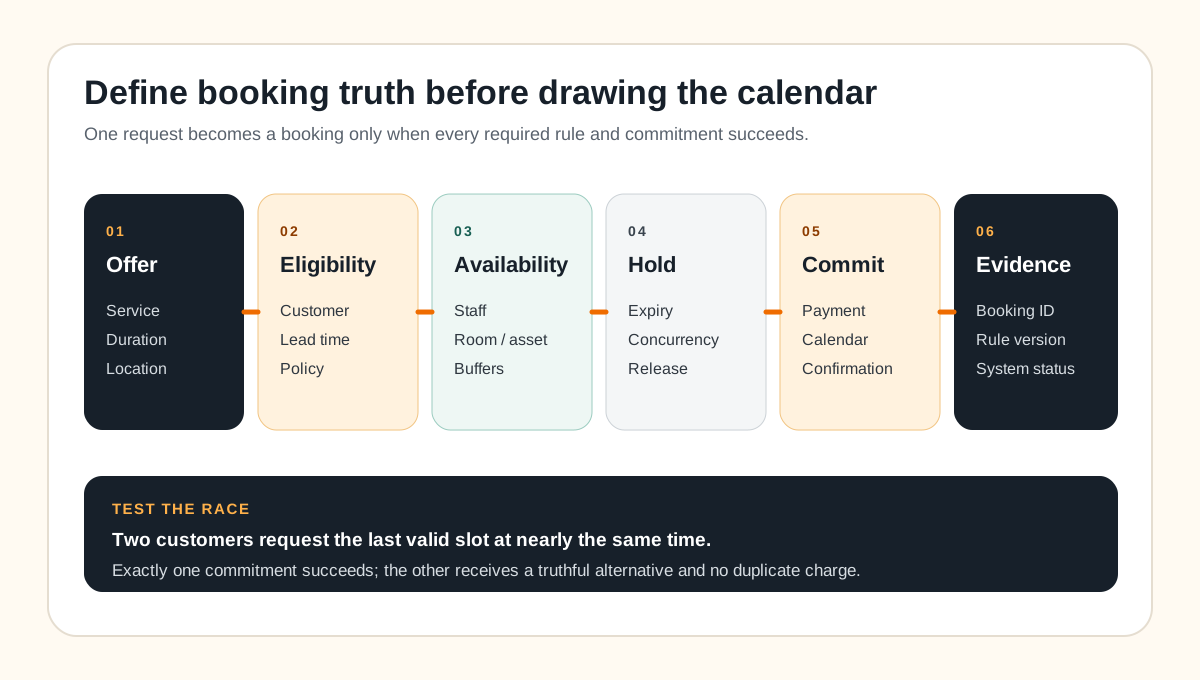
Convert each rule into examples just below, at, and above its boundary. If the service needs 15 minutes of cleanup, test the last slot before closing. If a deposit is required, test success, decline, timeout, duplicate callback, and a customer retry. A requirements document becomes useful when it predicts system behavior for uncomfortable cases, not when it lists calendar, email, and payment as separate features.
Calculate availability, then protect the last valid slot
Define the source of truth for working hours, leave, blackout periods, existing bookings, external calendar events, service duration, setup and cleanup, travel, capacity, rooms, equipment, and location opening hours. Decide whether customers see exact staff, pooled capacity, the first available resource, or a request awaiting confirmation.
Store an unambiguous instant for confirmed events and preserve the business time zone or recurrence context needed to explain future schedules. The IETF's iCalendar specification defines date-time, time-zone, and recurrence structures; use the applicable platform's documented behavior rather than treating a displayed local time as sufficient data.
External free/busy data is an input, not a booking transaction. Google Calendar's Freebusy API returns busy ranges for requested calendars, but your application still needs ownership, freshness, mapping, conflict, and failure rules. If an external calendar is temporarily unavailable, decide whether to hide slots, accept a request for review, or use a known-safe cached window.
Protect contention at the trusted data boundary. A hidden slot in the browser cannot stop two customers from requesting it. Use a short-lived hold or an atomic commit appropriate to the architecture, and test two simultaneous requests for the last slot. Exactly one should succeed. The other should receive a truthful alternative, and neither should produce a duplicate charge or orphaned resource hold.
Model the booking lifecycle and every operator exception
Define candidate, held, pending payment, confirmed, rescheduled, cancelled, in service, completed, no-show, and failed states as needed. For every transition, name who may trigger it, required reason or evidence, resources released or acquired, financial effect, calendar changes, notification, audit event, and safe retry behavior.
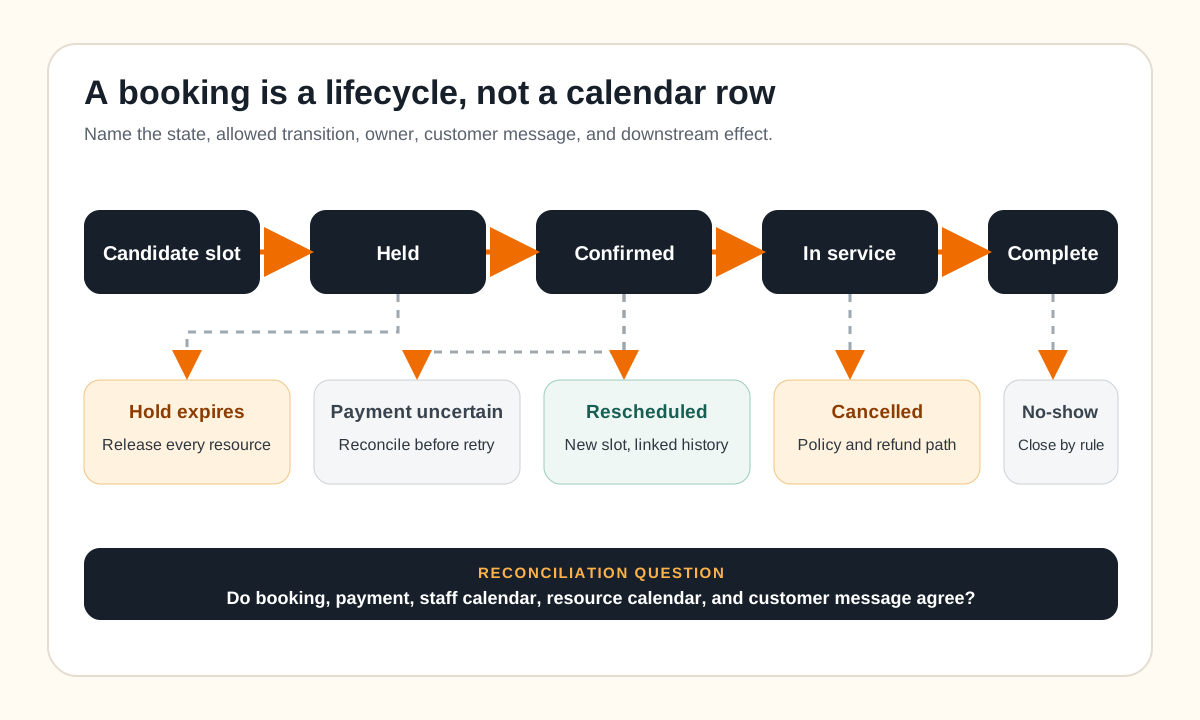
Rescheduling should create a traceable transition, not silently mutate history. Decide whether the original slot is released before or after the new one is secured, how price differences work, whether eligibility is rechecked, and what happens if one downstream calendar updates while another fails. Cancellation rules need the same precision for cutoffs, fees, refunds, credits, resource release, waitlists, and operator overrides.
Design staff controls around real responsibilities. Separate schedule management, booking changes, refunds, policy override, customer-data access, reporting, and integration repair. Use the admin panel requirements checklist for operator search, bulk actions, risky-action confirmation, audit evidence, and recovery.
Integrate by state, reconcile by evidence, and test recovery
List every system that receives or influences booking truth: staff calendars, rooms, payments, CRM, customer accounts, messaging, video links, access control, routing, inventory, reporting, or fulfillment. For each boundary, define the system of record, identifier mapping, event owner, authentication, rate limits, timeout, retry, idempotency, out-of-order events, duplicate delivery, dead-letter handling, and reconciliation.
Payment success and booking success may arrive separately. Stripe's API documentation describes idempotency keys for safely retrying requests, but the booking design must still decide how keys map to a customer attempt and how an operator resolves “paid but not booked” or “booked but payment unknown.” Never ask the customer to retry blindly while the first result is uncertain.
Build acceptance scenarios from production-shaped cases: last valid slot, simultaneous booking, expired hold, stale free/busy data, daylight-saving transition, resource removed mid-flow, payment timeout, duplicate webhook, partial calendar failure, reschedule race, cancellation after cutoff, no-show, manual override, unauthorized change, and notification failure. Save the request, rule version, expected and actual state, external acknowledgements, customer message, and repair steps.
A first-release appointment-booking brief
Choose one service, customer type, location, and fulfillment path. Record offer and eligibility, every constrained resource, availability sources, time-zone and recurrence rules, hold and conflict behavior, payment policy, booking states, change and cancellation rules, staff roles, integrations, evidence, reporting, acceptance scenarios, owners, and exclusions.
Keep a manual exception path during the first release. Operators need a queue that distinguishes customer action, staff action, integration retry, reconciliation, and product defect. Measure conflict attempts, abandoned holds, failed commitments, reschedules, cancellations, no-shows, integration exceptions, and manual repairs only after the definitions are stable.
When the booking truth and exception path are clear, Leeonex's custom web application development service can help scope the smallest booking workflow worth owning.
Appointment booking software requirements FAQ
What are the core requirements for appointment booking software?
Define the services and durations, customer eligibility, staff and resource availability, location and time-zone rules, booking holds, conflict prevention, payment and refund behavior, confirmations and reminders, changes and cancellations, permissions, integrations, reporting, reconciliation, and acceptance tests.
Should we buy or build appointment booking software?
Buy and configure when a product represents your availability, resources, policies, customer journey, integrations, and reporting without manual repair. Extend or build when booking logic is operationally distinctive, spans several constrained resources, must live inside your product, or requires reliable workflows that generic tools cannot express.
How do booking systems prevent double bookings?
They must enforce availability at the trusted data boundary, not only hide a slot in the interface. Use a short-lived hold or an atomic commitment, define idempotent retries, and test simultaneous requests for the last slot. Exactly one request should commit; the other should receive a truthful alternative without a duplicate charge.