Define the contract decision record before buying software
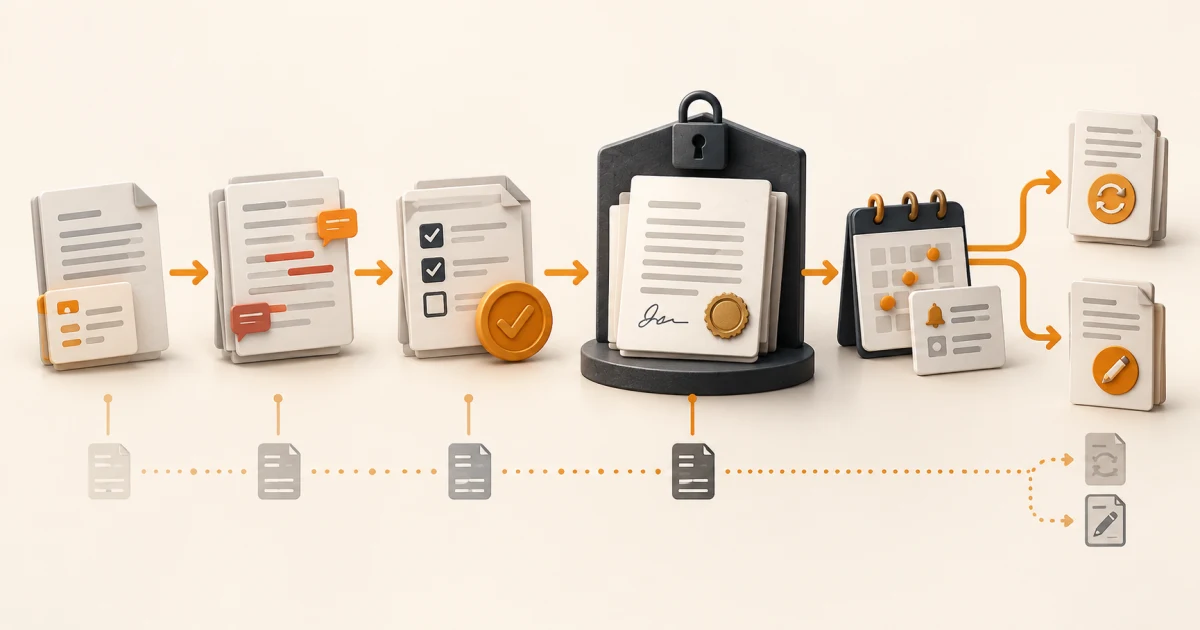
A useful contract management software requirements checklist defines how a business request becomes controlled draft language, how changes and approvals preserve authority, which signature evidence creates an effective agreement, and how obligations, notices, amendments, renewals, and termination remain connected to the terms currently in force.
Cover intake, contract types, parties and entities, templates, clauses, drafting, redlines, versions, approvals, signature, repository, metadata, search, permissions, obligations, milestones, notices, amendments, renewals, retention, audit history, integrations, reporting, migration, and export. Then test the system with a difficult agreement whose ownership and dates change after signature.
Preserve contract lineage instead of collecting files
Choose one agreement with realistic complexity: third-party paper, several legal entities, parallel redlines, an exception approval, a signature correction, a later amendment, a renewal notice, and obligations owned by different teams. Connect the request, draft, source template, clause versions, counterparty changes, approvals, signature package, executed record, effective dates, obligations, notices, amendments, and final disposition.
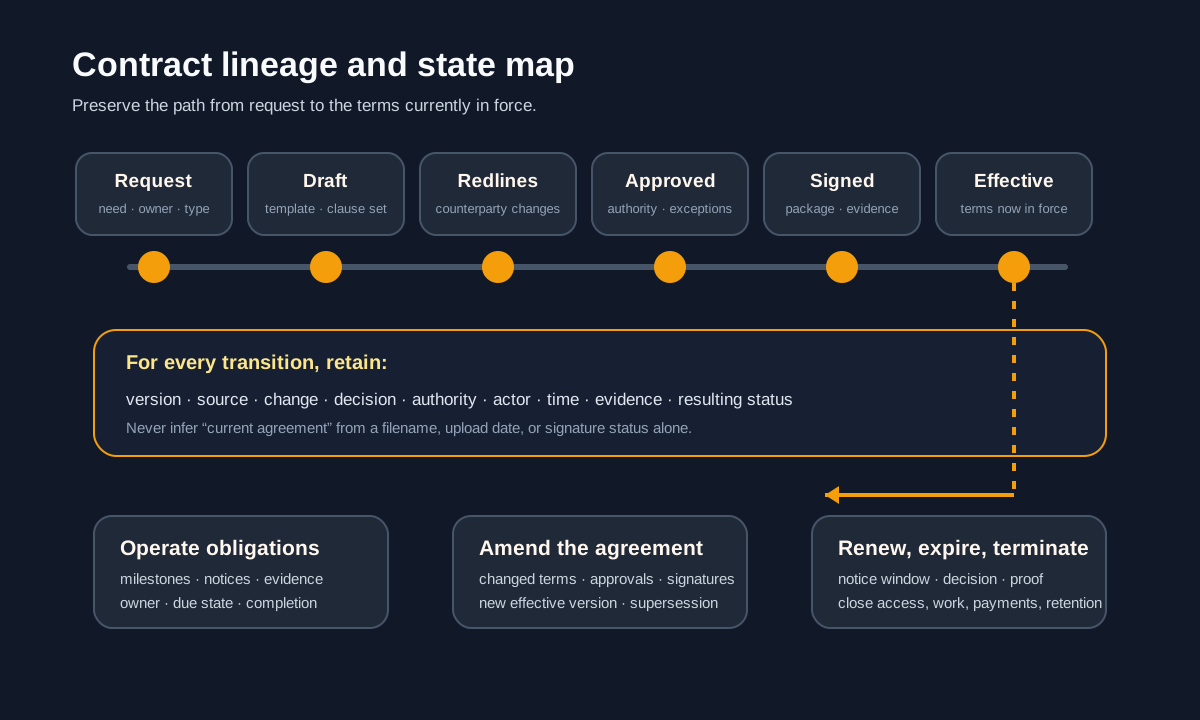
A file is evidence, not the whole state model. “Final-v7-signed” may be superseded by an amendment, relate to the wrong legal entity, omit an exhibit, or contain an expired signature package. Store durable relationships and decisions so a reader can establish why a version became effective and which terms a later change replaced.
This is the practical boundary between a document management system and a contract workflow. Document management governs files, metadata, versions, access, retention, and retrieval. Contract management adds parties, commercial context, controlled language, authority, signature, obligations, notices, and the meaning of amendments across the lifecycle.
Cover the requirement lanes that keep agreements actionable
Request and contract data
Request type, business purpose, owner, counterparty, legal entities, value, currency, region, risk, dates, related opportunity or supplier, attachments, and required route.
Content and collaboration
Templates, clause library, fallback language, variables, Word or browser editing, comments, redlines, comparison, version lineage, external collaboration, and third-party paper.
Decision and signature
Legal and business review, approval thresholds, conditions, segregation of duties, delegation, rejection, exception, signature preparation, signer order, status, and completion evidence.
Post-signature operation
Repository, metadata, full-text search, obligations, milestones, notices, service levels, payments, renewals, termination, amendments, disputes, holds, and closeout.
Security and records
Roles, matter or entity boundaries, ethical walls, field and document access, sharing, audit history, encryption, retention, legal hold, privacy, export, backup, and recovery.
Integration and ownership
CRM, procurement, ERP, vendor master, identity, e-signature, email, calendar, document editing, service desk, payments, analytics, migration, APIs, monitoring, and support.
Separate a repository-first problem from a full CLM problem. Some teams need to find signed agreements, control access, own dates, and report obligations. Others need controlled intake, drafting, negotiation, approval, and signature as well. Buying every lifecycle feature at once can create a larger adoption and migration project than the urgent control problem requires.
Route intake and drafting from business context
Intake should capture enough information to choose a route without asking business users to act as lawyers or data architects. Define contract type, requester, owner, legal entities, counterparty, purpose, related deal or supplier, value, currency, geography, target date, source paper, sensitivity, unusual terms, attachments, and who can answer commercial questions.
State when the system may generate from an approved template, when legal review is required, and when third-party paper starts a different path. For templates and clauses, retain owner, version, jurisdiction or use context, approved alternatives, guidance, effective date, retirement status, and every agreement created from that source. A later template update should not silently rewrite executed contracts.
Collaboration requirements should name the actual editing environment, comparison method, comments, mentions, internal versus counterparty notes, attachments, access expiry, and version ownership. Decide whether negotiation happens in a browser, a document editor, email, or a controlled combination. Require a deterministic way to identify the exact version under review and the exact version approved for signature.
Make redlines, approvals, and exceptions evidence-based
A redline is not only a file comparison. Record who proposed a change, which clause or commercial term changed, the before and after language, internal position, counterparty response, related risk or business rationale, and the version that contains the decision. If an AI assistant summarizes or suggests language, show the source text, model output, reviewer decision, and resulting document without presenting the model as legal authority.
Approvals should be derived from explicit facts: entity, contract type, value, term, liability, data use, security, exclusivity, discount, non-standard clause, payment, or another accountable rule. Reuse the controlled routing principles in the approval workflow requirements guide: decision, authority, evidence, expiry, delegation, escalation, and exception ownership should remain reviewable.
Define what invalidates an approval. A material redline after approval, changed entity, increased value, different signer, new attachment, expired decision, or changed effective date may require a new route. The system should explain why review was reopened rather than relying on a user to remember policy.
Connect signature evidence to obligations and later change
Define the signature handoff: approved document checksum or version, attachments, signing entity, signers, order, authentication, consent, fields, expiration, reminders, correction, decline, void, completion, certificates or evidence, event delivery, and authoritative executed copy. Treat late, duplicate, and out-of-order webhook events as expected integration conditions.
Electronic form does not remove legal and records obligations. In the United States, 15 U.S.C. § 7001 says a contract or signature generally cannot be denied effect solely because it is electronic, while its retention provisions address accurate reflection, accessibility, and later reproduction where retention law applies. Jurisdiction, agreement type, consent, notice, records, and sector rules still need qualified legal review.
Post-signature work should come from the effective agreement, not manually retyped reminders with no source. For each obligation or right, record the source clause, responsible and backup owner, counterparty, start condition, due or recurrence logic, evidence, dependency, notice method, escalation, completion, waiver, dispute, and the amendment that changes it. Renewal is a decision workflow: notice window, commercial and performance review, owner, approval, negotiation, notice evidence, resulting term, and access or service changes.
Apply retention and disposition by accountable policy. Microsoft’s retention policy and label documentation illustrates event-based starts such as contract expiry and the ability to mark content as a record. Your implementation may use different technology, but requirements should distinguish the business event, policy, record state, hold, permitted actions, disposition review, and proof.
Assign authority across business, legal, finance, and systems
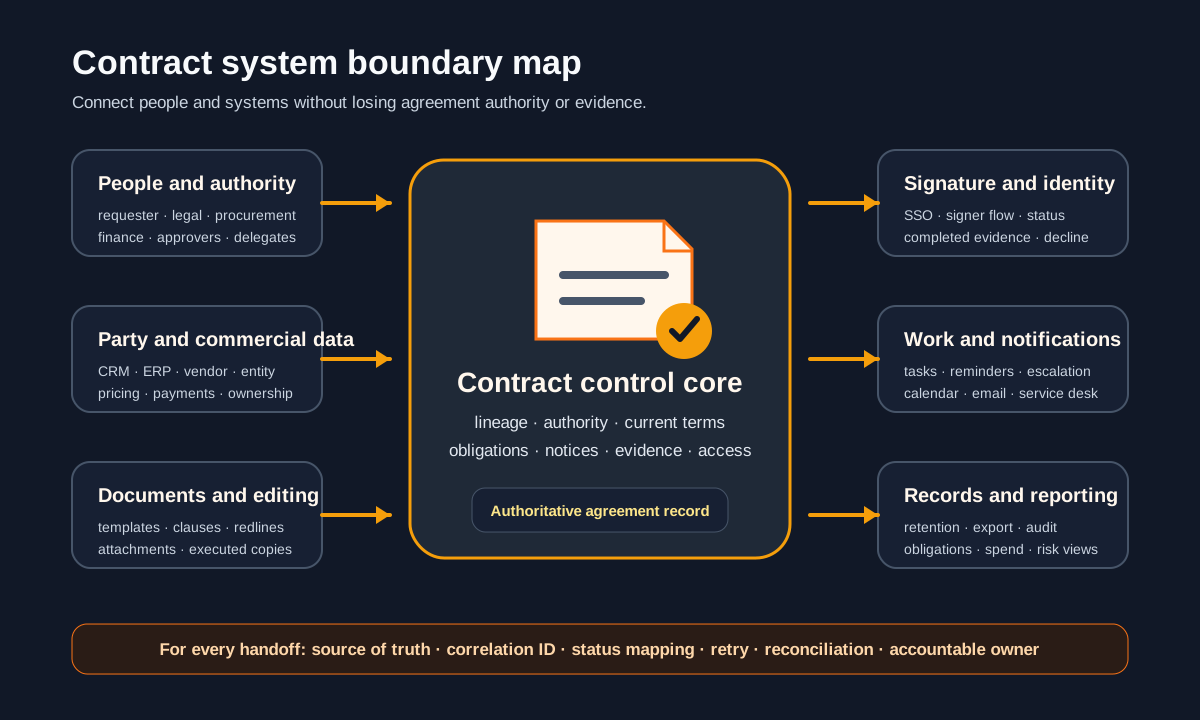
Name the authoritative source for party and entity identity, commercial values, clause content, approval decisions, signer status, effective agreement, obligations, payments, vendor state, customer opportunity, retention, and reporting. A CRM may own the opportunity while CLM owns the approved agreement and ERP owns invoicing. Integration should preserve that boundary rather than making every system editable.
For each handoff, define the correlation ID, source event, status mapping, replay and idempotency rule, attachment or document integrity, acknowledgement, timeout, reconciliation, alert, and repair owner. The API integration requirements checklist provides a deeper template for reliable contract, CRM, e-signature, procurement, and ERP connections.
Audit history should answer what happened, when, where, from which source, with what outcome, and involving which identity or object. Those are the core content elements listed by NIST in SP 800-53 Rev. 5 control AU-3. Decide which contract content belongs in the audit trail and which sensitive data should be minimized rather than copied into logs.
Choose the smallest system boundary that controls the risk
Repository and obligation control
Use when signed agreements are hard to find, dates have no owners, access is inconsistent, and reporting is manual. Prioritize migration, metadata validation, search, permissions, obligations, alerts, export, and adoption.
Full contract lifecycle management
Use when intake, templates, redlines, approvals, signature, and post-signature work all need one governed flow. Prove that configuration and user experience fit business, legal, procurement, finance, and IT—not only the demo team.
Focused extension or integration
Use when an existing repository or CLM is sound but request intake, CRM handoff, approval evidence, obligation workspace, migration tooling, or reporting is weak. Preserve the core system’s authority.
Custom contract workflow
Consider only when a narrow, differentiating process cannot be supported safely by configuration or extension. Avoid rebuilding commodity editing, signature, records, and security capabilities without a compelling ownership reason.
Leeonex can help scope a focused portal or administrative workflow, integration, migration utility, or reporting layer around an approved contract operating model. Legal interpretation and policy decisions remain with the accountable specialists.
Use a difficult-contract worksheet before selection
Bring one ordinary agreement and one difficult agreement into every pilot. Do not accept a vendor’s tidy sample as evidence. Record the expected state, owner, and proof after each step:
- Request, parties, entities, business purpose, value, region, contract type, owner, target date, sensitivity, and source paper.
- Template or third-party draft, clause versions, attachments, internal and external comments, redlines, and current negotiating version.
- Standard and exception approvals, authority, delegation, expiry, changed terms, rejection, and reopened review.
- Signature preparation, corrected signer, decline or expiry, duplicate event, completion evidence, and authoritative executed copy.
- Obligations, notice window, owner change, amendment, updated renewal date, payment or CRM handoff, report, export, retention state, and final disposition.
Score each requirement as proven, unproven, failed, or not needed for the first release. Add an owner, proof request, and blocker condition. The pilot passes when the team can establish the current agreement, authorized decisions, active commitments, access, and recovery path without relying on filenames, inbox memory, or a private spreadsheet.
Contract management software FAQ
What should contract management software requirements include?
Include request intake, contract types, party and entity data, templates and clauses, drafting and redlines, version lineage, approvals and delegated authority, negotiation history, signature handoff, executed records, metadata, search, obligations, milestones, notices, amendments, renewals, termination, permissions, audit history, retention, integrations, reporting, migration, export, administration, AI review controls, and acceptance scenarios.
What is the difference between a contract repository and CLM?
A repository focuses on signed agreements, metadata, search, access, alerts, obligations, and reporting. Full contract lifecycle management can also cover request intake, template and clause control, drafting, negotiation, approval, signature, amendment, renewal, and termination. A team should buy the smallest scope that fixes its present control problem without closing off a later phase.
Should contract software include e-signature?
It may embed e-signature or integrate with a specialist provider. Either way, define who prepares the signature package, signer identity and order, authentication, consent, status synchronization, decline or expiry, corrected envelopes, completed evidence, authoritative executed copy, and recovery when events arrive late or more than once. Legal requirements vary by jurisdiction and contract type.
How should CLM software be tested before rollout?
Use representative contracts and difficult changes: third-party paper, several entities, restricted terms, parallel redlines, rejected approvals, delegated authority, a failed signature, an amendment that changes a renewal date, a notice window, an owner who leaves, and a termination. Verify the current version, authority, evidence, permissions, obligations, reminders, integrations, search, export, and recovery after every step.