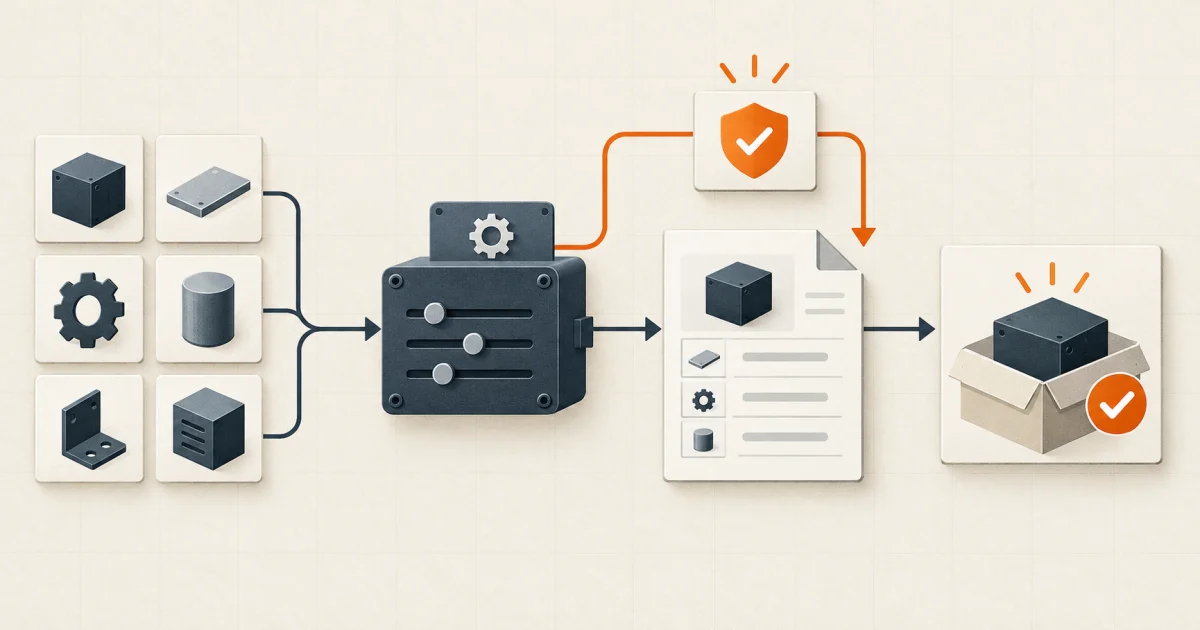
Define the commercial decision behind the quote
A useful CPQ software requirements checklist defines how a team creates a valid offer: which products or services may be combined, which customer and commercial context applies, how price is calculated and explained, who approves exceptions, which revision is active, how acceptance is recorded, and what structured data becomes an order, contract, delivery plan, or billing schedule.
Do not begin with PDF formatting. Cover customer context, configuration, pricing, discounts, approvals, revisions, documents, collaboration, acceptance, quote-to-order handoff, permissions, integrations, migration, administration, reporting, and exception recovery. Then make every vendor or build option process the same difficult quote.
Write a quote decision contract before comparing CPQ tools
Choose a representative opportunity and record the inputs that make its quote valid: customer and legal entity, market, channel, product configuration, quantities, service scope, dates, term, price source, cost or margin context where authorized, discount, tax treatment, delivery assumptions, approval, document language, acceptance method, and downstream obligations.
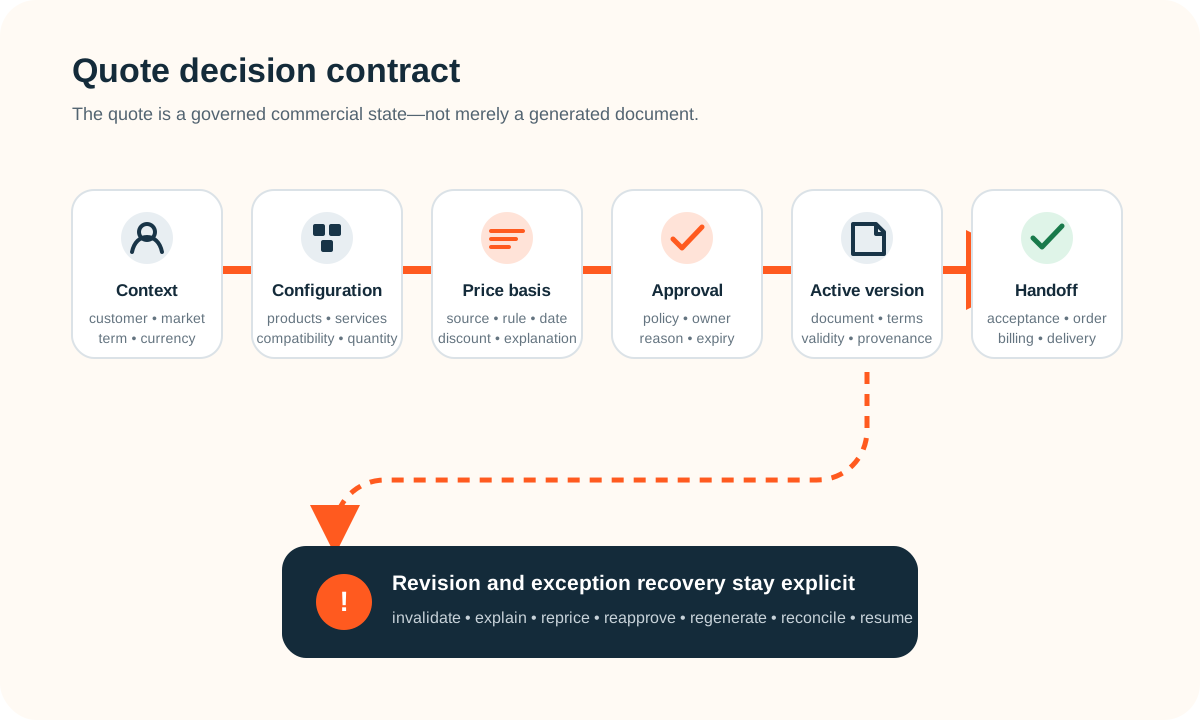
The state model matters. Microsoft's current Dynamics 365 Sales documentation describes draft quotes, activation that makes a quote read-only, revision that creates a new draft with an incremented revision, and closure as won, canceled, or revised. Review its quote, order, and invoice lifecycle. Your system need not copy those states, but it must answer the same authority question: which version can be changed, sent, accepted, converted, or withdrawn?
Add the exception path beside every happy path. Price data may be missing or expired. A configuration may need engineering review. Approval may lapse after a quantity or term changes. Document generation or e-signature delivery may fail. A customer may accept an older link while a newer revision exists. Each condition needs a visible owner, safe state, repair action, and retained history.
Cover the requirement lanes that preserve commercial intent
Customer and opportunity context
Account, legal entity, segment, market, channel, seller, opportunity, contract, entitlement, currency, tax context, credit or policy status, and effective dates.
Offer configuration
Products, services, bundles, dependencies, exclusions, quantities, units, options, attributes, substitutions, amendments, renewals, and fulfillment constraints.
Pricing and economics
Price books, customer agreements, cost inputs, quantity tiers, terms, one-time and recurring charges, usage assumptions, discounts, uplifts, rounding, taxes, and price explanation.
Approval and collaboration
Thresholds, policy triggers, reviewers, delegation, comments, expiry, reapproval, escalation, sales-engineering input, legal review, and customer-facing collaboration.
Document and acceptance
Templates, clauses, schedules, attachments, languages, branding, rendering, delivery, access, expiry, signature, rejection, withdrawal, and immutable accepted output.
Operations and governance
Permissions, audit history, data stewardship, rule releases, migration, monitoring, reporting, export, retention, support queues, and reconciliation.
Use the approval workflow software requirements checklist when discount, margin, legal, finance, or delivery exceptions need a reusable decision model. CPQ should submit the full decision context and receive a durable decision; it should not reduce approval to an email that cannot be tied to the active revision.
Make configuration and pricing explainable
Product rules should say whether an option is required, recommended, incompatible, conditionally allowed, or available only with approval. Name the rule owner, effective dates, priority, message, dependency, and expected behavior when multiple rules conflict. Treat service scope the same way: locations, effort, deliverables, service levels, milestones, usage, and term may all change what is sellable.
A price is the result of inputs and policy. Record the source price, unit, quantity, currency, effective date, customer agreement, adjustment sequence, rounding, discount, tax input, override, approval, and final amount. Microsoft documents several built-in Dynamics pricing methods and volume-discount behavior in its price calculation guidance. That illustrates why “supports pricing rules” is not a testable requirement: precedence, missing price lists, currency mismatch, recalculation, and rounding all change the result.
Decide when to recalculate. A draft may use current catalog data, while an activated or accepted quote may preserve the agreed price. Microsoft distinguishes current pricing from locked pricing for downstream sales records. Your rules should cover catalog changes, customer changes, copied quotes, renewals, amendments, approval expiry, and deliberate refresh. Never let a background update silently change an offer already sent.
Bind approval, documents, and acceptance to one version
An approval should reference the exact configuration, price, discount, margin or policy measure, terms, attachments, requester, reason, and version under review. Define which changes invalidate it. A corrected postal address may be harmless; changing quantity, term, product, delivery commitment, payment schedule, or clause may require recalculation and reapproval.
Separate editable working state from immutable issued versions. Give every issued quote a stable identifier, revision, generated time, input provenance, approval snapshot, validity window, and document checksum where appropriate. Define whether customers can view prior revisions, how withdrawn links behave, and which version an acceptance action signs.
The accepted document and the accepted structured data must agree. Test document rendering for long descriptions, tables, optional sections, page breaks, locale, accessibility, attachments, and failed generation. Then prove that acceptance creates the same products, quantities, prices, terms, milestones, and obligations downstream—not a loosely reconstructed order.
Assign authority across the quote-to-order boundary
Map CRM, account and entitlement data, product catalog, pricing, cost, approvals, document generation, electronic signature, contracts, order management, provisioning or delivery, billing, tax, identity, and analytics. For each boundary define the source of truth, stable ID, active version, event, direction, timing, authorization, retry, idempotency, reconciliation, and support owner.
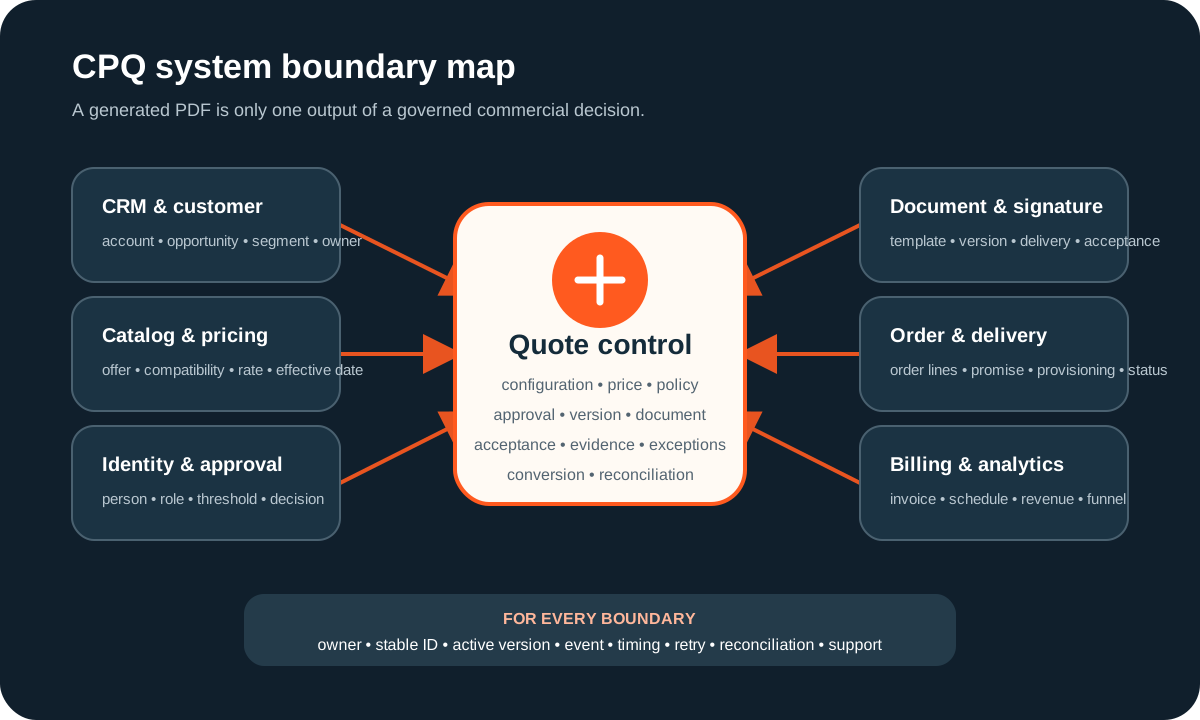
Microsoft's developer documentation represents quote, order, and invoice as related but distinct records with line items, customer, addresses, price list, dates, and closure events. See its quote, order, and invoice tables. Use your own domain model, but preserve the accepted commercial identity through conversion. If a handoff retries, it should not create a second order; if one line fails, the exception must be visible and reconcilable.
The API integration requirements checklist provides a deeper control model for retries, idempotency, partial failure, replay, reconciliation, and support. Reporting should be built from governed states: quote cycle time, approval wait, revision count, exception causes, acceptance, conversion, and downstream mismatch need explicit populations and timestamps.
Choose buy, extend, or build from the quote gap
Buy and configure
A product fits the catalog, pricing, approvals, documents, CRM or ERP boundaries, administrator skills, and expected quote complexity.
Extend
The quote engine is sound, but one specialized configuration, customer experience, document, approval, or integration is missing.
Build
The offer is inseparable from a distinctive product, service, engineering, fulfillment, or recurring-commercial model that packaged workarounds repeatedly distort.
Run the same scenarios in every option: a normal quote, an incompatible bundle, customer-specific pricing, an exceptional discount, a revised quantity after approval, an expired offer, a renewal or amendment, duplicate acceptance, and a failed quote-to-order call. Score correctness, explanation, repair, administrator effort, lifecycle cost, export, and user burden.
Use a capable platform when it fits. Leeonex can help with API and integration services or custom web application development when a focused configurator, approval surface, customer quote experience, or quote-to-delivery bridge is the real missing part. The quote-to-delivery concept study shows how an evidence-led first slice can make the handoff visible without pretending to be a client result.
Use a difficult-quote scenario worksheet
- Outcome: name the quoting delay, error, control gap, or downstream rework the scenario must expose.
- Context: capture customer, seller, market, currency, term, dates, channel, and governing agreement.
- Configuration: include required options, incompatibility, substitution, quantity, service scope, and one exception.
- Price: record every source, effective date, calculation, rounding rule, discount, override, and explanation.
- Approval: define trigger, accountable owner, evidence, expiry, delegation, rejection, and reapproval conditions.
- Version: prove draft, issue, revision, withdrawal, expiry, delivery, acceptance, and immutable accepted output.
- Boundaries: assign authority for customer, catalog, price, document, signature, order, delivery, billing, and analytics.
- Acceptance: reconcile the active quote, rendered document, approval history, customer action, order lines, and failure recovery.
A pilot is complete when a sales or operations owner can explain the quote, reproduce its price, identify the active version, and repair a failed handoff without private spreadsheets or manual re-keying. That is stronger evidence than a polished document demo.
CPQ software requirements FAQ
What should CPQ software requirements include?
Include customer and opportunity context, product and service configuration rules, price sources and calculations, discounts, margin or policy approvals, taxes and currencies where relevant, document generation, revisions, collaboration, acceptance, quote-to-order handoff, CRM and ERP integration, permissions, audit evidence, migration, administration, exceptions, and acceptance scenarios.
What is the difference between CPQ and a quote template?
A quote template formats approved information into a document. CPQ software also controls which combinations may be sold, how prices and discounts are derived, who must approve an exception, which revision is active, and what structured data moves downstream. A template can improve presentation without controlling the commercial decision.
Should a business buy or build CPQ software?
Buy and configure a product when its catalog, pricing, approval, document, and downstream data models fit. Extend one when the core quote engine is suitable but a focused rule, portal, workflow, or integration is missing. Consider custom software when the offer is inseparable from a distinctive configuration or delivery model and packaged workarounds create recurring commercial risk.
How should CPQ software be tested before rollout?
Use ordinary and difficult real quote scenarios: incompatible products, customer-specific prices, expired inputs, exceptional discounts, multiple revisions, rejected approvals, changed quantities, renewals, failed document generation, duplicate acceptance, and downstream integration failure. Verify the price explanation, active version, permissions, evidence, recovery path, and resulting order data.