Answer first
Build the controlled handoff from approved opportunity to closed work—not another customer database.
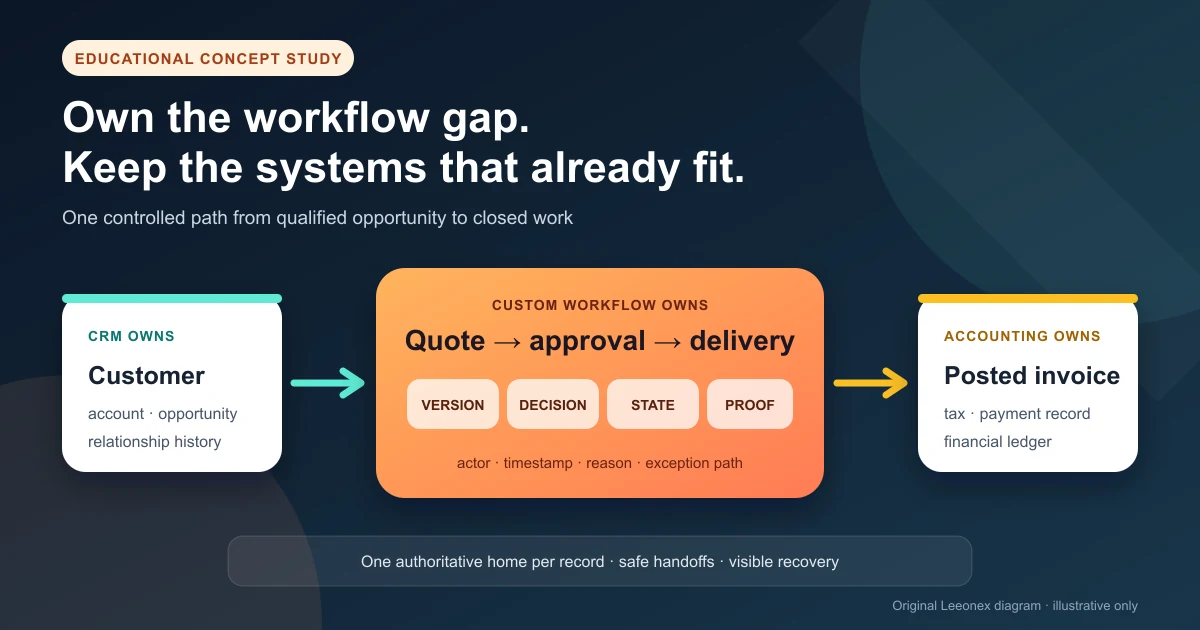
A quote-to-delivery web app should own the decisions your existing systems cannot represent safely: versioned scope, internal review, customer approval, authorized work, delivery state, exceptions, and closure evidence. The CRM should keep owning the customer and opportunity. The accounting platform should keep owning the posted invoice and payment record.
The smallest useful first release follows one service line and one complete case from a qualified opportunity to a closed work order. It creates new records only where the business needs distinct behavior, gives every transition an accountable actor, and treats failed handoffs as visible operational work. That boundary is usually more valuable than copying CRM screens, scheduling everything, or building a general workflow platform.
Evidence boundary
This is a Level E educational concept study. Leeonex has not built, integrated, deployed, operated, or measured this system. No service business, customer, quote, approval, work order, invoice, product screen, speed improvement, error reduction, or commercial outcome is presented. The dialogue, roles, states, diagrams, scope choices, and technology labels are illustrative planning material—not client evidence or delivered-work proof.
Starting situation and intended buyer
The CRM tracks the relationship; the spreadsheet quietly runs the promise.
This concept is for a service business owner, operations leader, or product team whose sales system can mark an opportunity won but cannot control what happens next. Scope versions live in documents, price decisions sit in messages, customer approvals arrive by email, delivery teams receive copied rows, and nobody can reproduce which promise authorized the work.
The first instinct is often to customize the CRM until it behaves like an operations system—or replace it with a custom application that also handles contacts, marketing, sales, quoting, scheduling, projects, billing, support, and reporting. Both paths can hide the real product boundary. The differentiating need may be the narrow chain of custody between a qualified deal, approved scope, authorized work, and accepted completion.
A useful constraint is one service line, one legal entity, one approval model, one delivery pattern, and a small pilot cohort. The concept does not assume every service firm should build custom software. If a supported CRM, quoting product, project tool, or configured workflow can pass the hard cases, buying or configuring it may be the responsible decision.
Illustrative discovery conversation
Find the decision the current stack cannot keep trustworthy.
The following exchange is fictional. It is not a client quotation, transcript, testimonial, or description of delivered work. It illustrates how discovery can separate the customer system from the workflow system.
Operations lead
The CRM says the opportunity is won, but the real work starts in a spreadsheet. Quotes get copied, approvals sit in email, and delivery teams argue about which version is current.
Leeonex
Which record should the CRM continue to own, and which decision can it not represent safely today?
Operations lead
The CRM should own the account and opportunity. We need to control scope revisions, customer approval, the authorized work order, and completion evidence.
Leeonex
Then the first product is not a new CRM. It is a bounded workflow between qualified opportunity and delivery closure, with one owner for every record and an explicit exception path.
The answer is not predetermined. A fit-gap test may show that the CRM can support the process with configuration, or that a focused extension is enough. Custom development becomes defensible when a specific, durable workflow boundary remains unsafe, awkward, or operationally expensive after that test.
User roles and accountability
A role is a set of allowed decisions, not a dashboard label.
Account owner
Owns: Selects the qualified opportunity, confirms customer identity and commercial context, and requests a quote without recreating the account record.
Boundary: Cannot silently change an approved scope or mark delivery complete on behalf of the delivery owner.
Estimator
Owns: Builds versioned scope, assumptions, exclusions, price inputs, validity, and internal review notes for the proposed work.
Boundary: Cannot overwrite a version already sent to the customer; a material change creates a new version and approval decision.
Customer approver
Owns: Reviews the exact quote version, accepts or rejects it through an authenticated or appropriately verified path, and leaves a durable decision record.
Boundary: Sees only the customer-facing scope and decision context, not internal margin, private notes, unrelated accounts, or other customers' work.
Delivery lead
Owns: Accepts the authorized work order, moves allowed delivery states, records blockers, and attaches the evidence needed to close or return the work.
Boundary: Cannot begin from an unapproved quote or edit the commercial promise after authorization without a controlled change path.
Some businesses will split or combine these roles. The design still needs to distinguish authority. An administrator who can repair data, for example, should not automatically receive commercial approval power or access to every customer document.
Core workflow
Make the promise, authorization, work, and evidence traceable.
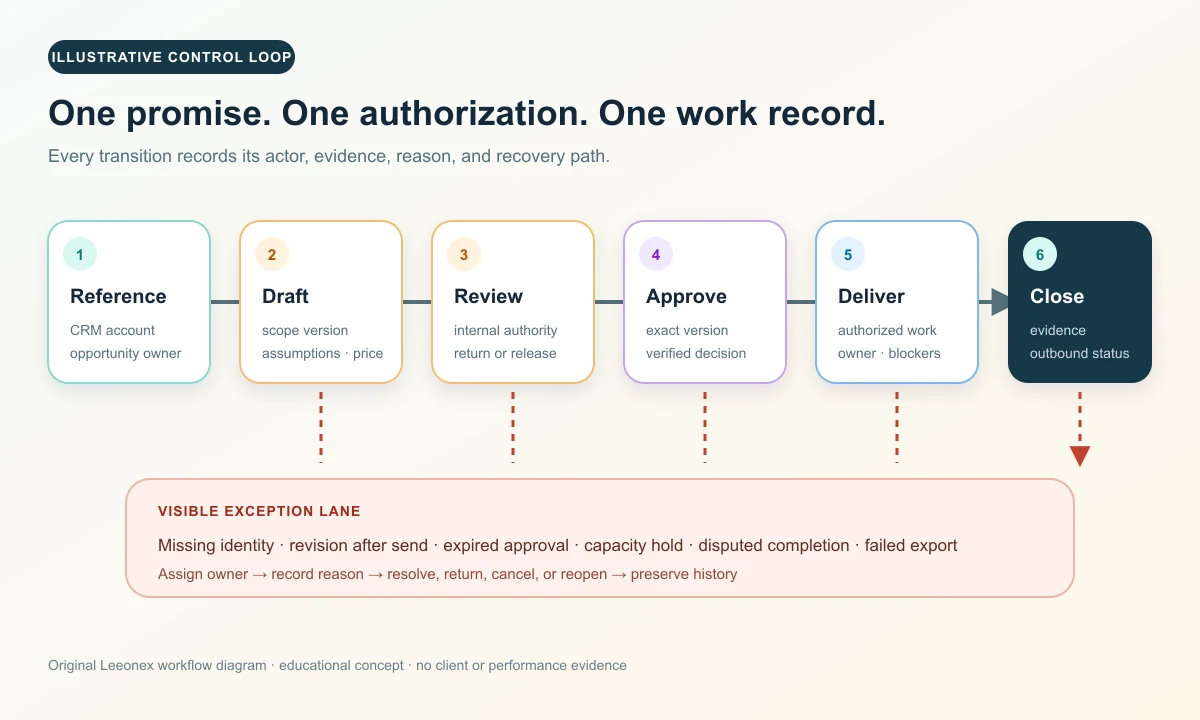
One proposed loop has six top-level states: draft, internal review, sent, approved, in delivery, and closed. Real products may need substates, but every added state should answer who can enter it, what evidence is required, what happens next, and how the team recovers when the transition is wrong or incomplete.
| Transition | Accountable actor | Required evidence | Failure path |
|---|---|---|---|
| Opportunity to draft | Account owner | Stable account and opportunity reference | Reject or reconcile missing identity |
| Draft to sent | Estimator / reviewer | Locked version, assumptions, exclusions, validity | Return for correction |
| Sent to approved | Customer approver | Verified actor, exact version, time, decision | Reject, expire, or issue a revision |
| Approved to delivery | Delivery lead | Authorized work order and owner acceptance | Hold for capacity, dependency, or change |
| Delivery to closed | Delivery lead / approver | Completion artifact, acceptance, exception outcome | Return, dispute, or reopen |
Smallest useful scope
Build the differentiating state machine; borrow commodity capabilities deliberately.
The first release should prove that one representative job can move through the correct promise and authorization without losing ownership. It does not need to replace every upstream and downstream system. Manual work can remain when it is named, capacity-bounded, and visible in the operating procedure.
Build now
- CRM reference and ownership check
- Versioned quote and review trail
- Verified approval or rejection
- Authorized work-order states
- Exception queue and reason codes
- Completion evidence and outbound status
Operate deliberately
- Complex estimating judgment
- Legal or commercial review
- Capacity confirmation
- Unusual changes and disputes
- Accounting reconciliation
- Pilot support and data repair
Add after evidence
- Advanced price configuration
- Scheduling or route optimization
- Customer self-service portal
- Supplier or subcontractor network
- Automated invoicing and payment
- Cross-service analytics and forecasting
Deliberately excluded from the concept
This concept does not define contract terms, pricing policy, taxation, accounting treatment, electronic-signature validity, workforce classification, sector regulation, customer credit, payment collection, route planning, inventory, payroll, or a universal document-retention rule. Those decisions need the appropriate commercial, finance, legal, security, privacy, and operational owners before related features enter scope.
Architecture and system ownership
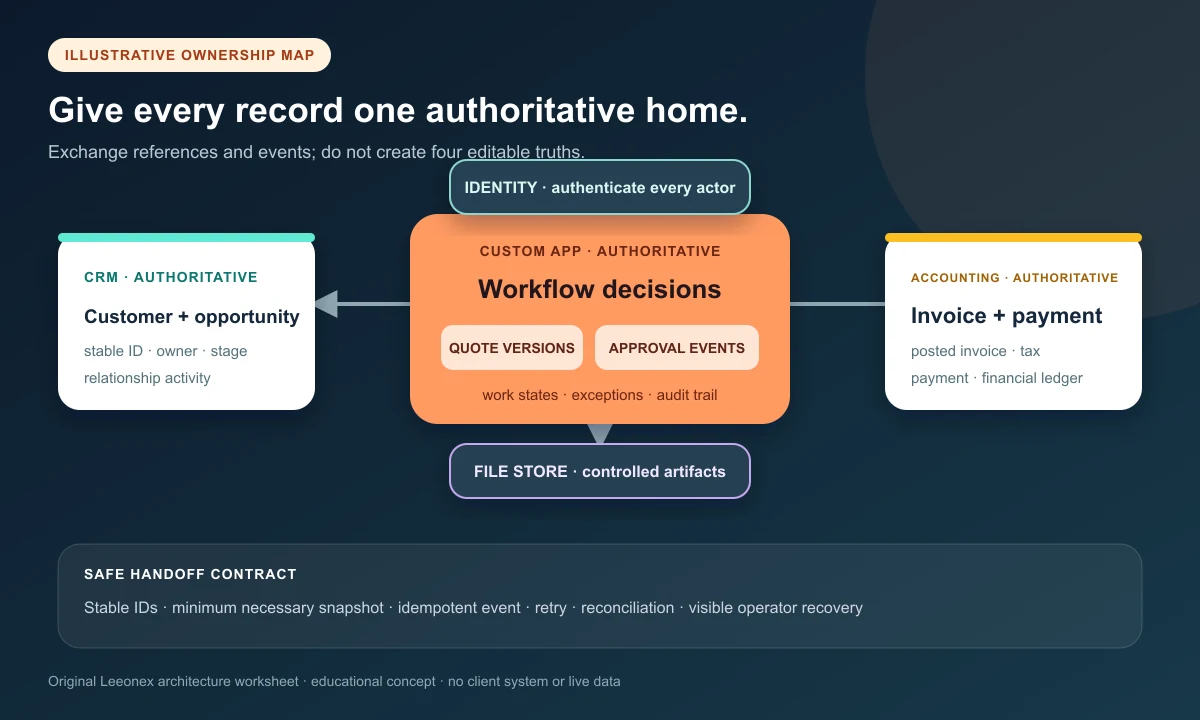
Every important record needs one authoritative home.
The custom app should not win ownership merely because it can copy data. Assign authority by business responsibility: CRM for the customer and opportunity, the workflow app for quote versions, approvals, work states, and exceptions, managed file storage for controlled artifacts, and accounting for posted invoices and payments. Send references and necessary snapshots across the boundary while preserving lineage.
- Keep the CRM authoritative for customer and opportunity identity. Store stable external identifiers and a small snapshot needed to explain the workflow, not an unmanaged copy of the whole CRM record.
- Model quote versions as immutable commercial proposals. A new scope, price, assumption, or validity period creates a new version; approval points to the exact version the customer saw.
- Separate quote state from work-order state. Commercial acceptance authorizes work, but delivery ownership, scheduling, blockers, completion, and reopening need their own controlled transitions.
- Generate documents and notifications from recorded state. A PDF or email can communicate a decision, but it must not become the only place where current scope or approval is known.
- Use an outbox or equivalent delivery pattern for cross-system events, idempotency keys for safe retries, and a reconciliation view for partial failures. Do not treat one webhook response as proof that every system agrees.
- Record actor, timestamp, previous state, new state, reason, related version, and source for meaningful transitions. Keep the audit trail append-oriented and restrict access to sensitive commercial details.
A practical first data model may include external accounts and opportunities, quote requests, quote versions, line items, assumptions, exclusions, review decisions, approval invitations, approval events, work orders, delivery events, artifacts, exceptions, comments, outbound messages, and integration jobs. Exact technology follows the real constraints; the design goal is recoverable custody, not a fashionable stack.
Risks and guardrails
Workflow software becomes risky when authority is implied instead of tested.
- 1
Define the commercial boundary before development: which entity contracts, who may approve, how long approval remains valid, when tax or legal review is required, and what makes a quote non-binding.
- 2
Use representative normal, rejected, expired, revised, duplicate, and partially delivered examples. A happy-path demo does not prove the state model or integration recovery.
- 3
Apply least-privilege access to customer, price, margin, document, and delivery information. Test record-level separation and denied actions, not only whether permitted screens render.
- 4
Make exceptions first-class: missing CRM identity, changed customer contact, approval after expiry, work started early, delivery blocked, completion disputed, accounting export failed, and reopened work.
- 5
Define retention, deletion, export, file scanning, backup, recovery, support, incident, and accessibility responsibilities according to the actual data and jurisdictions involved.
- 6
Instrument workflow events and manual effort without turning activity counts into business claims. Cycle time, rework, acceptance, and delivery quality need definitions, baselines, observation windows, exclusions, and accountable interpretation.
Limitations and evidence needed
The blueprint explains a boundary; it does not prove the business should build it.
No interviews, workflow records, product trials, vendor comparisons, legal requirements, integration documentation, or production constraints were supplied for this concept. No service line, quote model, approval rule, accounting process, identity method, customer experience, or operating capacity has been validated. The diagrams are explanatory artifacts, not screenshots of a working system.
Stronger implementation claims would require an approved brief, delivered repository, schema and state model, integration contract, acceptance tests, permission tests, security and privacy review, deployment record, audit history, recovery tests, support procedure, incident evidence, and approved visuals. A client relationship would additionally require identity or anonymization permission and publication approval.
Stronger performance claims would require defined baselines, metrics, cohorts, observation windows, source events, calculations, exclusions, attribution limits, verification, and approved wording. Quote cycle time, revision rate, work started without authorization, integration exceptions, rework, customer acceptance, delivery quality, margin, revenue, and conversion are possible measurement candidates—not results, forecasts, or promises in this study.
Lessons and first consultation
Bring the disputed version, the missing handoff, and the exception nobody owns.
The most useful discovery material is not a polished feature list. It is a representative case that shows where identity, scope, approval, work, and accounting become disconnected. Bring these inputs to a first conversation:
- One representative opportunity, quote, revision, approval, work order, completion record, and exception with private information removed where needed
- The people who create, review, approve, deliver, support, administer, and audit the work—and the actions each role must never perform
- The current CRM, accounting, file, identity, messaging, scheduling, and reporting systems, including available APIs and ownership constraints
- The quote structure: line items, bundles, assumptions, exclusions, attachments, currency, tax context, validity, templates, and approval rules
- Allowed states, transition owners, service-level expectations, change requests, cancellations, partial work, disputes, reopening, and closure evidence
- Security, privacy, legal, accessibility, retention, geography, availability, backup, recovery, support, and audit requirements
- The pilot cohort, operator capacity, launch acceptance cases, rollback conditions, and evidence that would justify expanding the workflow
Leeonex's custom web application development service fits teams with a durable workflow that packaged tools cannot support cleanly. Use the no-code versus custom software decision guide to test whether configuration, a hybrid, or custom ownership is justified. Start with the custom CRM versus off-the-shelf CRM guide if the real question is whether to configure, extend, or build. Use the API integration requirements checklist when system contracts and recovery paths need deeper work.
Explore the Leeonex case-study hub to compare other evidence types and product decisions. Metadata, sitemaps, structured data, and AI-readable discovery can make the material easier to find and interpret, but none guarantees rankings, indexing, traffic, citations, trust, leads, conversions, or business outcomes.
A problem-aligned next step
Map one approved quote all the way to closed work.
Bring the current artifacts, owners, systems, and one difficult exception. Leeonex can turn them into a focused workflow-app brief—or show where configuration, integration, or process repair should happen before custom development.