The short answer: design a location operating system
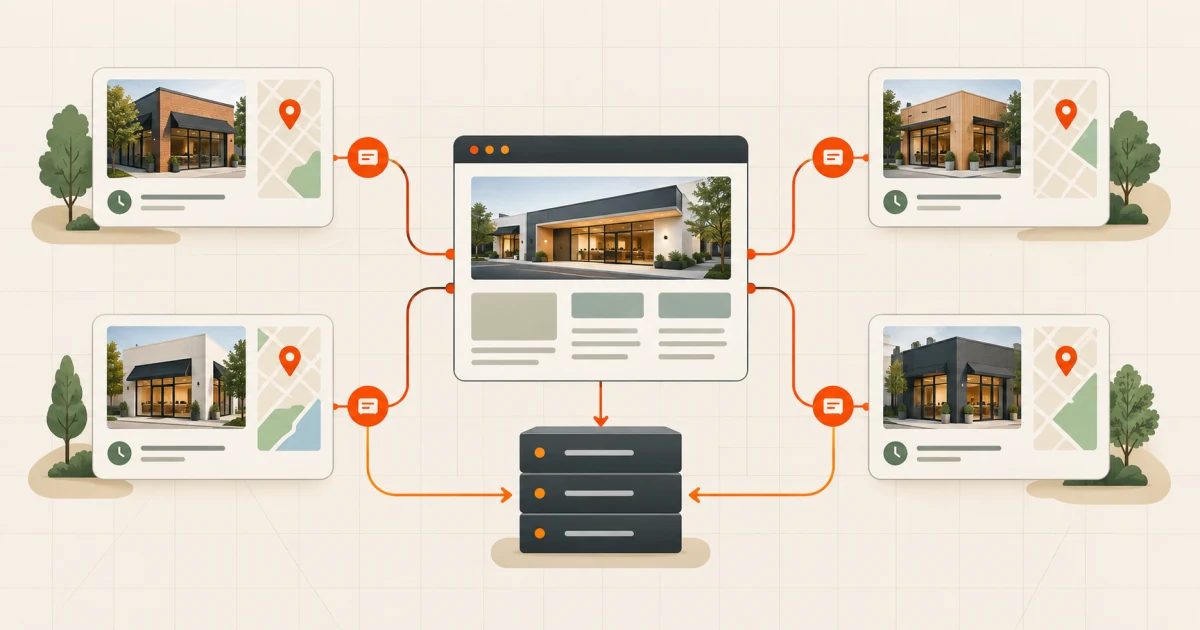
Multi-location website requirements should define one governed location record, which pages and actions that record powers, who may change each field, how inquiries reach the right team, and what happens when a branch opens, changes hours, moves, or closes. A page template is only the visible surface of that operating system.
Start with three representative locations: the ordinary one, the most operationally complex one, and the next opening. Trace how each fact reaches the locator, location page, structured data, Business Profile, form, booking or ordering link, analytics, and downstream team. If nobody owns a field or an exception, the site will drift even when its design is sound.
Use the broader website requirements checklist for the shared brand platform. Use this guide to define the location-specific data, governance, routing, and lifecycle that a generic company-site brief usually misses.
Write the location contract before choosing a CMS
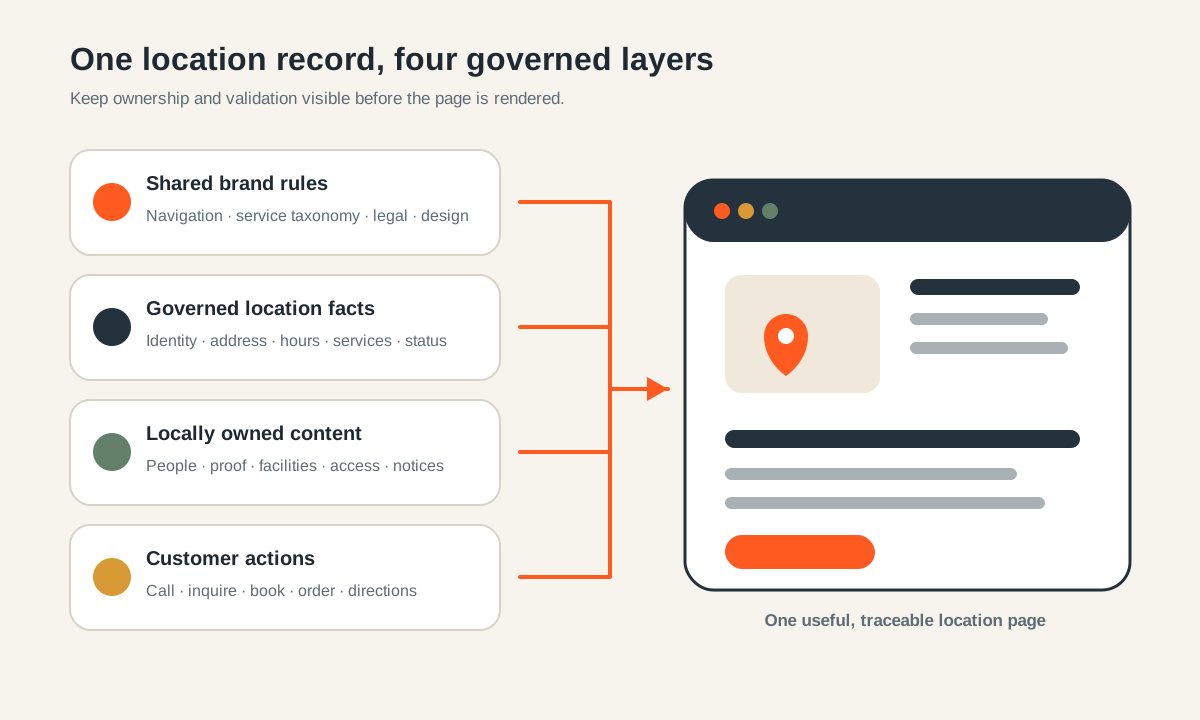
Define a location as a durable entity with a stable identifier, not a collection of text blocks. Record its public name, business type, status, address or service area, coordinates, contact methods, hours and exceptions, services, facilities, languages, accessibility details, eligibility rules, routing destination, external profile identifiers, and effective dates.
Separate four kinds of information. Shared rules come from the brand: navigation, legal copy, design tokens, and service definitions. Governed facts need a trusted source and validation. Local content needs an owner and review standard. Actions need a real destination, availability rule, and failure path. This separation prevents a local editor from accidentally changing policy while still allowing useful local detail.
Add completeness rules by location type. A clinic, showroom, service-area team, warehouse, and office do not need identical fields or actions. The page should expose what helps a visitor decide or complete a task, not every field the organization happens to store.
Define eight requirement lanes with acceptance evidence
| Lane | Decision to specify | Acceptance evidence |
|---|---|---|
| Location identity | Stable ID, type, status, address or area, coordinates, external IDs | One location stays identifiable across every channel |
| Discovery | Hierarchy, locator, search, filters, nearby logic, zero-result path | A user can find the right eligible location on mobile |
| Page usefulness | Services, proof, staff or facilities, access details, FAQs, local media | Each published page helps a real local decision |
| Hours and availability | Regular hours, exceptions, holidays, time zone, temporary changes | Every surface shows the same effective state |
| Actions and routing | Call, form, booking, order, directions, consent, fallback owner | A test action reaches the intended team and is acknowledged |
| Publishing governance | Roles, field ownership, approval, expiry, audit, preview, rollback | A permitted edit ships without weakening shared controls |
| Search and measurement | Canonical URL, indexability, structured data, sitemap, location attribution | Crawlers and analytics resolve the same location |
| Lifecycle and resilience | Opening, pause, move, closure, redirects, integration failure, recovery | Every state has a visible result, owner, and repair path |
Require a useful page, not a city-name substitution
A location page can use a shared structure while containing real local value: available services, access and parking, service boundaries, facilities, current hours, relevant staff, local proof, specific next actions, and honest limitations. Google describes doorway abuse as substantially similar regional or city pages created to rank and funnel people onward in its search spam policies. Do not publish a matrix of thin pages simply because the CMS can.
Make actions location-specific and recoverable
Decide whether phone calls, forms, bookings, quotes, orders, and directions differ by branch, service, time, or visitor context. Store the routing rule outside presentation copy. Define the fallback when a destination is missing, a calendar is full, or an integration is unavailable. Google's Business Profile guidance says action links for multi-location businesses should lead to a specific location's landing page; the same precision should govern your website handoff.
Design CMS governance around fields and decisions
“Corporate” and “local editor” are too coarse. Build a field ownership matrix. Central teams may own brand, service taxonomy, legal copy, templates, structured-data rules, and global campaigns. Location owners may propose hours, staff, facilities, photos, local announcements, or temporary conditions. Some changes can publish immediately; others need review, an effective date, or automatic expiry.
Require preview for the actual location, validation for address, phone, hours, image rights, and required fields, plus an audit record of who changed what and when. Add stale-content reports and named review cadence. The headless versus traditional CMS guide can help with platform shape, but choose only after defining these workflows.
If the site also publishes in several languages or regional editions, the multilingual website requirements checklist adds locale URLs, alternate relationships, language switching, translation review, accessibility, and source-change handling to this governance model.
Keep Business Profile governance explicit too. Google advises chains to maintain consistent names and categories and not to create more than one profile per location in its business representation guidelines. Record profile ownership and identifiers so the website and listings can be reconciled without sharing passwords.
Model opening, temporary change, move, and closure
A new branch may be planned, verified, previewable, announced, and live on different dates. A live branch may have changed hours, a temporary closure, reduced services, or an emergency notice. A move must preserve visitor and search continuity. A permanent closure needs a destination policy, not an abrupt deletion.
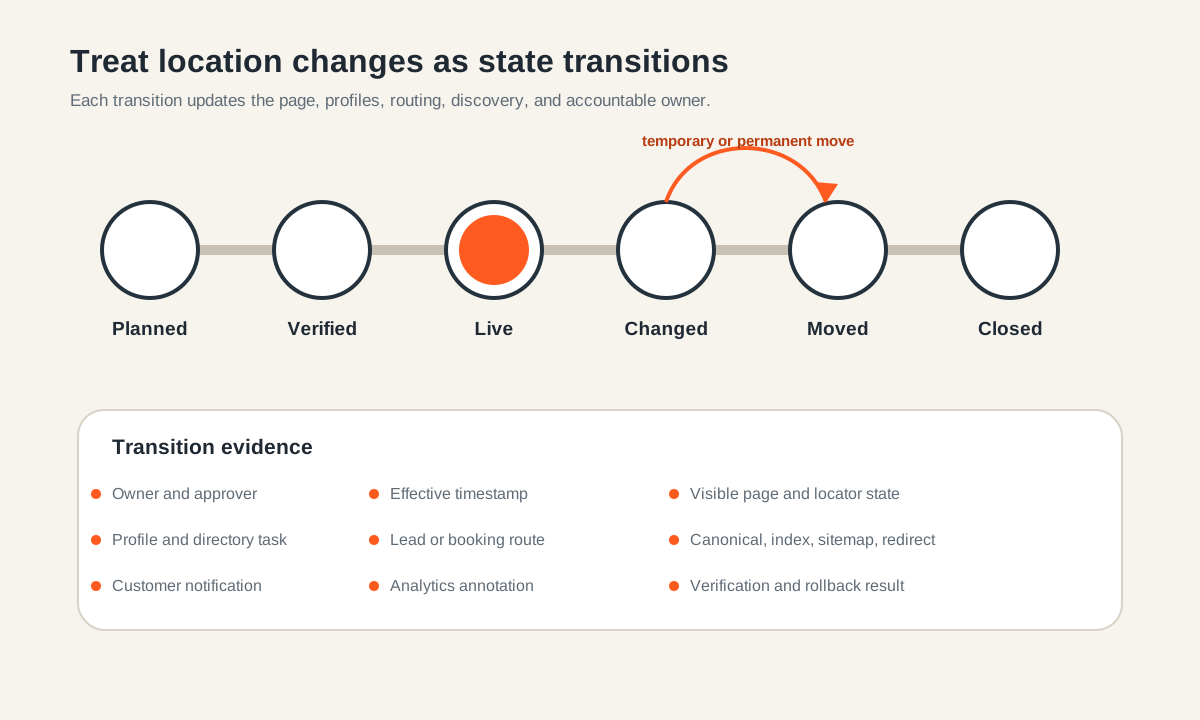
For each transition, name the approver, effective timestamp, page and locator behavior, Business Profile task, sitemap and structured-data result, redirect, routing change, analytics annotation, notification, and verification evidence. Google's LocalBusiness structured-data documentation recommends a specific business subtype and location-specific facts; generate markup from the governed record instead of maintaining a second manual version.
Choose architecture by governance and change load
| Model | Best fit | Watch closely |
|---|---|---|
| Shared CMS templates | One brand, consistent page model, moderate local variation | Role granularity, bulk changes, preview, and location-data quality |
| CMS plus location service | Facts feed several channels or change frequently | Source-of-truth boundaries, synchronization, repair, and editorial joins |
| Separate sites | Genuinely independent brands, markets, owners, or legal operations | Duplicated maintenance, fragmented measurement, and inconsistent standards |
Prefer one coherent domain and content system when the brand and customer journey are shared. Separate sites only when the operating model is truly separate, not because the current CMS makes permissions awkward. Before migration, map every existing location URL, backlink, profile link, and action endpoint using the website migration checklist.
Leeonex's company website development service is relevant when the requirement is a governed public platform; the CMS website offering fits teams that need controlled publishing across central and local owners.
Use this one-location release worksheet
- Identity: stable ID, type, status, canonical URL, profile IDs, and source owner.
- Facts: address or area, coordinates, contacts, hours, services, facilities, and effective dates.
- Content: local proof, media rights, staff, access details, unique guidance, reviewer, and expiry.
- Actions: call, inquiry, booking, order, directions, consent, destination, acknowledgement, and fallback.
- Discovery: hierarchy, locator, filters, internal links, canonical, indexability, structured data, and sitemap.
- Governance: field permissions, validations, approval, preview, audit, rollback, and stale-content alert.
- Scenarios: ordinary, opening, holiday, temporary closure, move, permanent closure, duplicate, missing data, and failed integration.
- Evidence: page output, mobile action, routed lead, structured-data validation, analytics event, redirect, and named owner.
Pilot with a small but varied set of locations. Release when the team can keep facts aligned, publish useful differences, route actions correctly, and repair a failed update without a developer editing production content by hand.
Multi-location website requirements FAQ
What should a multi-location website include?
Include a governed location record, browseable locator, useful page for every eligible location, accurate contact and hours data, services and service areas, local proof, accessible directions and actions, lead routing, CMS roles and approvals, structured data, analytics by location, integrations, redirects, and explicit opening, temporary-change, move, and closure workflows.
Should every business location have its own page?
Usually, when the location is real, customer-facing, and has enough distinct information to help someone choose or act. A location page should do more than swap a city name: show accurate facts, services, access details, local proof, staff or facilities where relevant, and a direct next action. Combine or withhold pages that cannot add genuine utility.
How should a multi-location website be tested before launch?
Test representative locations plus an opening, temporary closure, changed hours, moved branch, permanently closed branch, duplicate record, missing field, local edit, rejected edit, routed lead, failed integration, and mobile action. Verify the visible page, search and locator, structured data, analytics, notifications, redirects, and downstream owner after each scenario.