
Define the route decision, not a list of map features
Route optimization software requirements should state which tasks and resources are true, which constraints may never be broken, which outcomes are trade-offs, how a dispatcher approves the result, and what may change after release. The useful output is not the shortest line on a map. It is a feasible, explainable, publishable plan that survives execution.
Start with one representative route day and one difficult day. Include late work, a missing driver, an incompatible vehicle, a tight time window, excess demand, a cancellation, and a stop already completed when replanning begins. If a vendor cannot show those cases with your data shape, a polished demo proves very little.
This guide narrows the routing decision. Use the broader fleet management requirements checklist when vehicle readiness, telematics, inspection, maintenance, fuel, and lifecycle ownership are also in scope.
Write a route optimization decision contract
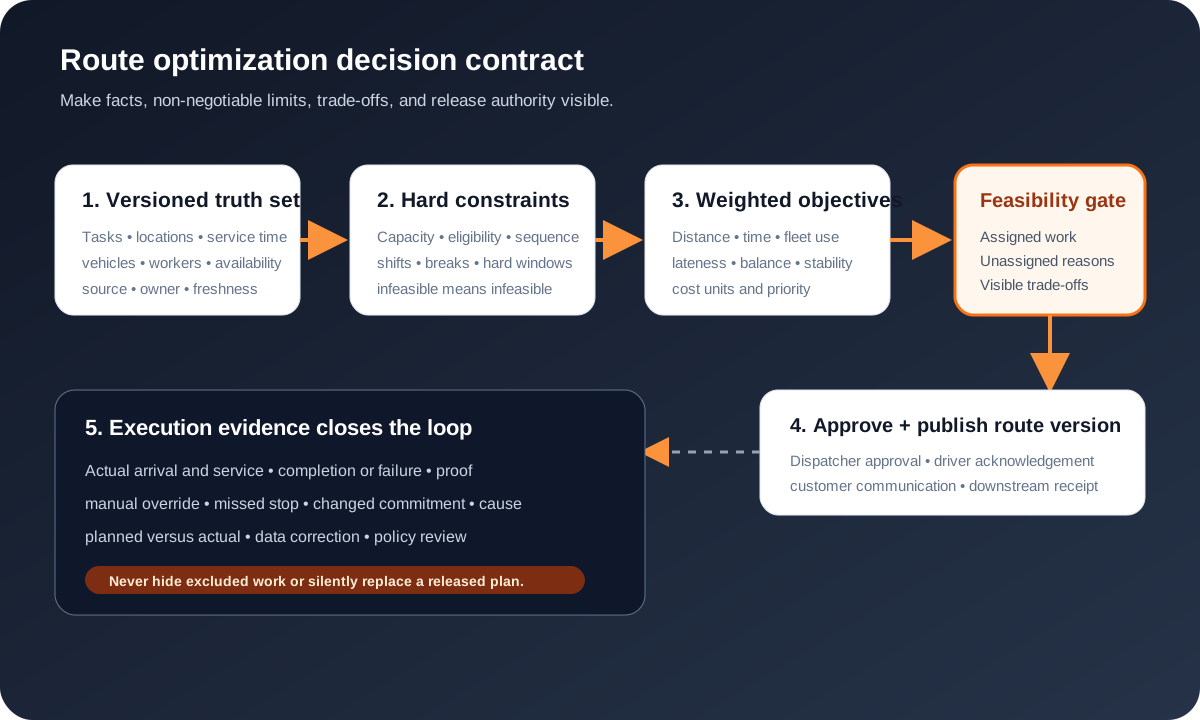
Separate inputs into four sets. Tasks describe pickups, deliveries, visits, service durations, locations, quantities, time windows, dependencies, and priority. Resources describe vehicles, workers, depots, capacities, skills, shifts, breaks, start and end rules, and current availability. Hard constraints make a plan infeasible. Soft constraints may be broken at a visible cost. Objectives decide which feasible plan is better.
Google's current Route Optimization API overview reflects that structure: tasks or shipments, vehicles, time and capacity constraints, plus costs and objectives. Its route-plan lifecycle guidance also starts by scoping objectives, resources, tasks, and constraints before mapping them to an API. That is a useful requirements discipline regardless of solver or vendor.
Define the plan's business outputs: assigned and unassigned tasks, stop sequence, planned arrival and departure, load state, working and travel time, breaks, cost components, violated soft constraints, infeasibility reasons, and the input version used. A route without the reason for excluded work is incomplete.
Cover the requirement lanes that affect feasibility
Tasks and locations
Stable IDs, geocoding confidence, entrances, zones, pickup-delivery pairs, service time, quantity, priority, promised window, dependencies, cancellation, and evidence.
Vehicles and workers
Capacity dimensions, equipment, compatibility, skills, depot, shift, break, eligibility, availability, cost, working limits, handover, and substitution.
Decision model
Hard versus soft constraints, objective order, cost units, skip penalties, fairness, workload balance, stability, solve limit, infeasibility, and fallback.
Dispatch and execution
Draft, compare, edit, approve, publish, acknowledge, navigate, complete, fail, capture proof, work offline, escalate, and reconcile actuals.
Live operations
Late tasks, traffic or travel-time refresh, worker absence, breakdown, missed stop, customer change, protected sequence, replan scope, notification, and rollback.
Platform and lifecycle
Roles, audit history, integrations, security, privacy, accessibility, localization, maps, retention, performance, continuity, support, export, migration, and exit.
State scale in operational units: tasks and stops per planning run, vehicles and workers, depots, planning horizon, matrix size, concurrent planners, update frequency, solve-time target, daily replans, driver devices, retained route versions, and peak dispatch window. “Real-time optimization” has no acceptance meaning until the trigger, data age, allowed change, and response target are defined.
Evaluate scenarios, not feature claims
Build a truth set from approved historical days, then correct known data errors before replay. Include normal operations, seasonal peaks, sparse and dense territories, long service times, paired tasks, specialized equipment, multiple capacity dimensions, and jobs that should remain unassigned. Record the accepted business result; the historic route is evidence, not automatically the optimum.
For each scenario, check that all hard constraints hold, soft violations and skipped tasks are explained, trade-offs match the configured objective, and two runs from the same versioned input are reproducible enough for your operating need. Review routes with dispatchers and drivers. A mathematically valid plan may still encode a bad entrance, unrealistic service time, unsafe maneuver, or local restriction missing from source data.
Add failure tests: mapping or traffic unavailable, partial order import, duplicate task, stale worker status, solver timeout, mobile sync delay, publication failure, and downstream notification rejection. The API integration requirements checklist provides a deeper model for idempotency, replay, degraded operation, and repair ownership.
Make replanning a controlled operational change
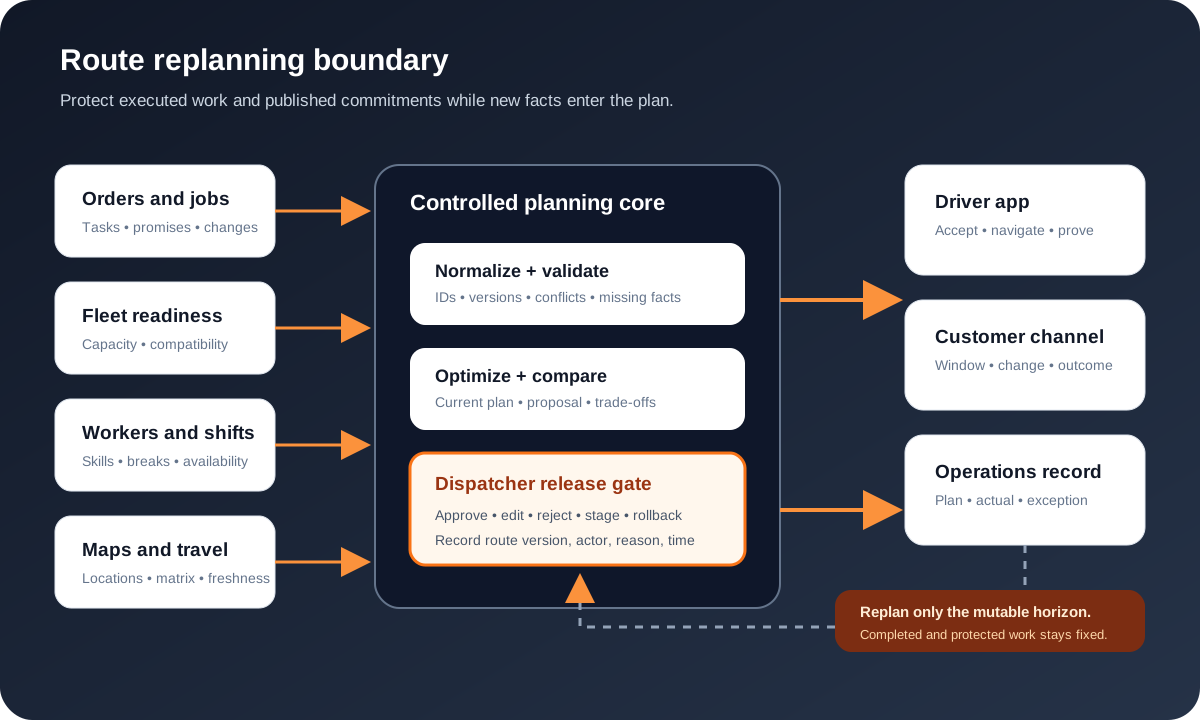
Preserve the released plan, driver acknowledgement, completed work, current position when appropriate, active stop, customer commitments, and manual locks. A replan request should declare its trigger, earliest mutable point, protected tasks, eligible resources, new information, objective version, and approval rule. Do not silently replace the record operators are already executing.
Compare the proposed plan with the current plan: reassigned tasks, changed sequence, moved windows, added travel, new risk, customer messages, and drivers requiring acknowledgement. Let the dispatcher reject, edit, or stage a replan. Record why the final plan differs from the recommendation and whether the downstream systems accepted it.
The driver path may need resilient mobile behavior. Use the offline-first mobile requirements guide when route manifests, completion evidence, and corrections must remain trustworthy through weak connectivity.
Choose the smallest ownership boundary that fits
Buy or configure a route platform when its task model, constraints, maps, solver, dispatcher tools, mobile execution, integrations, support, and commercial unit fit the operation. Prefer an evidence-based pilot over a long feature comparison: import your scenarios, generate plans, operate a controlled route, replan it, and export the audit trail.
Extend when the optimization engine is suitable but a bounded layer is distinctive—for example order normalization, eligibility rules, dispatcher review, a driver workflow, customer communication, or operational reporting. Build more only when the decision model itself creates durable advantage and the organization accepts long-term ownership of mapping, optimization, integrations, mobile releases, monitoring, support, and change governance.
Leeonex's custom web application service can help scope the operator and integration boundary around a routing engine without assuming the solver must be built from scratch.
Use this one-route-day pilot worksheet
- Name the decision: planning horizon, users, release time, approval owner, and what “better” means.
- Freeze the truth set: versioned tasks, resources, locations, service times, availability, and actual outcomes for representative days.
- Separate policy: hard constraints, soft constraints, objectives, cost units, exceptions, and authority to override.
- Define publication: route version, driver acknowledgement, customer communication, mobile availability, and downstream confirmation.
- Define replanning: triggers, protected work, mutable horizon, comparison view, approval, rollback, and repair owner.
- Agree acceptance: scenario pass conditions, feasible and infeasible behavior, solve time, operator review, failure recovery, and export evidence.
The first useful release may be a planning workspace around a proven optimization service, not a new solver. Make one route day trustworthy end to end before widening territories, objectives, live changes, or automation authority.
Route optimization requirements FAQ
What should route optimization software requirements include?
Include authoritative tasks and locations, service times, vehicle and worker eligibility, capacities, shifts and breaks, time windows, task dependencies, priorities, objectives and costs, infeasibility behavior, dispatcher overrides, route publication, driver acknowledgement, live changes, customer communication, offline execution, integrations, security, reporting, support, and scenario-based acceptance tests.
What is the difference between route planning and route optimization?
Route planning creates a usable sequence and schedule for stops. Route optimization searches possible assignments and sequences against explicit objectives and constraints. Optimization can support planning, but it does not replace accurate task data, dispatch ownership, driver execution, or exception handling.
How should route optimization software be tested?
Replay representative historical days plus deliberately difficult scenarios: tight windows, incompatible vehicles, absent workers, excess demand, late tasks, cancellations, partial execution, stale traffic, and integration failure. Check feasibility, unassigned-task reasons, objective trade-offs, operator edits, publication, replanning stability, downstream messages, and actual-versus-planned evidence.
Should a business buy or build route optimization software?
Buy or configure when a proven platform represents the operation's constraints, integrations, dispatch workflow, and commercial scale. Extend a platform when the solver is suitable but operator, driver, customer, or system handoffs are distinctive. Consider custom ownership only when the decision model is strategically important and the organization can maintain mapping, optimization, mobile, integration, support, and operational governance.