
The short answer: scope the operating loop, not the map
Fleet management software requirements should connect vehicle identity and readiness with drivers or operators, assignments, dispatch, field work, inspections, defects, maintenance, fuel or energy, cost, and exception recovery. Live location can be a useful signal. It is not the operating model.
Start with one fleet day for a representative vehicle class: confirm readiness, assign an eligible operator and task, dispatch, record work and evidence, respond to delay or failure, inspect, open any defect, maintain if necessary, reconcile the day, and release the vehicle back to service. Add a difficult case such as stale location, swapped device, breakdown, missed inspection, fuel anomaly, unplanned driver change, or vehicle used while a critical defect remains open.
Keep fleet scope distinct from adjacent systems. The asset tracking checklist follows individually identified physical assets and custody; the field service guide follows customer jobs, technicians, evidence, and commercial close. A fleet product may integrate with both without owning every one of their records.
Define vehicles, resources, events, and decisions
Give each vehicle or powered unit one stable internal ID. Keep VIN, registration, telematics device, plate, lease record, maintenance-system key, fuel card, and legacy references as linked identifiers with source and validity dates. A tracker replacement or plate change must not create a new vehicle history.
For US road vehicles, the National Highway Traffic Safety Administration's vPIC information and API can decode vehicle specifications from manufacturer-submitted VIN data. That is a useful enrichment source, not a replacement for the fleet's own identity, configuration, attachments, duty class, operating status, or historical facts.
Define events such as acquired, assigned, dispatched, arrived, task started, task completed, inspected, defect reported, immobilized, serviced, released, transferred, and retired. Each event needs effective and recorded time, vehicle, actor, source, location if relevant, evidence, reason, resulting state, and a correction rule.
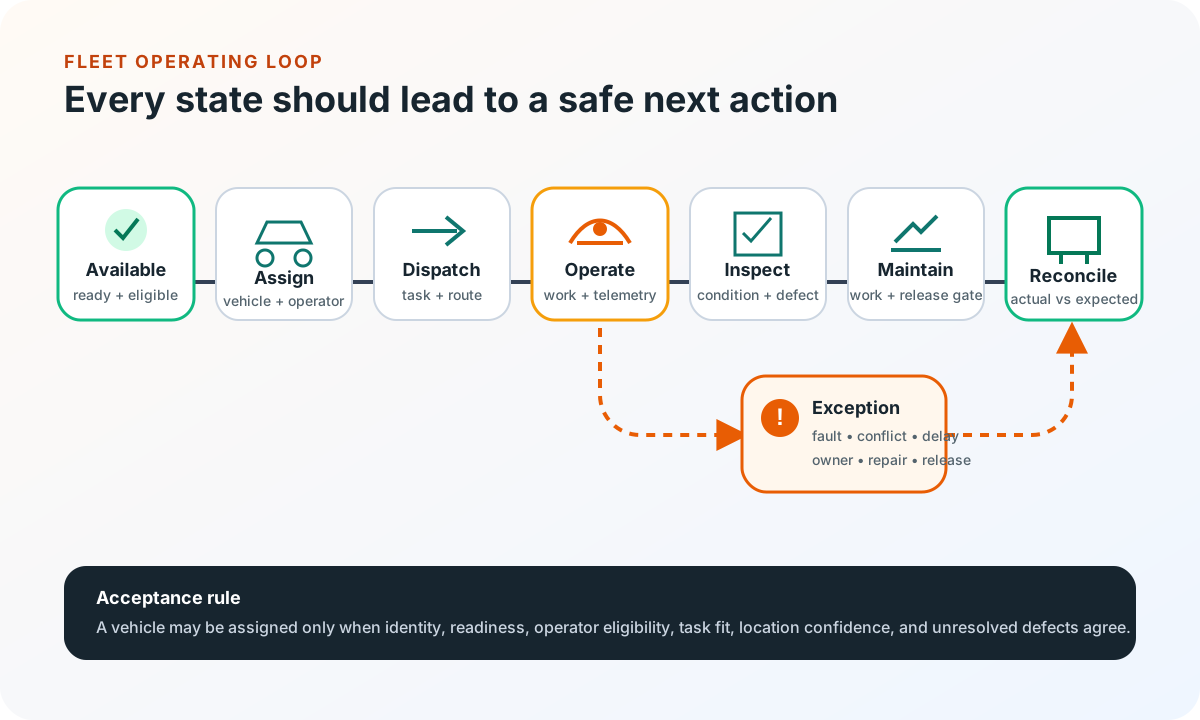
Separate availability, mechanical readiness, legal or policy eligibility, assignment, movement, and lifecycle status. A vehicle may be parked at the depot and unassigned while still unavailable because an inspection expired or a critical defect has not been released.
Define eight requirement lanes around real fleet work
Use representative vehicles, drivers, schedules, inspections, work orders, telematics payloads, fuel transactions, invoices, incident records, route plans, customer tasks, and reconciliation reports. Requirements should state the decision and proof—not merely name a feature.
| Lane | Decision to specify | Acceptance evidence |
|---|---|---|
| Vehicle and equipment | Identity, class, capacity, attachments, documents, ownership, lifecycle | Every operating unit resolves to the correct current configuration |
| People and authority | Drivers, qualifications, shifts, roles, consent, delegation, contractors | An ineligible or unauthorized operator cannot be assigned |
| Readiness and inspection | Checklists, evidence, defects, severity, immobilization, release | Critical defects visibly block availability until authorized release |
| Assignment and dispatch | Tasks, stops, priorities, capability, capacity, changes, acknowledgement | The planned and accepted assignment remain traceable |
| Telematics and location | Devices, signals, freshness, confidence, gaps, privacy, diagnostics | Stale or conflicting signals never masquerade as current truth |
| Maintenance and fuel | Triggers, work orders, parts, vendors, downtime, fuel or charge | Service state and operating cost reconcile to source records |
| Mobile and exceptions | Offline work, navigation handoff, proof, breakdown, recovery, safety | Field users can complete or escalate work through weak connectivity |
| Integration and insight | APIs, finance, HR, jobs, alerts, reports, audit, export, support | Failures are visible, replayable, reconcilable, and owned |
Record fleet-specific non-functional constraints: number and types of units, active users and shifts, event frequency, connectivity, device ownership, location update expectations, data retention, map regions, supported languages, accessibility, restore objectives, alert latency, and support hours. Separate operational targets from vendor marketing labels such as “real-time.”
When the differentiated gap is the driver's stop-level handover rather than the whole fleet platform, the proof-of-delivery mobile app concept study shows how to separate delivery outcome, evidence meaning, offline persistence, server acknowledgement, exception ownership, and correction in one bounded mobile release.
Treat telematics as evidence with confidence and freshness
Define every incoming signal by device, vehicle binding, source timestamp, receipt timestamp, unit, accuracy or confidence, sequence if available, expected cadence, acceptable delay, and missing-data rule. Preserve raw references where useful, then derive operational events through explicit rules. Do not let a late packet rewrite an already reviewed incident silently.
Plan for installation and replacement, swapped hardware, duplicate devices, power loss, GPS gaps, roaming, clock drift, impossible movement, odometer resets, unit changes, firmware differences, and provider outages. Show operators signal age and quality where it changes a decision. “Last known” must never look like “current.”
Some US commercial fleets have separate electronic logging obligations. The FMCSA ELD rule overview notes performance and design standards plus device certification and registration. Do not casually recreate a regulated ELD inside a general fleet app. Define the jurisdiction, vehicle class, data boundary, certified source, driver correction flow, and accountable compliance review.
Make dispatch constraints and overrides explicit
A dispatch decision may depend on vehicle type, capacity, attachments, readiness, depot, driver eligibility, shift, customer time window, service duration, pickup-before-delivery, access restrictions, priority, promised time, charging or fuel, breaks, and return-to-base rules. Write these as named constraints with a consequence when they cannot all be met.
Route optimization is not a checkbox. Google's current Route Optimization API overview models shipments or tasks, vehicles, objectives, capacities, time windows, work hours, and breaks. Whether you use that service or another, the lesson is the same: an optimizer needs an explicit constraint and cost model. It cannot repair missing service times or contradictory business rules by itself.
Preserve the plan, accepted dispatch, later changes, actor, reason, customer communication, and actual result. Operators need to override a recommendation safely, see which constraint is being broken, and explain why. Track unassigned tasks, infeasible plans, late acceptance, route deviation where useful, missed stops, and recovery ownership—not only distance saved.
When routing is the buying decision rather than one fleet feature, use the route optimization requirements checklist to define the truth set, hard and soft constraints, objective model, scenario tests, publication contract, and controlled replan boundary in more detail.
Connect inspection, defects, maintenance, and release
Design inspection templates by vehicle class, attachment, jurisdiction, job type, or operating environment. Define when an inspection is required, which observations need photos or measurements, how pass/fail/not-applicable works, whether users may continue, and how a defect becomes a controlled maintenance item rather than a comment buried in a form.
Defect severity should drive action: monitor, schedule, restrict, immobilize, or escalate. Record the observation, reporter, vehicle state, evidence, triage, decision, work order, repair, parts, technician or vendor, verification, release authority, and resulting readiness. Corrections should append history, not erase the report that caused the decision.
Maintenance triggers may be calendar, odometer, engine hours, condition, fault, inspection, campaign, manufacturer guidance, or human judgement. Record the source and confidence of each reading. Reconcile telemetry, manual entry, invoices, and work orders rather than silently choosing whichever arrived last.
If maintenance planning and execution are becoming a system in their own right, use the CMMS requirements checklist to define work states, preventive rules, technician evidence, materials, verification, exceptions, and system ownership.
Give fleet operations a clear system boundary
Map vehicle master data, telematics, HR or contractor identity, licenses and qualifications, dispatch, field service or order systems, maintenance, fuel or charging, finance, insurance, document storage, mapping, customer communication, and analytics. Decide which system owns each fact and which only observes it.
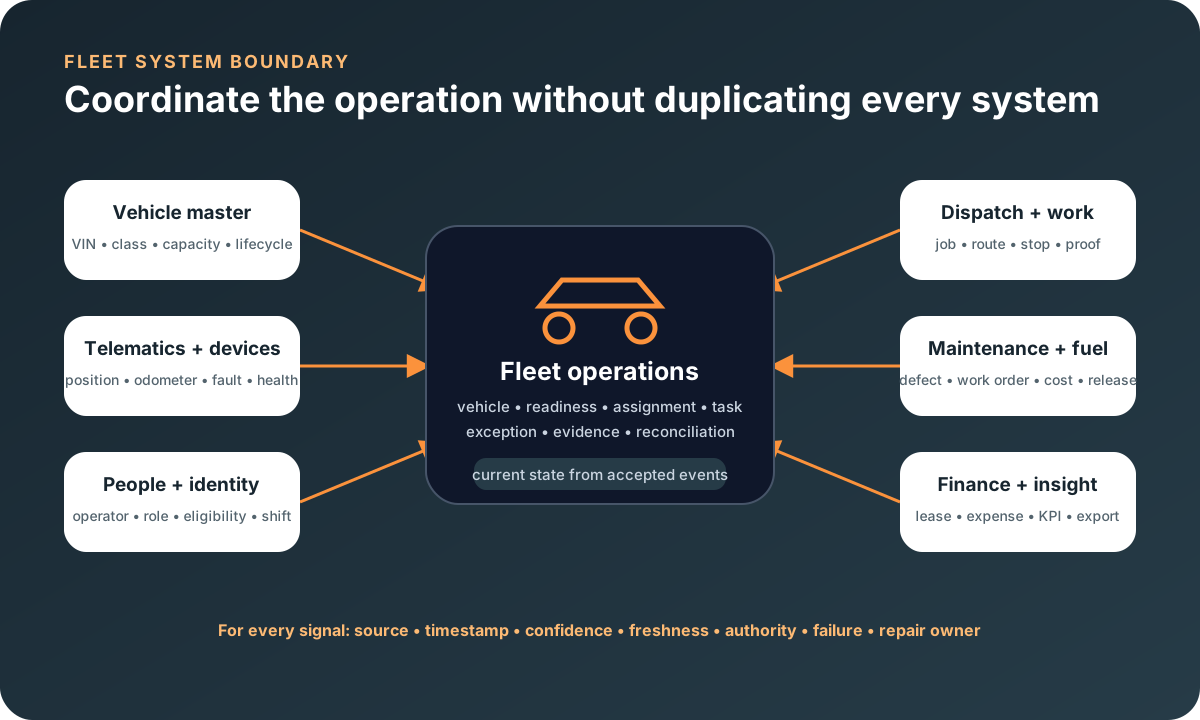
For each boundary record identifiers, direction, timing, freshness, units, authorization, replay and duplicate behavior, retention, failure visibility, reconciliation, and repair owner. The API integration requirements checklist provides a deeper launch model for state, idempotency, degraded operation, and recovery evidence.
Define metrics only after decisions: vehicles unavailable and why, unresolved critical defects, maintenance due, jobs at risk, location signals stale, fuel transactions unmatched, utilization by stated denominator, downtime by cause, and exceptions past owner deadline. Use the dashboard data readiness guide to give each KPI an owner, formula, freshness rule, and action.
Choose buy, extend, or build with representative operations
Buy and configure
Standard tracking, dispatch, inspection, maintenance, reporting, and supported hardware fit the fleet.
Extend
A stable fleet platform exists, but one mobile, customer, optimization, dashboard, or integration gap matters.
Build
Distinct dispatch rules, mixed equipment, field UX, offline work, or reconciliation logic are central.
Compare options using the same vehicles, devices, drivers, shifts, tasks, inspections, maintenance triggers, integrations, weak-connectivity condition, and exception scenarios. Include hardware, installation, data plans, mapping, API usage, migration, support, training, and exit—not just software seats.
Use configuration before custom code when it safely represents the operation. Use cross-platform mobile development for focused field interaction or custom web application development when the coordinating workflow and system boundaries are a meaningful competitive or operational requirement.
Use a one-day fleet pilot worksheet
- Fleet slice: choose two or three representative vehicle classes, devices, sites, shifts, and operating conditions.
- Identity: map internal ID, VIN or serial, plate, device, operator, attachments, system keys, and replacement rules.
- Decisions: define readiness, eligibility, assignment, dispatch, override, immobilization, maintenance, and release authority.
- Signals: record source, cadence, units, freshness, confidence, missing-data behavior, device health, and privacy boundary.
- Work: model stops or tasks, capacity, time windows, service duration, proof, customer updates, and actual completion.
- Exceptions: test stale GPS, device swap, offline work, breakdown, unqualified driver, critical defect, missed stop, and conflicting odometer.
- Boundaries: assign ownership for vehicles, people, jobs, maintenance, fuel, finance, documents, routes, and analytics.
- Acceptance: prove the operating loop, mobile recovery, permissions, reconciliation, complete export, and human repair with retained evidence.
The first release may cover readiness, assignment, and exception visibility for one fleet slice. That can be valuable if the state is trustworthy and repairable. Add optimization, predictive models, customer tracking, or broader automation only after the underlying events and ownership hold up in daily work.
Fleet management software requirements FAQ
What should fleet management software requirements include?
Include vehicle and equipment identity, driver or operator eligibility, readiness, assignment, dispatch, routes or tasks, inspections, defects, maintenance, fuel or energy, documents, telematics, alerts, permissions, mobile and offline behavior, integrations, reporting, reconciliation, administration, and acceptance scenarios. Scope only the lanes that serve the fleet's real operating model.
What is the difference between fleet management and vehicle tracking?
Vehicle tracking reports a vehicle's observed location or movement. Fleet management connects vehicle identity and readiness with drivers, assignments, jobs, inspections, maintenance, cost, compliance evidence, and exceptions. Tracking may be one input, but a map alone cannot decide whether a vehicle is safe, eligible, assigned correctly, or ready for the next task.
Should fleet management software include route optimization?
Only when routing changes a real dispatch decision and the team can provide accurate stops, service times, vehicle capabilities, capacity, shifts, breaks, time windows, priorities, and exception rules. Start with transparent dispatch and actual-versus-planned evidence; add optimization after the constraint model and human override path are trustworthy.
When should a business buy or build fleet management software?
Buy when standard tracking, maintenance, inspection, dispatch, and supported hardware fit the operation. Extend a platform when one mobile, customer, optimization, or integration gap matters. Consider custom software when differentiated dispatch rules, mixed equipment, field workflows, offline work, telematics boundaries, or reconciliation are central and cannot be represented safely through configuration.