
The short answer: white-label the experience, not the codebase
White-label SaaS requirements should define which parts of one product may vary by tenant or reseller—brand, domain, communications, content, entitlements, workflow settings, and integrations—while preserving shared security, data isolation, releases, observability, and support. If every customer request becomes a fork, the offer is bespoke software wearing a SaaS price model.
Start with one target partner and one end customer. Walk through discovery, tenant creation, domain verification, branding, invitation, sign-in, core work, notifications, support, billing, upgrade, export, and offboarding. For every visible difference, name its configuration owner, validation, fallback, audit trail, and behavior after the shared product changes.
Pair this guide with the single-tenant versus multi-tenant decision guide when deployment shape is unsettled, and the tenant provisioning checklist when onboarding automation needs deeper definition.
Define the commercial and product promise first
“Fully white-label” is not a requirement. Write a capability matrix by plan, reseller, tenant, market, and channel. Does the offer change only visual identity, or also domains, email sender, legal text, help content, mobile packaging, feature visibility, pricing, workflow rules, integrations, data region, and support ownership? State what remains provider-branded and where disclosure is required.
Model the hierarchy explicitly. A reseller may manage several customer tenants; a customer tenant may contain organizations, workspaces, or locations; a person may belong to more than one. Define who owns the commercial relationship, user account, tenant data, domain, configuration, support case, and deletion decision. Never infer authorization from the hostname or chosen logo.
Add service boundaries to the contract: setup prerequisites, included configuration, approval times, domain responsibilities, support path, release notice, incident communication, export, termination, and paid bespoke work. This is product scope, not only legal wording; the software and operating tools must be able to uphold it.
Define eight requirement lanes with acceptance evidence
| Lane | Decision to specify | Acceptance evidence |
|---|---|---|
| Tenant hierarchy | Provider, reseller, customer, workspace, user, ownership, delegation | Every action resolves the correct tenant and authority |
| Brand system | Logo variants, color tokens, type, favicon, assets, contrast, fallback | Approved themes remain legible and complete on every surface |
| Domains and identity | Provider subdomain, vanity domain, verification, TLS, redirects, sign-in | A domain cannot claim or route to the wrong tenant |
| Communications | Sender, reply path, templates, links, consent, bounce, support identity | Email and in-product messages preserve tenant context |
| Configuration | Content, locale, feature, workflow, integration, validation, versions | A setting changes only the permitted behavior and is reversible |
| Security and data | Isolation, permissions, storage, cache, export, audit, support access | Cross-tenant tests fail closed across every data path |
| Commercial model | Plans, entitlements, metering, billing owner, limits, suspension | Access and invoices match the contracted tenant state |
| Operations and exit | Release, monitoring, incident, domain renewal, rollback, deletion | The team can detect, repair, upgrade, and remove one tenant safely |
Treat every surface as part of the brand contract
Inventory public pages, sign-in and recovery, navigation, transactional email, notification previews, generated documents, exports, share links, browser title and icon, error and empty states, payment pages, support tools, mobile web, and any native shell. Define a safe default when an asset is missing or invalid. Test contrast and layout with the longest permitted names and both light and dark assets where supported.
Separate identity from presentation
The request host can help select a candidate tenant, but the authenticated membership and server-side authorization must decide access. Keep tenant identifiers attached to jobs, files, caches, search indexes, analytics, exports, webhooks, and audit events. The OWASP multi-tenant security guidance specifically warns about client-supplied tenant context and cross-tenant leakage across shared resources.
Draw a hard boundary around safe configuration
Use a typed, versioned configuration schema. Each setting needs a scope, allowed values, default, validation, permission, preview, effective time, audit record, rollback rule, and compatibility behavior. Feature flags can control rollout, but they are not a permanent substitute for a coherent entitlement and configuration model.
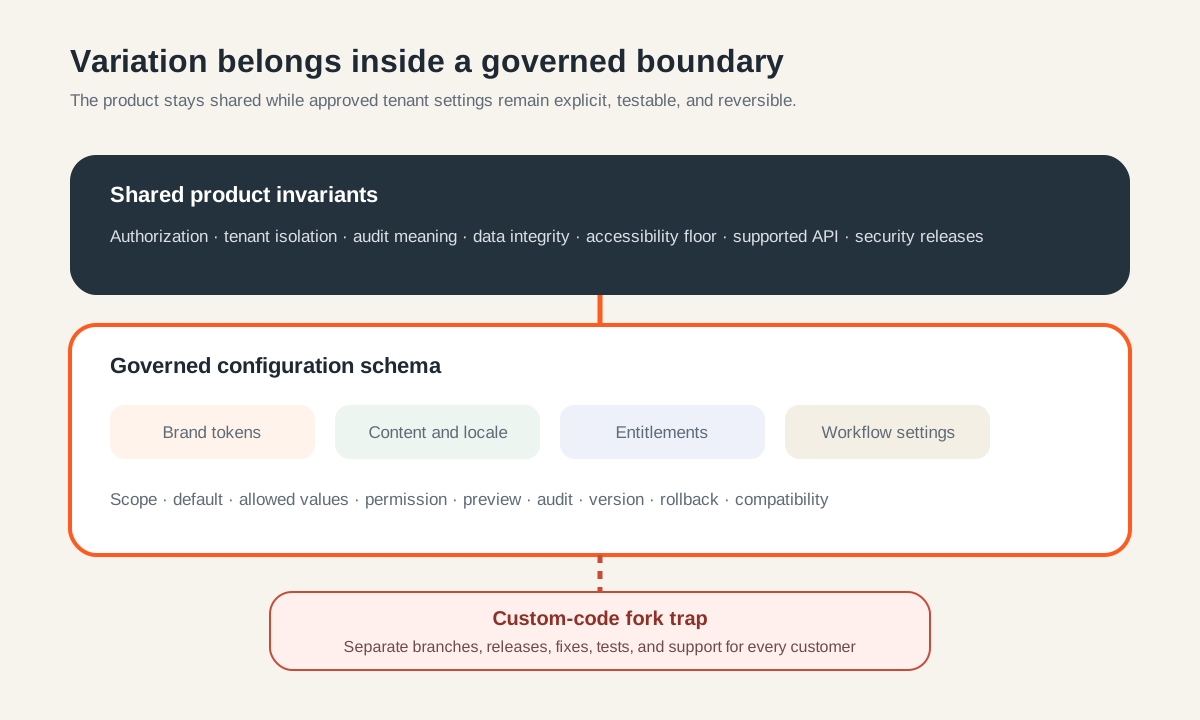
Keep product invariants shared: authorization rules, audit semantics, data integrity, core lifecycle, accessibility floor, security updates, and supported API behavior. Allow governed variation in tokens, content slots, locale, entitlements, workflow parameters, templates, and approved integrations. Reject arbitrary tenant-specific code paths unless the business is prepared to version, test, secure, operate, and retire them.
Test configuration combinations, not only individual fields. A hidden feature may still emit an email or appear in search. A locale can lengthen navigation. A reseller-level setting can collide with a customer override. Define precedence and show the effective result before publication.
Operate custom domains and releases as lifecycles
Decide which hostname options exist: a provider-managed tenant subdomain, a reseller subdomain, or a customer-owned vanity domain. For each, specify uniqueness, restricted names, verification challenge, DNS instructions, timeouts, TLS issuance, renewal, routing, canonical links, cookies, sign-in callbacks, email links, analytics attribution, removal, and recovery after DNS changes.
Microsoft's multitenant Front Door guidance documents that vanity domains require customer DNS involvement and domain validation, while certificate and routing choices create ongoing operational work—not only setup work. Its custom-domain scenarios are vendor-specific examples of the lifecycle your requirement should make observable and supportable.
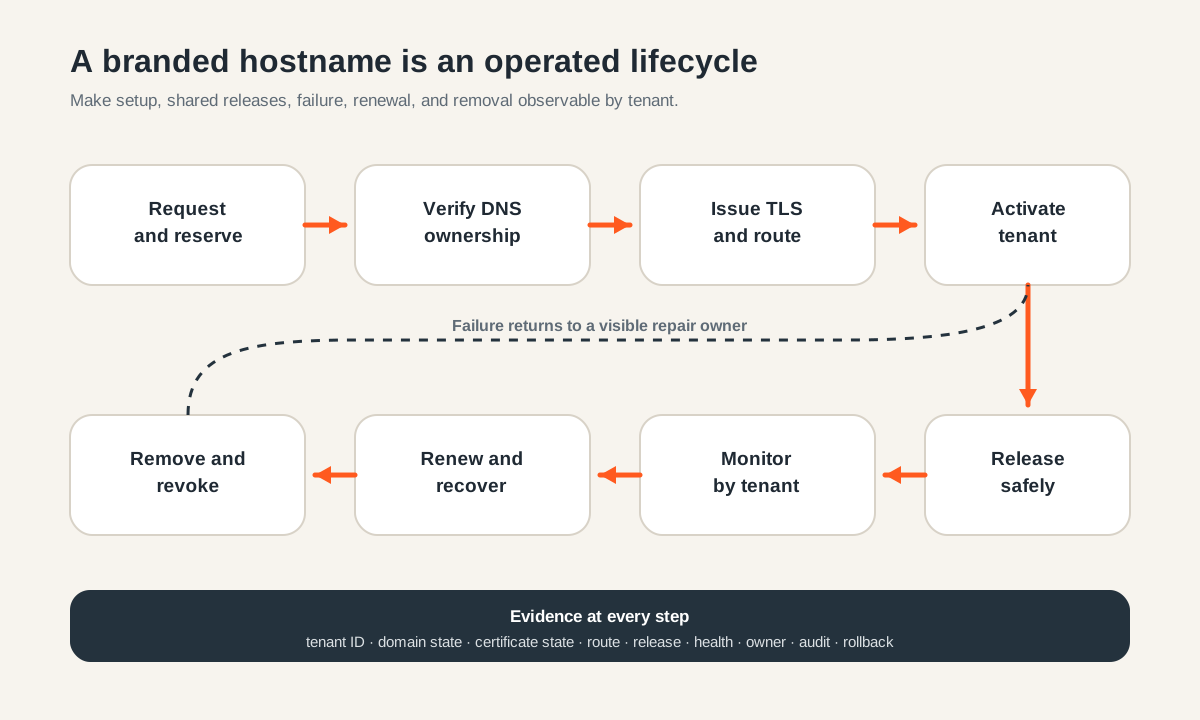
Define release compatibility too. A shared release should test representative themes, entitlements, locales, domains, authentication modes, integrations, and reseller hierarchies. Use staged rollout, tenant-aware monitoring, rollback, and migration status. Do not let a single heavily customized tenant freeze security fixes for everyone else.
Choose isolation by requirement, not by the word white-label
| Model | Best fit | Operational consequence |
|---|---|---|
| Pooled | Shared product and infrastructure with strong tenant controls | Efficient releases; isolation must hold across data and shared services |
| Targeted isolation | A sensitive data store, workload, region, or premium tier needs separation | More routing, provisioning, monitoring, migration, and cost logic |
| Full stack isolation | Documented compliance, contract, performance, or legacy constraint | Highest lifecycle cost; keep versions and operations unified |
Branding does not require separate infrastructure. AWS's SaaS Lens treats tenant isolation as foundational while noting that the implementation depends on domain, compliance, deployment, and service choices. Write the threat, control, and evidence first; then choose pooled, targeted, or siloed mechanisms.
Test tenant switching, guessed identifiers, copied URLs, support impersonation, bulk jobs, queues, object storage, caches, search, analytics, exports, backups, webhooks, and deletion. Pair this with the SaaS permissions checklist when roles, memberships, and administrator authority need a full decision model.
Leeonex's SaaS platform development service is relevant when the commercial offer and first reliable product boundary need to be defined. The custom web application service fits partner portals and operational tools that sit around the core product.
Use this one-partner pilot worksheet
- Promise: partner, end customer, plan, markets, provider disclosure, support, and excluded variation.
- Hierarchy: reseller, tenant, workspace, user, ownership, delegation, and billing relationship.
- Brand: tokens, assets, content slots, email identity, document output, accessibility, and fallback.
- Domain: hostname, verification, DNS owner, TLS, routing, callbacks, renewal, monitoring, and removal.
- Configuration: schema, defaults, precedence, validation, permissions, preview, audit, version, and rollback.
- Isolation: tenant context, authorization, data stores, jobs, files, caches, support access, export, and deletion.
- Release: representative matrix, staged rollout, migration, observability, incident path, rollback, and notice.
- Scenario pack: normal onboarding, duplicate domain, failed certificate, invalid theme, tenant switch, revoked reseller, delayed job, broken integration, downgrade, export, and offboarding.
Pilot the hardest representative partner, not the easiest demo. Release the offer when a new brand can be onboarded through the documented path, the shared product can change safely, failures are visible by tenant, and the team can remove the relationship without leaving domains, credentials, data, or access behind.
White-label SaaS requirements FAQ
What are the core requirements for white-label SaaS?
Define the tenant and reseller hierarchy, brand tokens, custom domains and TLS lifecycle, email and notification identity, configurable content and behavior, localization, authentication, permissions, tenant isolation, billing and entitlements, analytics, support roles, release policy, onboarding, offboarding, export, observability, and acceptance scenarios for both normal and failure paths.
Is white-label SaaS just custom branding?
No. Branding is the visible layer. A reliable offer also needs hostname and certificate operations, tenant-safe configuration, communications identity, authorization, data isolation, support boundaries, compatible releases, customer-specific observability, commercial entitlements, and a controlled exit path.
Should white-label customers get separate deployments?
Not by default. A shared product with configuration is usually easier to release and operate consistently. Use targeted or fully isolated deployments only when a documented security, compliance, performance, geography, contractual, or operational requirement justifies the extra lifecycle and cost. Keep provisioning and operations unified even when infrastructure differs.