The answer first
Scope the reservation contract before you scope two mobile apps
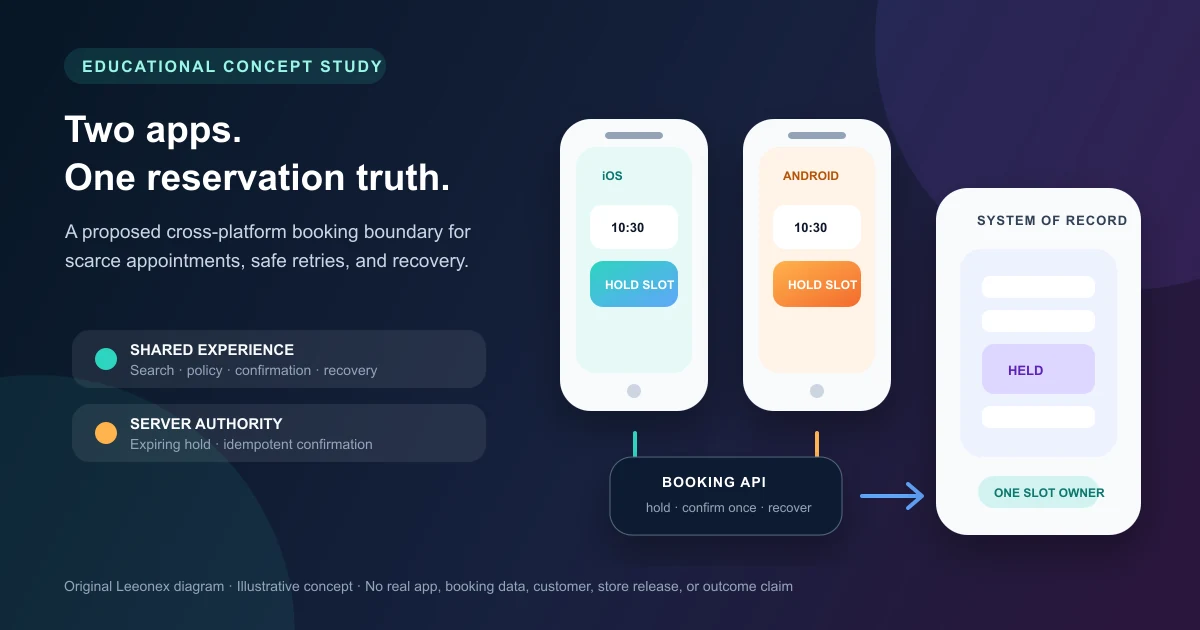
A trustworthy cross-platform booking app should not let iOS, Android, payment callbacks, or old search results compete to decide who owns a scarce slot. The smallest useful release puts availability, expiring holds, idempotent confirmation, cancellation, rescheduling, and recovery behind one server-owned reservation contract. The two apps share the customer experience while the scheduling system remains the authority.
One reservation truth
Search is informative; only an authoritative hold and confirmation reserve capacity.
Shared where it helps
Both stores share product logic and UI, with native adapters where the platforms genuinely differ.
Recovery before expansion
Interrupted confirmation must be explainable before loyalty, waitlists, or personalization enter scope.
Evidence disclosure
This is a Level E educational concept study, not a client story or shipped Leeonex product. The dialogue, roles, state counts, diagrams, architecture, and scope are illustrative. No booking, payment, conversion, reliability, time-saving, revenue, or store-launch outcome was measured. Stronger claims would need an implemented system, controlled tests, production evidence, approved identity and visuals, and publication permission.
Starting situation
“Build it for both stores” hides the real source of risk
Imagine a service business with several locations, bookable staff and rooms, a web booking provider, and a patchwork of calendar overrides. Customers ask for a mobile app because they want a faster repeat-booking experience. Operations also wants reminders and self-service rescheduling. The visible request sounds like a shared interface problem.
The expensive risk sits underneath. Availability may be cached, resource rules differ by location, payment and confirmation are not atomic, and a retry can arrive after the original request succeeded. Shipping the same screens to two stores does not make the booking trustworthy. It gives an unreliable booking loop two distribution channels.
Illustrative conversation — not a client quotation
Operations lead
Customers can book on our website, but we want one app for iPhone and Android with reminders, rescheduling, and location-specific availability.
Leeonex
Which system owns the slot, and what prevents two customers from confirming the same staff member or room at nearly the same time?
Operations lead
Each location manages calendars differently. The current booking provider caches availability, and staff sometimes fix collisions by phone.
Leeonex
Then the first product is not two sets of polished screens. It is one authoritative hold-and-confirm loop, shared by both apps, with expiry, recovery, and an operator trail.
Intended buyer and constraints
This scope is for a team with real capacity to protect
The intended buyer is a multi-location service operator, founder, or product leader whose app will reserve scarce time, staff, rooms, equipment, or appointment capacity. It is especially relevant when both stores matter, a scheduling product already exists, and manual recovery currently hides collisions or stale state.
Customer
Needs trustworthy availability, a clear hold or confirmation state, one receipt, and a safe path to cancel or reschedule.
Location operator
Needs the schedule to reflect staff, rooms, buffers, closures, overrides, and exceptions without reconciling a second hidden calendar.
Scheduling-system owner
Owns identifiers, availability rules, concurrency, provider contracts, audit history, and the API behavior both mobile clients depend on.
Support owner
Needs enough booking, device, provider, and notification context to explain an interruption without guessing or creating another reservation.
The first constraint is ownership: one system must decide whether a resource can be reserved. The second is time: search results can age while a customer reads policies or pays. The third is partial failure: a charge, confirmation, calendar write, notification, or app response can succeed while another step times out. The fourth is platform reality: shared code still ships through two stores, two notification services, and a varied device matrix.
Core flow
Treat search, hold, confirmation, and recovery as different states
A search response says a slot appeared available at a given version or time. It is not a reservation. When the customer chooses a slot, the server rechecks all constraints and creates a short-lived hold with an identifier and expiry. Confirmation uses that hold and an idempotency key. The app becomes confident only after the authoritative system returns a durable booking record.
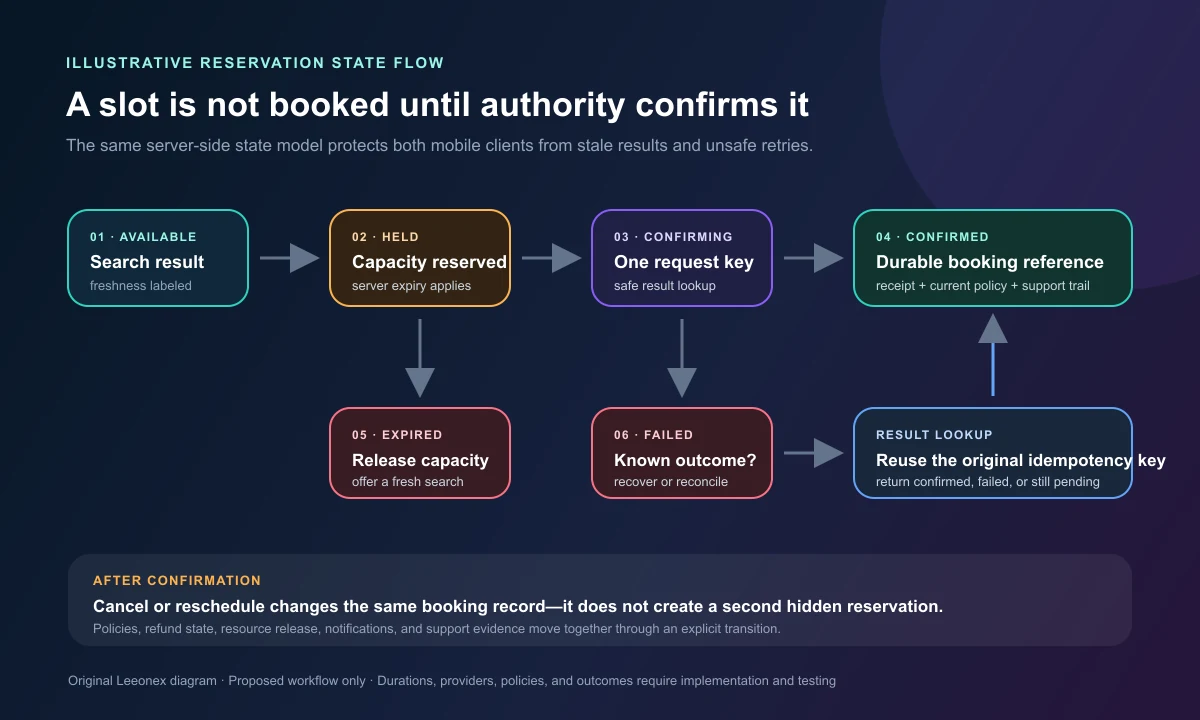
If the app loses connectivity after sending confirmation, it should ask for the result using the same idempotency key. It should not assume failure and create another booking. If payment succeeds but reservation fails, the reconciliation path needs a named state, owner, customer message, and refund or retry rule. “Something went wrong” is not an operating model.
Smallest useful scope
Build one complete booking loop, not the entire customer program
Build now
- One service family, a controlled group of locations, and one resource model
- Sign-in or guest identity rules that do not create duplicate customer records
- Server-owned availability query, expiring hold, confirmation, receipt, cancellation, and reschedule
- One explicit payment boundary: required now, deferred, or handled by an existing provider
- Shared iOS and Android navigation, forms, validation, accessibility, and error language
- Push and in-app reminders that deep-link to the current booking state
- Operator and support evidence for failed, expired, retried, or changed bookings
Later or deliberately excluded
- Waitlists, packages, memberships, loyalty, referrals, and promotional pricing
- Replacing the scheduling system, workforce planning, payroll, or provider settlement
- Every service, location, resource combination, country, language, and tax rule
- Complex group capacity, recurring appointments, class series, and multi-party bookings
- Offline booking confirmation when the authoritative inventory cannot be reached
- Personalized ranking, automated overbooking, or predictions presented as certainty
Restricting v1 to a known service and location cohort makes the unknowns observable. The team can prove identifiers, rule evaluation, holds, confirmation, support, and store behavior before introducing capacity pooling or commercial programs that multiply state combinations.
Architecture and implementation decisions
Share the experience; centralize the rules that protect inventory
The server owns reservation truth
The mobile clients may cache display data, but they do not decide whether a slot is still available. Holds and confirmations are created atomically against the authoritative scheduling boundary.
Every write has an idempotency key
A repeated tap, reconnect, provider callback, or app restart can return the existing result instead of silently creating a second booking or charge.
A hold is a visible state, not a promise
The app shows when a slot is temporarily held, when that hold expires, and what happens if payment or confirmation does not finish in time.
Notifications point to current state
A reminder, cancellation, or change message opens the booking record and rechecks authority. It does not assume the state embedded in an old notification is still true.
Shared code stops at the native edge
Navigation, forms, business-facing state, and most presentation can be shared. Store identity, permissions, notification delivery, calendar handoff, and platform accessibility still receive platform-specific testing and adapters.
Operational recovery is part of v1
Support can trace the booking reference, hold, confirmation attempt, provider response, and notification status without editing raw records or asking the customer to book again blindly.
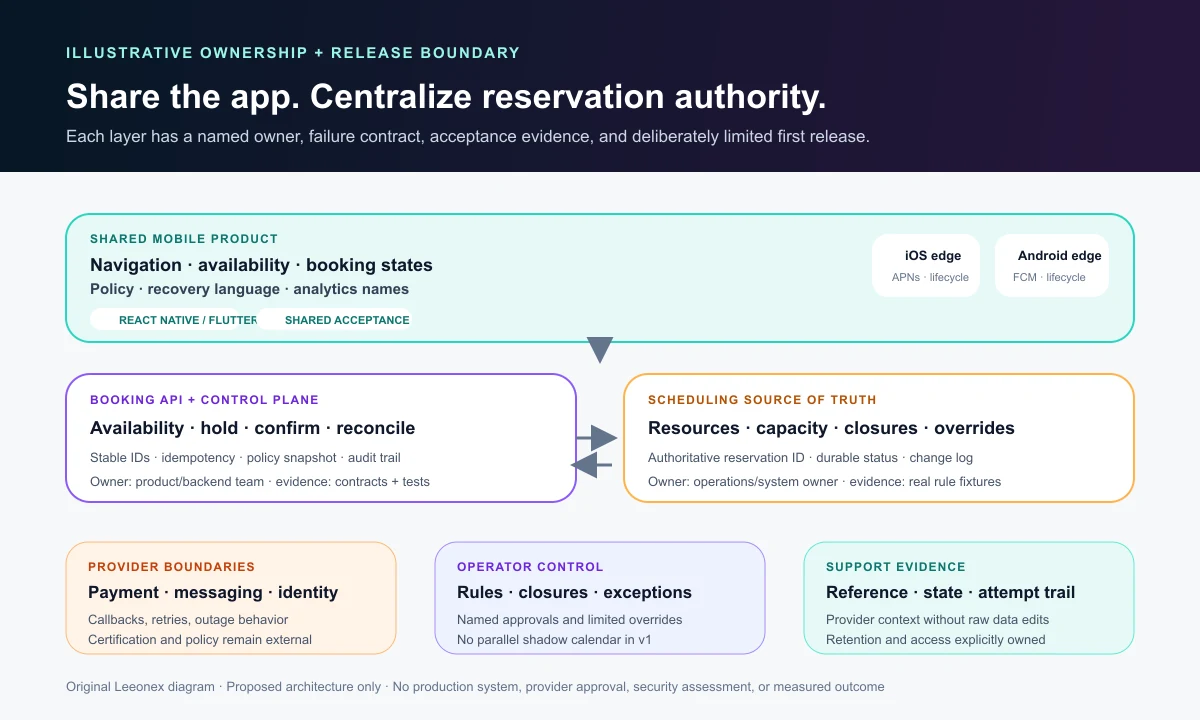
The app should use stable service, location, resource, customer, hold, and booking identifiers. Availability responses need a timestamp or version and a documented freshness expectation. The API contract should describe retry safety, conflicts, expiries, provider timeouts, and reconciliation—not only the happy response schema. The API integration requirements checklist is a useful companion when the scheduling boundary belongs to a third party or another internal team.
Risks and guardrails
Design for races, retries, and partial success before launch day
Never label a booking confirmed until the authoritative system returns a durable reservation identifier.
Expire holds server-side and make the countdown advisory; a phone clock cannot own inventory.
Recheck service, location, resource, price, duration, time zone, and policy before confirmation.
Treat payment success and booking success as separate events with a reconciliation path.
Keep customer-facing errors calm and useful while preserving provider detail in restricted diagnostics.
Test rapid taps, two devices, two customers, stale search results, lost connectivity, provider timeouts, delayed callbacks, app termination, and duplicate notifications.
Collect only the personal and diagnostic data needed for booking, support, security, and agreed analytics; define retention and deletion ownership.
Release through organization-owned store accounts with named signing, review, rollout, rollback, and support owners.
Acceptance should run the same critical scenarios against both apps and the real server boundary. A release candidate is not ready merely because the happy path worked once. The team needs evidence for concurrent attempts, delayed provider responses, repeated callbacks, stale notifications, app termination, accessibility, and operator recovery.
Limitations and evidence needed
This blueprint cannot prove that a real booking operation will work
The concept does not know the buyer’s provider contracts, capacity rules, existing data quality, payment and refund obligations, regulated-service requirements, device audience, accessibility needs, support staffing, or store markets. It also does not prove that a chosen scheduling provider can create safe holds or expose the reconciliation evidence the app requires.
No statement here supports a claim about fewer collisions, higher conversion, faster booking, lower support volume, greater retention, app-store approval, security, uptime, or revenue. A publishable outcome story would need at least:
- An implemented mobile and server boundary with versioned API and provider contracts
- Concurrency, hold-expiry, idempotency, payment, callback, cancellation, reschedule, and reconciliation tests
- Representative location, service, resource, time-zone, device, OS, network, accessibility, and store-review evidence
- Production telemetry and incident records with approved metric definitions, baselines, windows, exclusions, and an independent verifier
- Approved product identity, screenshots, quotations, visual rights, privacy and security review, and publication permission
The first discovery may show that the mobile app is not the next bottleneck. If the scheduling source cannot prevent collisions or expose durable identifiers, API and operational work should precede store development. If repeat use is weak, a mobile web flow may be more proportionate. Those are useful conclusions, not failed sales conversations.
Lessons for the buyer
The booking contract matters more than the number of shared screens
Fresh-looking availability can still be stale
Label freshness, recheck constraints, and reserve capacity through a hold. Do not make the customer infer authority from a green time slot.
Retrying is a product decision
Idempotency, result lookup, and reconciliation protect the customer when networks, apps, or providers interrupt the response after the server already acted.
Cross-platform does not remove platform ownership
Shared logic lowers duplication only when the team still owns store identities, native integrations, accessibility, device testing, release operations, and maintenance.
What to bring to a first consultation
Bring real rules and failure examples, not a polished feature list
- The current scheduling system, API documentation, provider contacts, and sandbox access
- Service, location, staff, room, equipment, duration, buffer, closure, and override rules
- Real examples of collisions, stale availability, duplicate customers, failed payments, and manual fixes
- Cancellation, reschedule, refund, no-show, time-zone, privacy, and regulated-service policies
- Target iOS and Android versions, representative devices, accessibility needs, and launch markets
- Existing identity, website booking, CRM, payment, notification, analytics, and support boundaries
- The single booking journey that matters most and the features the first release can deliberately exclude
Leeonex’s cross-platform app development service can turn that material into a technical spike, shared-product boundary, reservation contract, acceptance plan, and staged release scope. Review the broader mobile app requirements checklist if the product brief is still screen-led, or browse the Leeonex case-study hub for other evidence-labeled product and workflow blueprints.
Problem-aligned next step
Map one booking from search to recoverable confirmation
A first conversation can test whether cross-platform mobile is the right next layer, identify the authoritative scheduling boundary, and expose the technical spike needed before a broad app estimate.
Discuss your booking workflow