
The short answer: instrument decisions, not every interaction
Mobile app analytics requirements should connect a product question to a versioned event contract, identity and consent rules, offline delivery behavior, validation evidence, metric definitions, and an owned decision. Installing an SDK is only one implementation step; trustworthy analytics also needs clear triggers, minimized data, release QA, and observable failure.
Start with three to five questions the team expects to answer after launch: can a new user reach first value, where does the core journey fail, does a release improve completion without harming reliability, and which users return for the intended outcome? Instrument the few events needed to answer them before expanding the taxonomy.
This guide focuses on product instrumentation. Use the broader mobile app requirements checklist for the whole product and the dashboard data readiness checklist when teams still disagree about metric ownership or source data.
Start from the decision and work backward
Write the decision owner, review cadence, threshold, comparison, segments, and next action before naming an event. “Track onboarding” is vague. “The product owner reviews weekly whether invited users on the current app version complete the first successful task within seven days, split by platform, and opens an investigation when a step deteriorates” is implementable.
| Question | Evidence | Avoid |
|---|---|---|
| Did the core task succeed? | Server-confirmed or accepted outcome plus failure reason | Treating a button tap as success |
| Where does onboarding stall? | Stable stage events, eligibility, and time window | Mixing ineligible users into the funnel |
| Did the release help? | App version, rollout cohort, outcome, and guardrails | Comparing unlike populations or dates |
| Why is data missing? | Consent state, queue health, schema rejection, and environment | Assuming zero events means zero behavior |
Separate acquisition, store analytics, product behavior, technical performance, and business outcomes. They can inform one decision, but they do not automatically share identity, consent, attribution, completeness, or timing. Define how the team may compare them and which source is authoritative for each measure.
Give every mobile event a testable contract
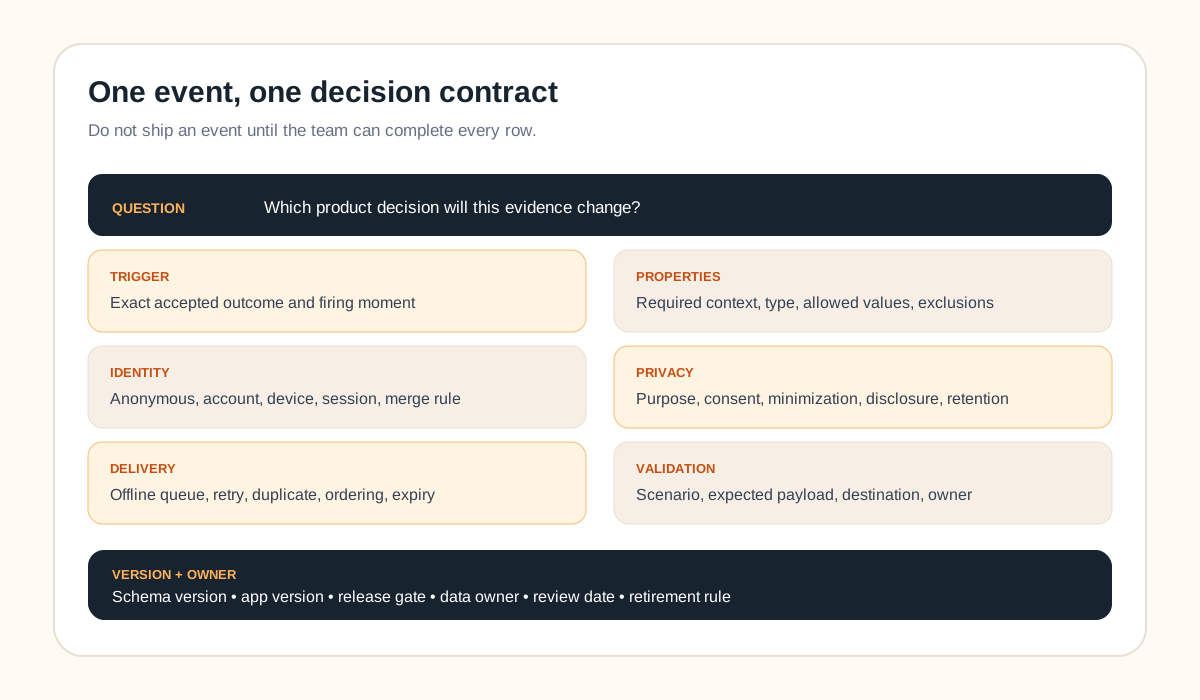
For each event, record its business question, canonical name, plain-language meaning, exact trigger, actor, required properties, prohibited properties, value types, allowed values, identity state, consent dependency, offline behavior, source, schema version, owner, and validation scenario. Keep examples beside the contract so development, QA, product, and analytics interpret it the same way.
Track outcomes and failures deliberately
Prefer accepted business outcomes over interface gestures. A booking request is not confirmed until the accountable system accepts it. A document upload is not complete while processing has failed. When a journey can fail, define a bounded reason vocabulary that helps the owner act without placing raw error text, secrets, or personal content into analytics.
Use consistent names and types, but do not force every platform event into a universal schema when behavior differs. A platform, app version, feature flag, and implementation source can make a result diagnosable. Version breaking changes and define when old event versions stop being included in a metric.
Specify the path from device to decision
Decide which events originate on the device, which come from a trusted backend, and how they are joined. Device events can describe views and local interactions. Server events can confirm durable outcomes such as accepted bookings, processed payments, or completed jobs. Define deduplication when both sides can report the same journey.
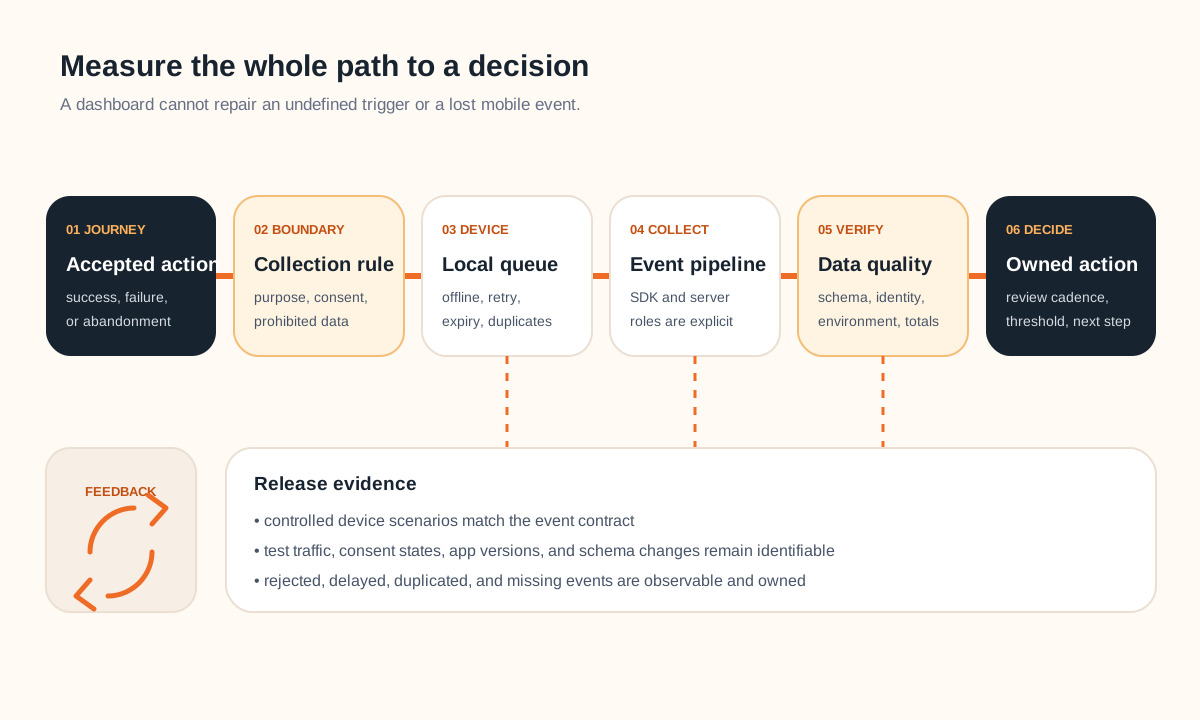
Mobile delivery is not immediate by default. Define whether the app queues events offline, how long it keeps them, whether order matters, how retries avoid duplicates, what happens after logout or consent withdrawal, and which events expire rather than arriving too late to interpret. If the core app itself works offline, align this contract with the offline-first mobile requirements guide.
Separate development, test, staging, and production data. Add a method to inspect raw events on a controlled device before relying on a dashboard. Firebase documents DebugView for near-real-time validation and exposes rejected event or parameter problems through analytics error codes. Other tools differ, but the requirement remains: teams need to see what the app emitted, what the collector accepted, and what the reporting layer transformed.
Define identity, consent, and collection boundaries
Decide what anonymous, device, account, and session identifiers mean; when they are created; whether pre-login activity may be joined to an account; what happens across reinstall or device change; and who may query identifiable data. Avoid sending email, free text, document contents, precise location, payment details, authentication material, or other sensitive values merely because an analytics property accepts strings.
Build a collection register for every SDK and endpoint: data type, purpose, recipient, identity link, consent or legal basis where applicable, retention, deletion, access, security owner, and store disclosure. Apple requires developers to account for their own and third-party partners' collection in App Store privacy information and uses privacy manifests to describe collected data and certain API use. Keep declarations aligned with the shipping app and its SDK versions.
Platform-provided store analytics may not equal an internal event stream. Apple explains that some App Store engagement data is available only for users who agreed to share diagnostics and usage information. Record such coverage limits beside the metric instead of presenting a partial population as every user.
Use release scenarios, not a screenshot of a dashboard
Run controlled journeys on the supported platform and version matrix. For each scenario, compare the expected contract with the device log, collection endpoint, transformed dataset, metric, and dashboard. Record the test user or device safely so its traffic can be excluded from production decisions.
- First launch, signed-out use, sign-in, sign-out, account switch, reinstall, and device change.
- Consent granted, denied, changed, or withdrawn plus store declarations and in-app controls.
- Success, validation failure, server failure, abandonment, backgrounding, force-close, and interrupted return.
- Offline creation, queue persistence, reconnection, retry, duplicate prevention, expiry, and out-of-order arrival.
- Old and new app versions, feature flags, schema evolution, invalid property values, and disabled SDK collection.
- Test-data separation, access control, retention, deletion, monitoring, alerting, and pipeline outage recovery.
Recheck the critical measurement loop after every SDK upgrade, consent change, identity change, core-journey release, or metric rewrite. Add analytics checks to the mobile app maintenance plan rather than treating instrumentation as finished at launch.
A first-release mobile measurement brief
Complete this worksheet before implementation:
- Three to five product questions, owners, cadence, and actions.
- Eligible users, journey stages, time windows, and metric definitions.
- Versioned event contracts with trigger, properties, and examples.
- Device, server, identity, session, consent, and SDK boundaries.
- Offline queue, retry, duplicate, expiry, and environment rules.
- Collection register, disclosures, access, retention, and deletion.
- Acceptance matrix, monitoring, dashboard owner, and review date.
This gives a mobile app development partner enough information to estimate a trustworthy first measurement loop without turning the app into an indiscriminate event feed.
Frequently asked questions
What should mobile app analytics requirements include?
Include decision questions, metric definitions, a versioned event and property taxonomy, trigger rules, identity and session handling, consent and collection boundaries, offline queue behavior, SDK and server responsibilities, environment separation, validation, privacy declarations, access, retention, dashboards, release gates, monitoring, and accountable owners.
Should mobile analytics be implemented before launch?
Implement the smallest trustworthy measurement loop before launch when product decisions depend on activation, task completion, purchase, reliability, or retention evidence. Do not instrument every tap. Prioritize the core journey, failure outcomes, app version, and enough context to diagnose a decision without collecting unnecessary personal data.
How do you test mobile app analytics events?
Validate events on supported devices and app versions using controlled scenarios. Check exact trigger timing, required and prohibited properties, consent states, anonymous-to-signed-in identity changes, duplicate prevention, offline queue and retry behavior, background or interrupted journeys, test-data exclusion, downstream transformations, dashboard definitions, and the effect of SDK or schema changes.