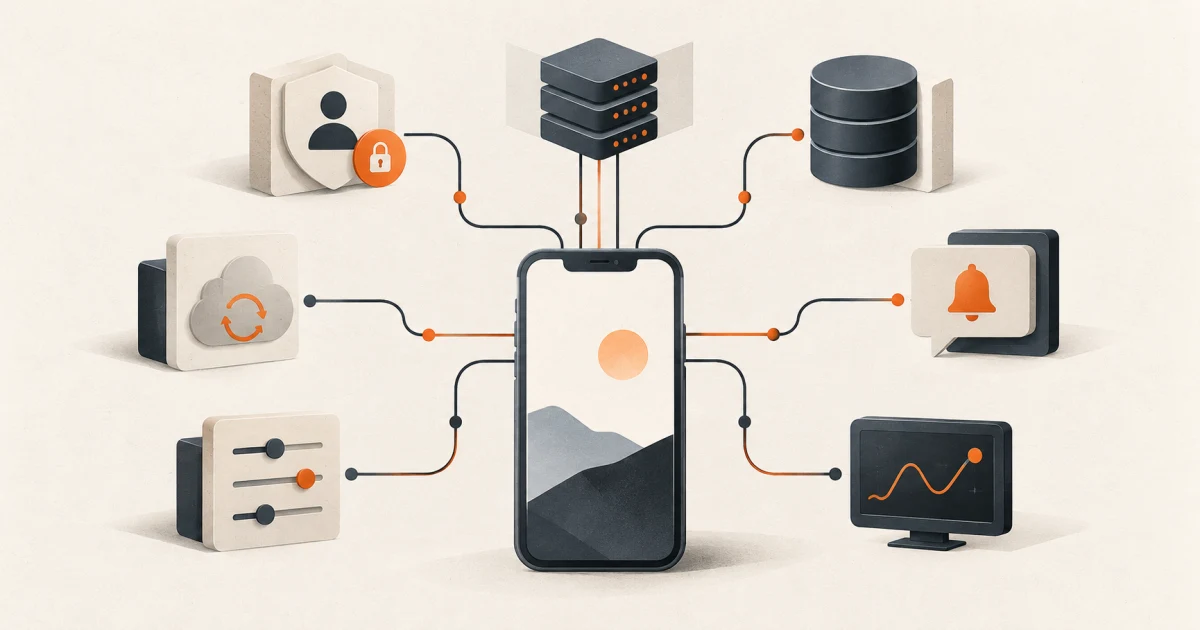
Define the service contract behind one complete app journey
Mobile app backend requirements should state who can act, which server-side rules apply, where each fact is authoritative, how the API behaves across retries and old app versions, what works offline, which background jobs and notifications follow, how operators repair failures, and what evidence proves the outcome. A list containing “database, API, login, and push” is not a build-ready backend brief.
Start with one valuable journey—submit an inspection, place an order, update a case, approve a request, or send a message. Trace it from the user's tap to the authoritative record and back to the visible result. Then add a lost connection, duplicate tap, expired session, stale local copy, and failed downstream system. Those cases reveal the real backend scope.
Use this guide with the broader mobile app requirements checklist. That article defines the whole product; this one isolates the service, data, integration, and operating contract behind it.
Draw the backend boundary before choosing cloud products
Decide which responsibilities belong on the device, in the versioned mobile service, and in existing systems. The client may own presentation, local interaction state, secure platform storage, and a retry queue. The backend should enforce identity, authorization, domain rules, authoritative transitions, and integration policy. CRM, ERP, payment, content, or operational systems may remain the source of truth for specific records.
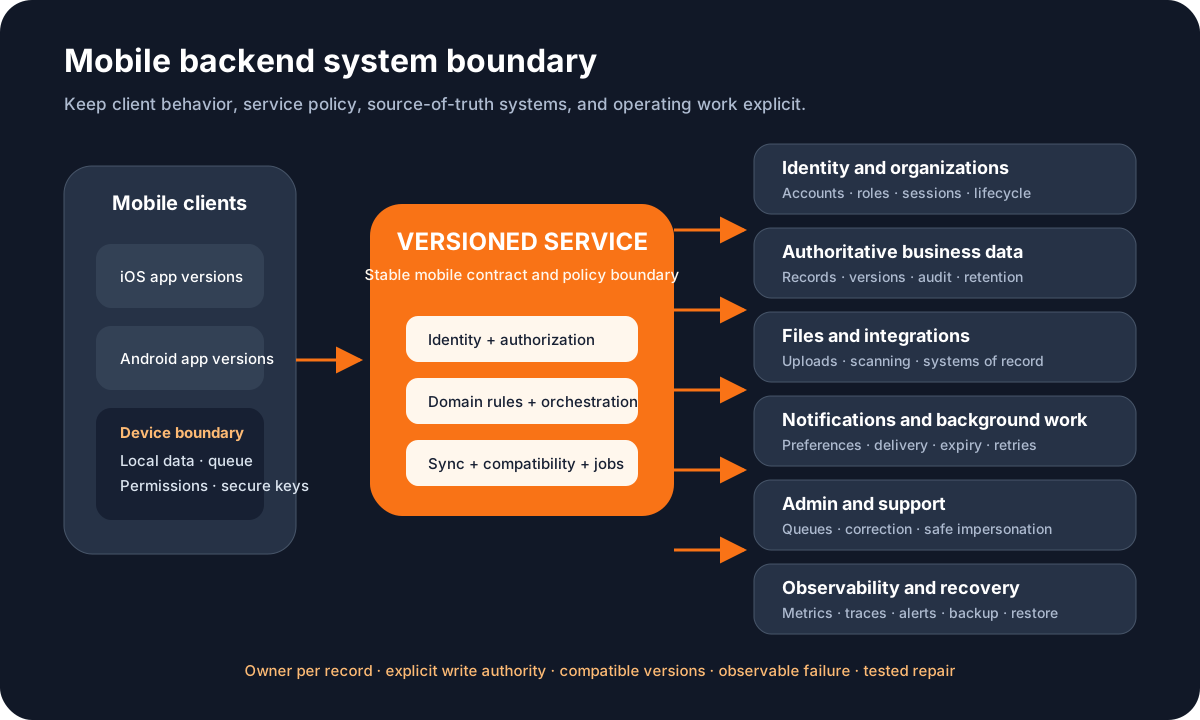
For every record, name the owner, read path, permitted writer, stable identifier, revision or timestamp, retention rule, and correction path. Avoid making the app call several internal systems directly. That pushes credentials, business policy, orchestration, and failure recovery into a client that cannot be updated instantly after every server change.
Mobile security also crosses this boundary. OWASP's Mobile Application Security Verification Standard separates storage, authentication, network, platform, code, and privacy controls. Use it as a review baseline, then add the product-specific authorization and recovery rules that a generic control catalog cannot define.
Write a request contract for every valuable action
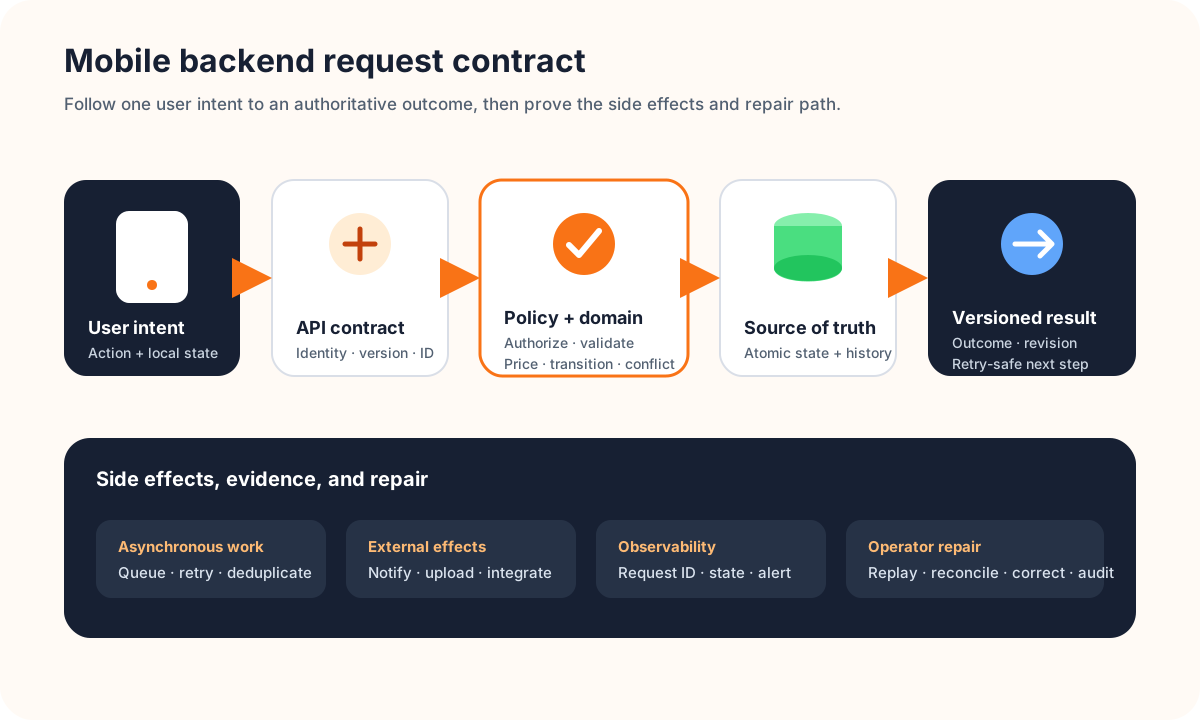
Record the actor, organization or tenant, client and API version, request identifier, submitted data, server validation, authorization decision, domain transition, authoritative write, response shape, retry behavior, asynchronous effects, audit evidence, notification, and repair owner. Define the outcome of the second identical request instead of hoping users never tap twice.
Separate “accepted” from “finished” when work continues in a queue. The client needs a stable operation or record identifier, a truthful state, a safe refresh path, and an explanation when a later step fails. The operator needs the same correlation ID, attempt history, current authoritative state, and an approved replay or correction action.
Cover eight backend requirement lanes
| Lane | Define | Acceptance evidence |
|---|---|---|
| Identity | Accounts, organizations, credentials, sessions, device association, recovery | Every account and device state reaches the correct server identity |
| Authorization | Object, action, tenant, role, state, step-up, delegation, revocation | Forbidden reads and writes fail even when identifiers are guessed or replayed |
| API | Versions, schemas, pagination, uploads, validation, errors, request IDs, idempotency | Supported clients handle success, rejection, retry, and compatible change |
| Data | Sources of truth, keys, revisions, transactions, files, retention, deletion, export | The visible result reconciles to one authoritative and auditable state |
| Connectivity | Cache, offline reads and writes, queues, freshness, conflicts, resync | Weak, lost, and restored networks produce defined outcomes without silent loss |
| Async work | Jobs, schedules, retries, ordering, deduplication, notifications, expiry | A delayed or failed side effect is observable and repairable |
| Operations | Admin tools, support access, audit, alerts, runbooks, backup, restore | An operator can diagnose and repair a scripted failure safely |
| Delivery | Environments, secrets, migration, compatibility window, rollout, rollback, ownership | New and supported old clients pass the release and recovery matrix |
Keep authentication separate from authorization. The mobile authentication requirements guide covers enrollment, sessions, step-up checks, and recovery. The backend brief must still state which authenticated subject may read or change each object in each business state.
Specify offline, synchronization, and notification semantics
For each journey, choose online-only, cached read, queued write, or local-first behavior. Define freshness, queue durability, retry limits, conflict detection, merge or winner rules, partial upload recovery, deleted records, server rejection, and what the user sees before and after reconciliation. Android's offline-first architecture guidance distinguishes online-only, queued, and lazy writes and notes that synchronization needs an explicit conflict strategy.
Treat push as a delivery hint or user message, not the system of record. Apple documents that remote notifications begin at a provider server and pass through APNs to a device; the provider remains responsible for token association and payload creation in its remote notification server guidance. Firebase likewise distinguishes notification messages handled by its SDK from data messages handled by the app in its Cloud Messaging message-type documentation.
Define why a message exists, which authoritative event triggers it, user and device preferences, localization, collapse or replacement behavior, expiry, deep-link destination, sensitive data limits, delivery evidence, token invalidation, and what the app fetches after opening it. Use the dedicated push notification checklist when messaging is material to the release.
Design for old clients, observability, and repair
App-store rollout is not an instant fleet upgrade. State the minimum supported app and API versions, additive versus breaking changes, deprecation signals, forced-upgrade policy, feature gating, schema migration, and how long the backend serves older behavior. Test at least the oldest supported client, the current release, and a staged next release against production-like data.
Observability should connect a user-visible action to API request, authorization result, data transition, job attempts, downstream calls, notification, and final state without logging secrets or unnecessary personal data. Define service indicators, alerts, dashboards, diagnostic access, retention, incident owner, and a runbook for the failures in the acceptance matrix.
Backup is not the same as tested recovery. Name what is backed up, its recovery objective, restore environment, encryption and access, restoration test, reconciliation of external side effects, and the decision-maker for rollback or forward repair. Support tools should use narrow permissions and auditable actions, not direct database edits.
Choose reuse, managed services, or custom code from the contract
Reuse an existing backend when it already owns the domain and can satisfy the mobile contract without exposing internal complexity. Add a focused facade when mobile payloads, aggregation, compatibility, or orchestration genuinely differ. Do not duplicate the business model only to create a “mobile API.”
A backend-as-a-service can fit standard identity, storage, files, functions, and messaging when the workflow accepts its data, authorization, portability, and operating model. Custom delivery is more defensible when domain rules, integrations, tenant boundaries, offline reconciliation, audit, or operator repair are distinctive. Compare the options using the same scripted journeys, failures, ownership, and exit requirements.
The broader API integration requirements checklist helps define system-to-system delivery. A scoped mobile app development engagement should combine that backend evidence with real device behavior.
Use this one-journey mobile backend release worksheet
- Outcome: Which user, organization, action, and authoritative result are in scope?
- Boundary: What belongs on device, in the service, and in each existing system?
- Contract: Which identity, version, request ID, validation, policy, data transition, and response apply?
- Connectivity: What works offline, queues, expires, conflicts, or requires fresh network proof?
- Effects: Which files, jobs, integrations, and notifications follow, and how are they deduplicated?
- Compatibility: Which app and API versions must coexist, migrate, roll back, or stop?
- Operations: What telemetry, alert, admin action, backup, restore, and runbook prove recoverability?
- Decision: What evidence supports reuse, managed services, custom build, narrower scope, or delay?
A useful first release can be small, but it must be complete. One end-to-end journey with defined authority, adverse network behavior, a safe integration boundary, visible diagnostics, and a tested repair path is more estimable than a broad feature list with an unnamed “backend” line item.
Frequently asked questions
What should mobile app backend requirements include?
Include users and organizations, authentication and authorization, API contracts, source-of-truth data, validation, files, offline and conflict behavior, notifications, asynchronous jobs, integrations, admin and support work, observability, backup and recovery, version compatibility, environments, acceptance evidence, and long-term ownership.
Does every mobile app need a custom backend?
No. A local-only app may need none, and a backend-as-a-service can fit standard identity, storage, messaging, and serverless workflows. A custom service becomes more useful when domain rules, integrations, tenant boundaries, audit, reconciliation, or operating workflows are distinctive. The requirements should define the boundary before choosing the implementation.
Can an existing web API be reused for a mobile app?
Often, but prove it against mobile needs: delegated identity, object-level authorization, slow or intermittent networks, compact payloads, pagination, uploads, retries, idempotency, offline reconciliation, push-triggered refresh, old app versions, and diagnostic visibility. Reuse the domain service where it fits; add a mobile-specific facade only when the client contract genuinely differs.
How should a mobile backend be accepted before release?
Run complete journeys across supported app versions, account and permission states, weak and lost networks, duplicate submissions, expired sessions, stale local data, integration failures, delayed jobs, notification rejection, rollback, restore, and operator repair. Capture request identifiers, authoritative state, user-visible outcome, alerts, and recovery evidence.