Answer first
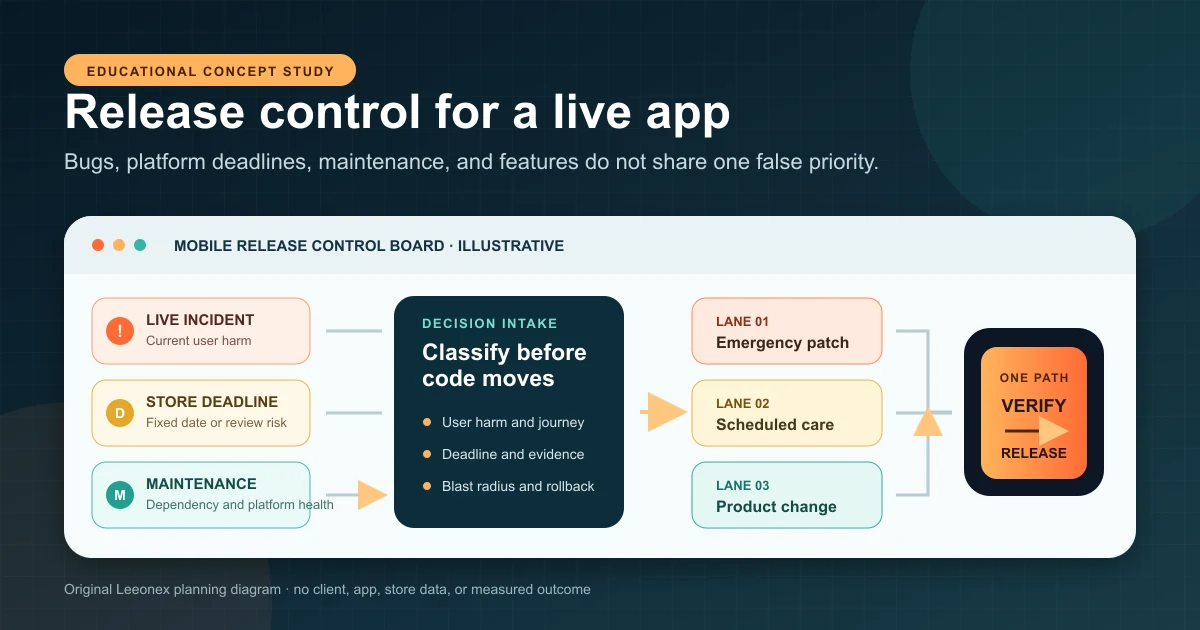
Run one release-control system with different lanes for live harm, fixed deadlines, maintenance debt, and product change.
A live mobile app should not prioritize every bug, dependency, store notice, and feature on one subjective list. First classify the work by affected user journey, present harm, deadline, evidence, blast radius, reversibility, and the release path it requires. Then route it to an emergency patch, scheduled maintenance, or planned product lane with explicit entry and exit rules.
The smallest useful support model protects one reproducible build-and-release path, one accountable queue, representative verification, staged exposure where possible, an observation window, and a rollback decision. This lets urgent stability work move quickly without allowing every interruption to bypass product ownership—or every promised feature to ignore a store deadline.
Evidence boundary
This is a Level E educational concept study. Leeonex has not implemented, operated, tested, or measured this maintenance system for a client or production app. The backlog, dialogue, roles, work classes, release lanes, diagrams, technology labels, counts, and decisions are illustrative planning material—not a product screen, engagement record, testimonial, or performance claim.
Starting situation and intended buyer
The app is live, but nobody can explain what should interrupt the roadmap.
This concept is for a founder, product owner, operations leader, or internal team responsible for an app already available to users. Feedback arrives through reviews, support, sales, crash tooling, analytics, engineers, store consoles, security notices, and executive promises. Each source uses its own language, so a reproducible crash can sit beside a vague feature request and a dated platform requirement with the same “high priority” label.
Mobile maintenance carries constraints that a generic backlog hides: store review time is outside the team's control; certificates and signing access can expire or remain with a former supplier; OS and device behavior varies; third-party SDKs can affect privacy or policy obligations; backend changes can break an unchanged app; and users may stay on older versions after a new release.
A maintenance partner cannot responsibly promise a calmer cadence from a backlog export alone. The first boundary is operating control: source, build, test, signing, store, monitoring, release, rollback, communication, and product decisions need named owners and working access.
Illustrative discovery conversation — not a client quotation
A maintenance queue becomes useful when urgency has a definition.
Product owner
“We have crash reports, an SDK deadline, a store warning, and three promised features. Can a maintenance team just work through the backlog?”
Leeonex
“Which issue is harming users now, which date can block distribution, and which changes can safely share a release?”
Product owner
“The crash affects one checkout path, the SDK deadline is six weeks away, and the features touch login and payments.”
Leeonex
“Then you need separate emergency, maintenance, and product lanes with one protected release path—not one numbered backlog pretending every item is comparable.”
This exchange is Leeonex-authored teaching material. It describes no real customer, quotation, app, incident, deadline, promise, or maintenance engagement.
User roles and decision ownership
Separate who feels the problem, who changes the app, and who accepts release risk.
Product owner
Defines user and commercial consequences, accepts trade-offs, names what may wait, and does not turn an external promise into an undocumented release command.
Support or operations owner
Connects user reports to affected journeys, preserves examples, communicates status, and verifies whether the issue actually stopped after release.
Mobile maintainer
Reproduces faults, maps dependencies and platform constraints, proposes the smallest safe change, and keeps build, signing, rollout, and rollback paths usable.
Release verifier
Checks critical flows on representative devices and OS versions, records evidence, guards the release gate, and remains independent of the code change where risk justifies it.
A small team may assign several roles to one person, but the decisions still need names. The engineer who found a technically elegant fix should not silently decide its commercial urgency; the stakeholder who promised a date should not silently waive verification or rollback readiness.
Core workflow
Convert noisy signals into one decision record before code moves.
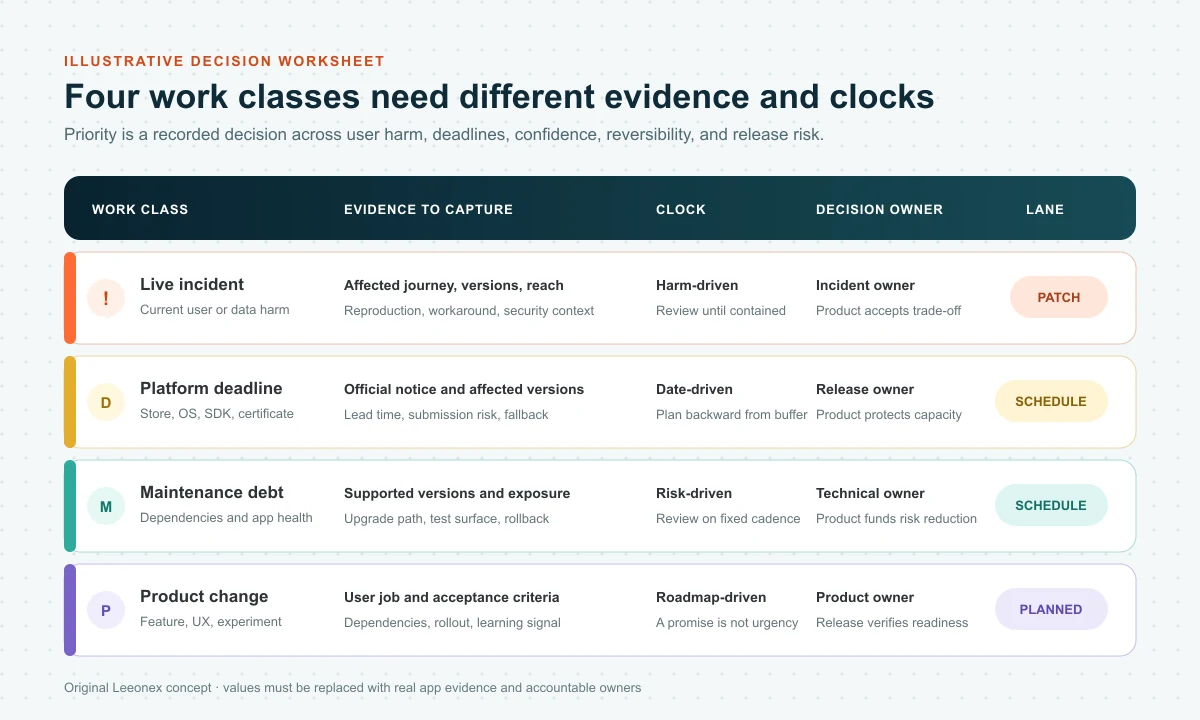
Intake links duplicate reports to one item and preserves the source. Triage records the affected journey, versions, device and OS context, frequency or reach when known, workaround, deadline, evidence quality, security or privacy relevance, and likely release surface. Unknown is an acceptable value; false precision is not.
A named owner then chooses the lane. An emergency patch is for current, material harm that justifies interrupting planned work. Scheduled maintenance handles dated platform and store work, dependency health, accessibility fixes, and bounded defects. Planned product changes follow product discovery and acceptance criteria even when the request arrived through support.
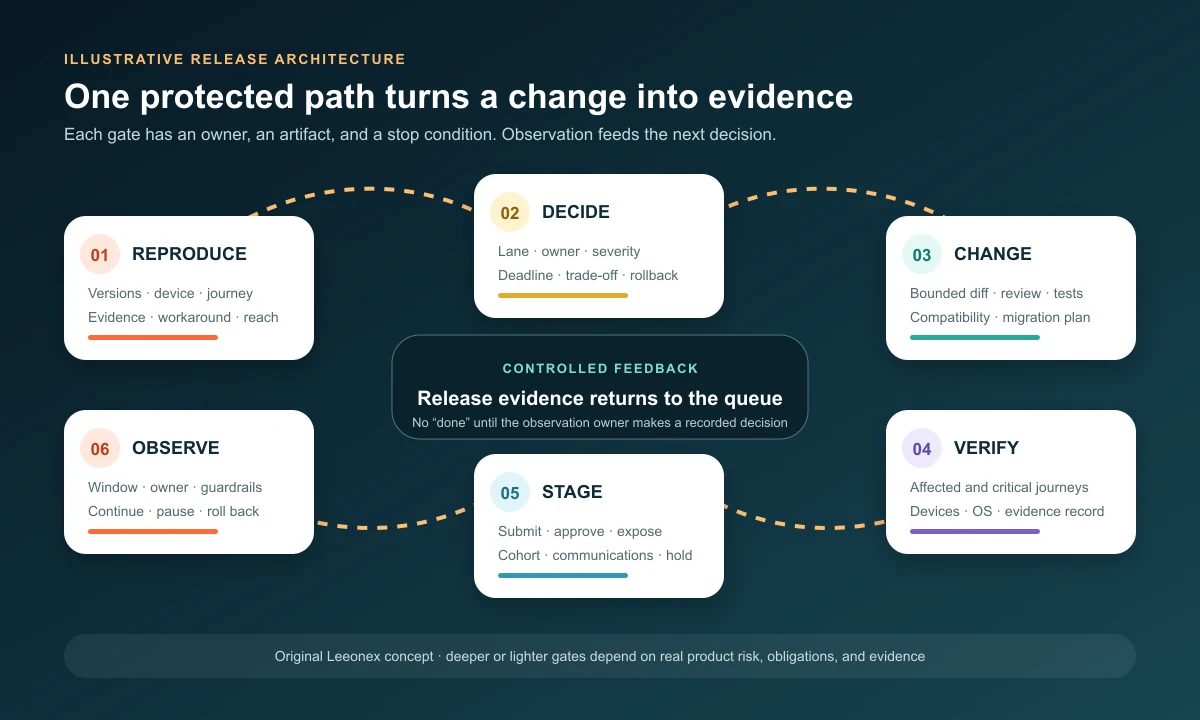
Every lane converges on the same protected release path. The depth of verification may change with risk, but nobody skips the recorded decision, bounded change, release evidence, observation owner, or rollback decision. If the team cannot reproduce the build or control signing and store access, restoring that baseline is the first maintenance release.
Smallest useful scope
Build the control loop now; earn broader modernization later.
Build now
- One intake record linking user reports, crash groups, store notices, dependency advisories, and roadmap requests to an accountable owner
- A severity and deadline model that records affected journey, scope, evidence quality, workaround, blast radius, and reversibility
- Three explicit lanes: emergency patch, scheduled maintenance, and planned product change, each with entry and release rules
- A reproducible build, protected signing access, representative-device checks, staged rollout, observation window, and rollback decision
- A weekly risk review plus a short incident path that does not wait for the next planning ceremony
Validate later or exclude
- A full service desk, public status page, release-note platform, or portfolio-management system before the control loop works
- Automatic priority scores that hide judgment, contractual obligations, store deadlines, or incomplete incident evidence
- Framework migration, visual redesign, backend rewrite, analytics rebuild, or broad refactor bundled into routine maintenance without a separate decision
- A promise to support every device and OS version before actual audience, store, contractual, and accessibility requirements are known
- Continuous feature delivery during an unstable release or ownership baseline merely to preserve roadmap optics
Architecture and implementation decisions
Maintenance quality depends on release architecture, not ticket volume.
Pin the relationship between source revision, application version, build number, environment, configuration, dependency lockfile, generated assets, and signing identity. A clean environment should reproduce the build through documented, reviewed automation. Store and cloud accounts should belong to the organization, while maintainers receive the least privilege needed for their work.
Crash and telemetry events need privacy-aware release, device, OS, journey, and correlation context. Support reports need a route into the same record without exposing personal data to everyone in engineering. Logs and dashboards support a diagnosis; they do not replace reproduction, user context, or a product decision.
Decouple risky changes where feasible. Feature flags can limit exposure, remote configuration can tune bounded behavior, and backend compatibility can let older app versions keep working. Each mechanism adds operational state, so it also needs an owner, test cases, monitoring, security rules, and cleanup. A flag that nobody removes becomes another production branch.
Plan for store latency and version adoption. A backend rollback can be quick; a mobile binary already installed on devices cannot be recalled in the same way. Define minimum supported versions, compatible API windows, forced-update criteria, data migration behavior, and what users see when the app or backend is temporarily incompatible.
Risks and guardrails
The release process must remain usable when the app is already under pressure.
Keep source control, store accounts, certificates, signing keys, cloud services, crash reporting, analytics, support tools, and recovery paths organization-owned with role-based access.
Define emergency authority, severity levels, communication owners, response expectations, evidence requirements, and rollback thresholds before the next incident.
Test the affected journey and neighboring critical flows on representative devices, OS versions, permission states, connectivity states, and backend conditions.
Separate code complete, verified, submitted, approved, released, and observed. A store upload or review acceptance is not proof that the user problem is resolved.
Use staged rollout and feature flags only when the product, platform, telemetry, and team can operate them safely; every control needs an owner and removal plan.
Record accessibility, privacy, security, data retention, third-party SDK, open-source license, store policy, and incident obligations according to the real product and jurisdictions.
Limitations and evidence needed
This blueprint cannot prove that a real app is maintainable.
Leeonex did not inspect a repository, build, store account, certificate, crash report, device matrix, backend, privacy flow, accessibility behavior, release history, support queue, or team capability for this study. The model may need different lanes, gates, or ownership in a regulated, safety-critical, high-volume, white-label, enterprise-managed, or hardware-linked product.
Stronger delivery evidence would require an approved scope, responsibility record, access baseline, risk register, release evidence, and permission to describe the work. Any outcome claim would also need a defined baseline and end state, observation window, version and cohort boundaries, calculation, exclusions, source system, verifier, attribution limits, and approved public wording. Store reviews, crash counts, ratings, release cadence, uptime, support volume, and revenue must not be used as proof without that chain.
Lessons and related decisions
Maintenance is product governance expressed through a release system.
A stable backlog is not the goal. The goal is a team that can explain why one change moves, what evidence supports it, who accepts the risk, how it reaches users, how the team knows what happened, and what it will do if the release behaves differently from the test.
Start with the Leeonex mobile app maintenance checklist for the broader operating inventory. This concept study goes deeper on the point where those maintenance needs compete for one release path. Teams still choosing an architecture can use the native versus cross-platform decision guide to make ownership and upgrade pressure visible. Teams preparing a first release should start with the mobile app requirements checklist. An inherited product also benefits from the software handover acceptance tests before a supplier promises feature velocity.
Browse the Leeonex case-study hub for other clearly labeled educational concepts and owned-work studies. Each page keeps implementation facts, planning ideas, and outcome claims separate.
What to bring to a first consultation
Bring the release reality, not a cleaned-up feature list.
- Store links and ownership, active versions, supported OS and device range, release history, review warnings, policy notices, and the next known platform deadlines
- Repository, build instructions, CI/CD, signing and secrets ownership, environment map, backend dependencies, feature flags, analytics, crash reporting, and rollback options
- One recent incident with user reports, affected journey, crash or log evidence, workaround, attempted fixes, communications, and the evidence used to close it
- The current backlog split across defects, dependencies, compliance, platform work, accessibility, security, operational debt, and product features
- Named product, support, engineering, verification, release, store, security, privacy, and executive decision owners
- Contractual response expectations, seasonal events, marketing commitments, user segments, unacceptable failures, and budget or capacity constraints
Leeonex's mobile app support and maintenance service covers crash triage, OS and dependency updates, store compliance, incremental features, and release coordination. The right first step may be a stabilization slice or ownership repair before an ongoing cadence begins.
Discuss a live app support plan